






Rob Painter, chief executive of tech giant Trimble, has delivered his vision for the future of the logistics sector at this year’s Transporeon Summit in Amsterdam.
With freight demand projected to triple by 2050, he urged the industry to embrace connected ecosystems, AI, and the “compound interest” of daily innovation to meet mounting global demands.
“We must use our power to drive efficiency today, even as we invest in what’s next,” he told a packed room of supply chain leaders at the city’s Beurs van Berlage conference centre. “That tension between the now and the later is the challenge we all face.”
Painter urged the audience of shippers, carriers, and industry stakeholders, to deliver immediate, measurable operational gains while simultaneously building the digital infrastructure that will support a logistics industry facing explosive growth.
Opening his address, he distilled the sector’s core dilemma into two simple phrases: “Use your power. Wait your time.”
The first phrase, he explained, refers to the daily grind of logistics: “that tactical work about making every single shipment count that can take minutes off of a route. That means blending more bids. That means turning a challenge into a competitive advantage.”
Painter added that the second phrase - “Wait your time” - speaks to long-term thinking and the patience required to see the returns of strategic investment. “That’s about building a foundation that will stand the test of time,” he said. “It’s about making decisions that are strategic today about new ways of doing work, new ways of leveraging technology to prepare for the future and gain original advantage.”
This dual challenge, he argued, is a polarity that every business in the room must wrestle with: “How do you manage that tension between the now and the later? Where do you start, and where do you go next?”
Painter went on to quote Albert Einstein, who said that compound interest is the eighth wonder of the world. “This fundamental law of finance applies to just about everything we do in life, personally and professionally,” he explained.
Whether operators are looking to save fuel across a fleet or streamline shipments with procurement tools, he urged them to think in terms of daily gains of as little as 1% that scale and multiply.
“Now think about that compounded across your fleet… every day, you’re saving a little bit of time, saving some kilometres… that saves you tens of thousands of hours and millions of joules over the course of a year,” he said.
Drawing inspiration from Atomic Habits, a book by James Clear, he returned to the idea of micro-efficiencies. “Just 1% better every day,” he said. “Do you think you could be just 1% better today? Now think about the compounding impact of that… 1% better every day over the course of the year means 37 times better, one year later.”
Since 2020, Trimble has invested more than $2bn (£1.6bn) into product development, he revealed. “We continue to challenge ourselves to have the courage to change and embrace the latest technologies,” he said, referencing the quote often attributed to General Eric Shinseki: “If you don’t like change, you’re going to like irrelevance even less.”
Describing Trimble’s shift toward integrated, scalable systems, he outlined a strategy of “connected scale” and the idea that formerly standalone tools can now work in sync, powered by shared data. “Our job is to connect the solutions we already have, integrate the data, and create connected workflows that unlock new levels of productivity,” he said.
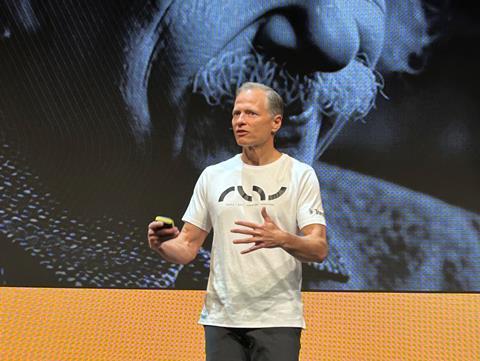
He positioned Transporeon as the embodiment of this strategy. From humble beginnings connecting shippers and carriers, it now forms a logistics network of over 1,400 shippers and retailers and more than 150,000 carriers and logistic service providers. “Today we execute over 110,000 transports and over 100,000 dock appointments every single day and power over 55 billion dollars in annual freight spend,” he said.
That ecosystem, he argued, is what sets Trimble apart and the backbone of what comes next: AI.
“AI is a force multiplier,” he said. “It’s making the most complex data actionable in minutes. Manual, repetitive tasks handled in seconds instead of hours. Productivity amplified in an instant.”
He cited partners who used AI-based autonomous procurement to automate negotiations and assignments, cutting friction from the process and gaining a competitive edge. “That’s a great demonstration of AI’s ability to act as a force multiplier,” he said.
But he was quick to note that it’s not just AI that matters but the broader transformation enabled by open ecosystems. Partner operators, for example, have reduced response times and optimised decision-making by connecting assignment and visibility workflows. “That’s the power of a connected ecosystem,” he said, “Better, faster, safer, cheaper, and greener outcomes.”
Another logistics partner has implemented real-time visibility through Transporeon, reducing check calls and achieving 80% real-time tracking: “That led to significant efficiency gains and freed up their teams to focus on higher-value work.”
Painter acknowledged that many attendees were just starting out with Trimble’s technology, while others were looking to deepen their integration or scale existing solutions. “Many of you are here to advance your business to the next level. You want to learn where we’re heading. And the good news is you’ve come to the right place.”
Throughout his keynote, he positioned Trimble’s role as a partner committed to continuous innovation, to improving not just products but outcomes.
He went on to remind the audience that Amsterdam’s canals aren’t just scenic photo opportunities but were “a 17th-century logistics network - a final mile system”. That spirit of practical innovation, he said, has always driven prosperity and is the same spirit Trimble is embracing now.
Reflecting on the scale of change since he joined the company in 2006, and became chief executive in January 2020, Painter pointed to rapid transformations in technology and geopolitics.
“If I said the word ‘chips’ in January 2020, most of us would think of crisps. But now we think of semiconductor chips; the ones powering the AI revolution and fuelling geopolitical turmoil. We can’t control the world, but we can control how we show up every day. And I truly believe that those who can adapt will thrive. Those who cannot are at risk.”
Looking toward 2050, Painter described the data as “staggering”.
“We’ll have 2.5 billion more people in cities. We’ll need 70% more calories to feed them. And freight demand? It’s going to triple.”
Those pressures, Painter said, won’t be met with brute force or marginal gains. “They’ll be solved with connected data, he insisted. “With platforms. With AI. And with daily improvement that compounds. That’s how we move the world.”