








Seventy per cent of refrigerated transport operators say the government is failing to provide a clear direction on cutting emissions from transport refrigeration units (TRUs), while 81% believe tighter regulation of diesel-powered equipment is likely.

The Cold Chain Live panel featuring (from left) event host Juliet Mann; Matt Owen of FreshLinc; Andy Eastlake of Zemo Partnership; Maddy Coupe of the Cold Chain Federation and Lionel Curtis of Thermo King
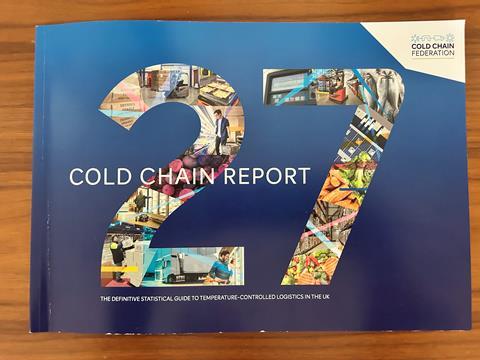
The findings from the Cold Chain Federation’s latest annual Cold Chain Report highlight the gap between the industry’s ambition to decarbonise and its ability to pay for the transition. Operators want greater clarity about the rules they may eventually have to meet, alongside a realistic and affordable route to compliance.
A key part of this year’s report is the federation’s first transport refrigeration unit (TRU) census, which aims to provide a clearer picture of the equipment used across the UK’s temperature-controlled transport sector, as well as operators’ views on the technologies and policies needed to reduce emissions.
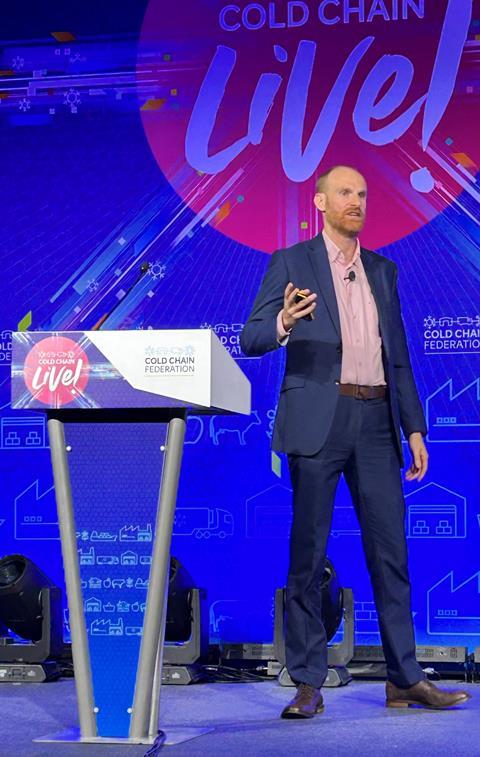
Presented at Cold Chain Live in Telford by CCF deputy chief executive Tom Southall, the research draws on a survey of 13,500 operators. It examines everything from equipment ownership and leasing to operational efficiency, refrigeration technology and the barriers to investment.
Operators want regulation – but need a route to compliance
The apparent contradiction in the survey findings is striking. Seven in 10 respondents believe government is not providing enough direction on the transition to lower-emission refrigeration, yet more than eight in 10 support regulation of diesel TRUs.
The report breaks down the government direction finding further: 70% said there was not enough direction, 11% said there was some direction but it was only partial, and 19% were unsure.
Asked about the prospect of tighter regulation of diesel TRUs, 81% expected requirements to become stricter, while 11% did not and 7% were unsure.
The findings suggest operators want clarity about the standards they will be expected to meet, the timetable for change and the support available to help them invest.
In a panel discussion at Cold Chain Live, Maddy Coupe, policy manager at the Cold Chain Federation, said the results were not unexpected given the conversations the organisation has been having with its members.
The technology is increasingly understood and there is growing confidence that lower-emission refrigeration can work. The difficulty is making it affordable and ensuring that the infrastructure is available to support it.
The report identifies capital cost as the biggest obstacle, with 44% of respondents citing the upfront investment required to adopt low- or zero-emission refrigerated vehicles.
For fleet operators, the economics are particularly challenging when equipment has to be purchased or leased across a large trailer fleet. The investment decision cannot be considered in isolation from vehicle replacement cycles, utilisation, maintenance costs and the availability of charging at the sites where trailers spend time.
The census also asked operators whether they had the infrastructure needed to meet the requirements of refrigerated distribution. Just 37% said they did. Another 37% said they had the necessary infrastructure only partially, while 15% said they did not and 11% were unsure.
That suggests even operators interested in moving towards electric refrigeration may not yet have the power supply or charging arrangements to make it practical.
The missing link in HGV decarbonisation
Transport refrigeration has traditionally received less attention than the emissions produced by the trucks pulling the trailers. But the refrigeration unit is a separate source of emissions and energy demand, with its own technology, operating patterns and investment requirements.
A battery-powered tractor unit does not automatically make the refrigerated trailer emission-free. The refrigeration system still needs energy, and that demand has to be met whether the vehicle is moving, parked at a delivery point or waiting at a depot.
The CCF’s report examines the different routes towards more sustainable transport refrigeration, including electric refrigerated trailers, HGVs with direct-drive refrigeration, zero-emission refrigeration and hydrotreated vegetable oil (HVO).
The census also considers the way operators manage their fleets, including the balance between leasing and ownership, route optimisation and empty running. These are important areas because reducing emissions does not depend solely on buying new equipment. Better utilisation, fewer empty miles and more efficient planning can all reduce the energy consumed by existing fleets.
That is particularly relevant while the cost of new refrigeration technology remains high. Operators can make progress by improving the efficiency of existing diesel units and the way they are deployed, rather than waiting for a wholesale replacement of equipment.
Andy Eastlake, chief technical consultant at Zemo Partnership, argued that the industry should not wait for regulation before taking action.
“Now is the time to jump in, before regulation,” he said.
Eastlake also highlighted the age of the emissions standards governing diesel refrigeration technology, arguing that diesel trailer units are still producing emissions at levels comparable with those seen in 1998.
His point was that the industry should not overlook the opportunity to clean up the equipment already in service. While electric refrigeration is an important part of the longer-term solution, there is a need to understand and improve the performance of the existing fleet in the meantime.
That requires better measurement of emissions and fuel consumption, and a consistent way of comparing the performance of different units under realistic operating conditions.
The federation is working towards a testing process to help establish that evidence. Better data would allow operators to understand the performance of their equipment, while giving government a firmer basis for setting standards and designing support.
A registration scheme for TRUs
One of the federation’s key policy proposals is a formal registration scheme for transport refrigeration units.
At present, there is no comprehensive registration system giving government and the industry a clear record of the TRUs operating across the UK. That makes it difficult to establish an accurate baseline, understand the age and technology of the fleet or measure progress towards lower-emission equipment.
The report suggests operators see a registration scheme as a useful step. Asked whether TRU registration could help government develop more effective decarbonisation policy, 63% said yes, 33% said maybe and just 4% said no.
Registration would give government a better understanding of the equipment in use and could provide the basis for future testing, emissions measurement and regulation.
The federation’s wider ambition is to secure recognition of transport refrigeration as a distinct part of the road freight decarbonisation challenge. The energy requirements of a refrigerated trailer are different from those of an HGV traction battery, and policies designed around electric trucks do not necessarily address the additional demands of refrigeration.
That distinction is important when it comes to funding. The panel discussed the need to widen government support for depot charging so that it includes TRUs, rather than concentrating solely on the batteries powering electric trucks.
For operators, the cost of upgrading a depot to support electric vehicles could be substantial even before refrigeration is taken into account. Adding charging for refrigerated trailers brings another layer of demand, and the availability of grid connections could determine whether a site can make the transition at all.
Could depot charging become a business opportunity?
The discussion at Cold Chain Live also considered whether depot charging could become a commercial opportunity rather than simply another cost for operators.
One suggestion was that third-party energy providers could install and operate charging facilities at distribution depots. This could allow operators to make charging available without taking on the full investment and responsibility themselves, while potentially creating a revenue stream from their sites.
Matt Owen, group manager for technical and sustainability at FreshLinc, brought the fleet operator’s perspective to the discussion, including the practical considerations around depot infrastructure.
The idea of bringing in an external charging provider could make sense for operators with suitable sites and sufficient demand. But the business case would depend on grid capacity, installation costs, the charging requirements of the fleet and whether the infrastructure could be used by other vehicles or operators.
It is another example of why the transition cannot be considered simply as a decision about which refrigeration unit to buy. It involves the wider energy infrastructure supporting the fleet.
Lionel Curtis, representing Thermo King’s renewable projects work, contributed the equipment and technology perspective. Manufacturers have a role in developing systems that can meet the demands of refrigerated distribution while giving operators a commercially viable alternative to diesel.
For fleet managers, the technology has to work across different operating conditions, not just in a demonstration or at a single depot. Reliability, range, charging time, payload and the cost of ownership all influence whether a new system can be adopted at scale.
The wider energy challenge
The report’s findings on cold storage provide further context for the energy demands of the temperature-controlled sector.
It says 35% of cold storage sites generate renewable energy, an increase of six percentage points on 2025, while 65% do not.
Those sites generated 77,582,175kWh of renewable electricity, equivalent to 5.7% of the sector’s total energy consumption, according to the report.
The figures relate to temperature-controlled storage rather than transport refrigeration, but they demonstrate the wider importance of energy generation and supply across the cold chain.
The report also shows that grid electricity and renewables accounted for 87.3% of the energy mix in 2025, compared with 90.8% in 2020, while gas increased from 6.7% to 11.7%.
For the transport side of the business, the implications are clear. Electrification will require not only suitable refrigeration equipment but also access to affordable electricity and sufficient capacity at the depots and distribution sites where vehicles operate.
The industry is therefore looking beyond the equipment manufacturers to government, energy companies and infrastructure providers to help make the transition possible.
Turning evidence into action
The CCF’s argument is that the new census gives it the evidence it has previously lacked when making the case to government.
Its priorities include recognition of TRUs as a distinct policy issue, registration of the equipment in use, consistent testing and emissions measurement, financial support for investment and a realistic timetable for the transition away from diesel.

There is also a question of how the UK compares with other European markets. The discussion raised VECTO, the European vehicle energy consumption calculation and reporting framework, as an example of the need for consistent measurement and a more developed approach to emissions data. The precise comparison with the UK needs to be considered carefully, but the wider point is that the industry does not want to fall behind in the development of standards and support for cleaner refrigerated transport.
For HGV fleet operators, the immediate decisions remain commercial. They must balance the cost of new equipment against fuel and maintenance savings, decide whether to buy or lease, and assess whether their depots can provide the electricity required.
The technology may be advancing, but the census suggests that confidence in the equipment is not enough. Without affordable investment, accessible charging and a clear government direction, the transition risks being delayed.
The federation now believes it has a stronger body of evidence to put in front of government. The challenge is to turn that evidence into a policy framework that gives operators the confidence to invest, and a practical route to making their refrigerated fleets cleaner.