





The logistics sector is entering a new era of rapid technological change, with delegates at the Microlise Transport Conference in Manchester warned that AI is now evolving faster than many operators are able to adapt. This is adding to wider pressures on supply chains, where keeping operations safe, resilient and efficient has become just as challenging as digitising them.
From AI and automation to cyber security, infrastructure and driver safety, the message from the event was that while technology may now sit at the centre of modern transport operations, people, culture and decision-making still determine whether systems succeed or fail.
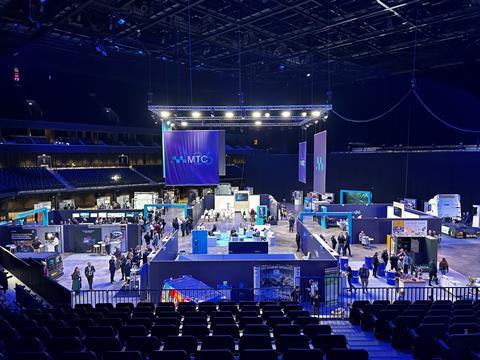
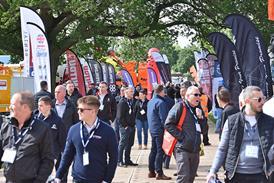
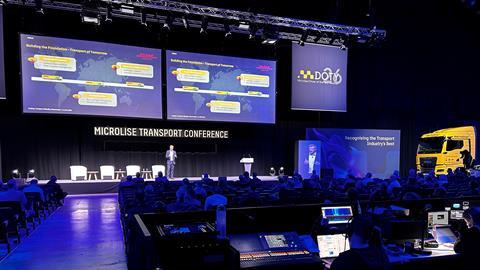
Held for the first time at Manchester’s Co-op Live arena, the conference brought together hundreds of transport and logistics professionals against a backdrop of rising fuel costs, mounting compliance demands, driver shortages and uncertainty surrounding global trade and tariff policies.
Hosted throughout the day by broadcaster and technology presenter Spencer Kelly, the event examined the growing impact of AI across transport operations, alongside discussions on compliance, infrastructure resilience, safety regulation and cyber threats facing increasingly connected fleets.
The day opened with a keynote from Microlise chief executive Nadeem Raza, who highlighted the pace of change facing the sector.
Raza pointed to Microlise’s fourth King’s Award for Enterprise, describing it as “the highest award business can win in the UK and recognised internationally,” before joking that although Prime Minister Keir Starmer had written to congratulate the company, he was “not sure he’ll still be in office by the time he gets my reply”.
He also signalled the company’s growing focus on AI, compliance and cyber resilience as transport operators become increasingly reliant on digital systems.
“We’re already deploying AI agents within Microlise,” he said, adding that some would be released to customers “fairly soon”.
Raza also highlighted the company’s Microlise Labs programme, which works directly with operators on product development and operational improvements.
AI: From helper to decision-maker
Following Raza’s introduction, Microlise chief technical officer Dean Garvey-North described the current shift to AI as comparable to the arrival of the internet, personal computers and the digitisation of transport systems.
He warned operators against treating AI as a future trend rather than an immediate operational reality.
“If you are standing still, you will get left behind,” he said.
He rejected the idea that AI would simply replace human roles, instead describing it as a tool designed to improve efficiency and support decision-making.
“This is not about what AI can’t do,” he said. “It’s about what it can do for you.”
He also cautioned against expectations of fully autonomous logistics operations in the near term, arguing that the industry remains firmly in an assistive phase.
“Today AI assists, humans still decide,” he said.

However, he said the technology is evolving rapidly towards systems capable of generating recommendations and eventually handling more complex operational tasks.
“In the next two to three years, AI will go from assisting you to surfacing recommendations,” he said. “And those systems will become embedded across everyday workflows.”
Garvey-North argued that operators would gain little from superficial AI branding unless the technology is integrated into the core of transport platforms.
“At Microlise, we are not bolting AI on and calling it innovation,” he said. “We are building it from the ground up.”
As part of the presentation, he also unveiled TruControl Compliance, a new AI-powered assistant designed specifically for transport and logistics operators. Built around conversational AI functionality similar to platforms such as ChatGPT, the system is intended to help operators manage compliance, surface operational insights and support real-time decision-making.
But Garvey-North also stressed that the effectiveness of AI ultimately depends on data quality.
“The quality of your data is fundamental,” he said. “What goes in determines what comes out.”
He urged operators to embrace experimentation rather than fear the technology: “Get curious before you get cautious,” he said. “AI isn’t coming for your expertise. It’s coming to make you more efficient.”
Later, Zebra Technologies transport and logistics strategy lead Phil Sambrook outlined findings from global research involving more than 1,000 industry decision-makers.
He said operators across logistics, retail and manufacturing are increasingly focused on the same core priorities: visibility, compliance, productivity and workforce enablement.
“Supply chains are under constant pressure from disruption and complexity,” he said. “What we hear consistently is a need for end-to-end visibility and better real-time decision-making.”
Sambrook added that automation investment is now becoming central to operational strategy rather than being treated as a standalone innovation project.
Safety, systems and the human factor
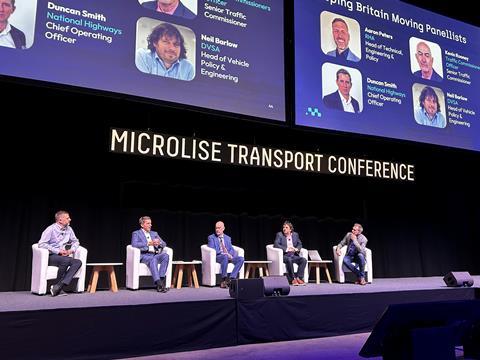
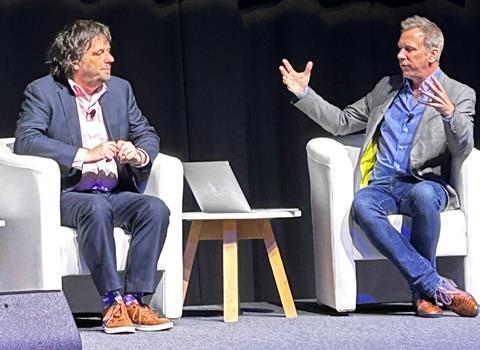
A transport safety and regulatory panel brought together Kevin Rooney, senior traffic commissioner; Neil Barlow, head of vehicle policy and engineering at the DVSA; Duncan Smith, chief operating officer at National Highways; and Aaron Peters, head of technical, engineering and policy at the RHA, quickly grounding the day’s wider discussion about AI and automation in operational reality.
The panellists agreed that while technology is transforming transport systems, safety outcomes still depend heavily on human behaviour, culture and decision-making.
Rooney said the industry risk picture is increasingly shaped by human factors rather than technology alone.
“Technology is part of the answer, but it’s not the whole answer. Culture, people and effective systems have to be part of it,” he said.
He warned that driver assistance systems can unintentionally encourage complacency, adding that culture is now the clearest differentiator between strong and weak operators.
He also highlighted growing concern around drivers disengaging safety systems due to overload or irritation.
“Drivers end up with white noise in the cab, like beeping and alerts, and they just start ignoring it,” he said.
The discussion broadened into driver behaviour, fatigue and operational pressure, with Rooney stressing the importance of speaking up when drivers are unfit to work: “In the best cultures, a driver can say ‘I’m not fit to drive’ without fear of losing their job.”
He added that safety responsibility extends across the whole chain, not just the driver.
“It’s not just drivers. It’s planners, loaders… everyone in the chain.”
Barlow focused on how regulation will need to evolve as vehicle technology advances, particularly around driver assistance systems and compliance testing.
He said the MOT regime will need to adapt as advanced driver assistance systems become more widespread.
“How do you know they still work? How do you know they haven’t been interfered with or damaged? There has to be maintenance and understanding of what that means.”
Barlow warned against confusion among operators where the absence of regulation is mistaken for permission.
He added that testing frameworks will eventually need to reflect these technologies more directly.
Meanwhile Harris set out the scale of infrastructure pressure on the strategic road network, much of which was built in the 1960s and 1970s.
He said investment is increasingly focused on maintenance rather than expansion.
“The priority now is maintaining and renewing what we already have,” he said, highlighting the link between infrastructure condition and freight efficiency, particularly where ageing structures impose weight restrictions on operators.
The RHA perspective focused on operator reality, training and the limits of technology in addressing behavioural issues.
Peters said driver behaviour remains the dominant factor in incidents: “Technology will protect vehicles, and investment will make assets safer, but most incidents still come down to decision-making.”
He warned that driver shortages risk affecting training quality and operational standards if not managed carefully: “There is a risk we push people through too quickly. That pressure can affect standards.”
He also stressed the importance of treating drivers as an asset rather than a problem within organisations.
“If you see drivers as the problem, that becomes how it plays out.”
On safety culture, the panel returned repeatedly to workforce wellbeing, fatigue and infrastructure support for drivers. In particular, they highlighted the importance of secure rest facilities and that recruitment and retention pressures are closely tied to respect and working conditions.
On training and standards, the panel agreed that passing a test is only the beginning of driver competence.
“Passing your driving test doesn’t mean you’re a competent driver. That’s when you start learning,” Rooney said.
He also stressed that safety improvement is incremental rather than driven by single interventions or regulation changes.
“We don’t always need new regulation. Often it’s about spotting patterns and improving systems step by step.”
Wider themes
Cyber security formed one of the most technical sessions of the day, with Jonny Pelter of CyPro warning that cyber crime targeting transport and logistics has evolved into a structured, highly professionalised industry.
The wider conference programme also featured a series of additional sessions spanning strategy, sustainability, safety and technology.
A key sustainability session focused on the eFREIGHT2030 project, highlighting collaboration between operators and industry partners driving the transition to zero-emission commercial vehicles, alongside developments in infrastructure, fleet readiness and commercial deployment of electric HGVs.
The event also ran a broad programme of breakout-style sessions across multiple stages throughout the day, giving delegates the opportunity to move between parallel talks and explore specialist topics in more depth.
These included sessions on driver excellence and data-led performance, fleet safety innovations using AI-enabled camera systems, transport system integration, customer-led development through Microlise Labs, and the use of connected platforms to centralise operational workflows.
Taken together, the agenda underlined the scale of change affecting the sector across sustainability, digitalisation and safety, reinforcing the conference’s central theme of balancing rapid technological advancement with operational resilience and workforce capability.
In a sector facing mounting regulatory pressure, workforce shortages and escalating cyber risk, the message from Manchester was that technology alone will not solve the industry’s problems. The operators that succeed will be those able to combine AI, data and automation with resilient systems, strong leadership and experienced people.