



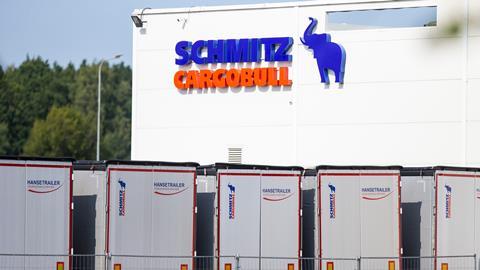

Eight trailer manufacturers are taking the European Union (EU) to court claiming climate regulations are “detached from practical realities” and will increase emissions.
The group, which includes Schmitz Cargobull, Krone and Kögel Trailer and accounts for over 70% of annual registrations across Europe, said key provisions in Regulation 2024/1610 introduced binding CO₂ reduction targets for trailers – despite the vehicles not emitting any carbon.
It has already filed an action for annulment in the General Court of the EU, but this was dismissed.
The group said the regulation mandates a 10% CO₂ reduction for semi-trailers and 7.5% for other trailers, based on the EU’s simulation tool VECTO-Trailer.
Failure to meet the targets could result in substantial annual penalties from 2030 onwards and estimates suggest this alone would push trailer prices by up to 40%.
But the manufacturers claimed that VECTO-Trailer positively rates theoretical improvements to trailers, such as reduced height or lower weight, without considering real-world transport implications.
They said in practice, the measures would reduce load volume, lead to more empty running and increase traffic – and increase CO₂ emissions.
Gero Schulze Isfort, spokesman for the trailer builders, said: “A tool that simulates CO₂ savings while in reality more trucks are on the road contradicts the climate goals.
“We need actual efficiency gains across the entire system, not simulated pseudo-solutions.
“In its current form, the regulation jeopardises not only climate targets but also production sites, fair competition and more than 70,000 jobs. We therefore see no alternative but to seek legal recourse.”
In a statement, Schmitz Cargobull said it supported the EU’s climate targets, but that it was crucial the targets were economically achievable: “We would like to emphasise that the trailer itself does not cause any CO₂ emissions, except for refrigeration units in refrigerated boxes,” the company said.
“We view VECTO critically since it does not realistically reflect the actual CO₂ emissions of trailers.
“The requirements for short distance transports differ from those for long distances and it is important to avoid unnecessary measures to prevent an unnecessary increase in costs for all parties involved.
“To implement CO₂ reduction requirements in the trailer industry, it is crucial that the targets are realistic and do not jeopardise economic viability,” Cargobull added.
The group said the German Association of the Automotive Industry shared its concerns; however, it was unable to comment as Motor Transport went to press.