









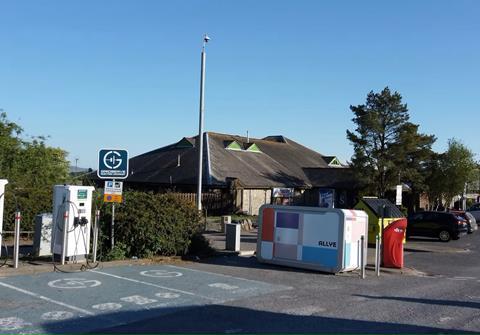
Will batteries from eHGVs find a ‘second life’ market in stationary grid applications? Battery company Allye Energy has launched upsized stationary battery systems containing up to 18 repurposed EV battery packs, dubbed Mega Max, and FCZ took the opportunity to ask whether the company would use HGV batteries in its offering in future.
Jonathan Carrier, founder and CEO of Allye Energy, told FCZ that while Allye has not specifically looked at repurposing HGV batteries yet, “this is primarily because commercial electric lorry batteries aren’t widely available for second-life applications at scale”. However, he said: “Allye is open to repurposing batteries from all modes of transport - not just passenger cars, but from trains, lorries, vans, buses, and even ships. Our technology platform is designed to be agnostic about battery chemistry and origin, focussing instead on intelligent management of mixed battery types within our systems.”
He said the suitability of eHGV batteries for second-life applications “will largely depend on their usage profiles and remaining capacity”.
“Commercial vehicle batteries typically face more demanding conditions than passenger car batteries - including heavier duty cycles, more frequent fast charging, and operation in varied environmental conditions - which can accelerate degradation,” he continued. “This could mean shorter first-life spans but doesn’t necessarily disqualify them from effective second-life use.
“On the positive side, HGV batteries are typically larger capacity units with robust construction designed for commercial durability.” These are all characteristics required for the MegaMax systems.
Carrier added: “The key will be thorough assessment of remaining capacity, cycle life potential, and safety characteristics on a case-by-case basis.”
As regards the financial model for such repurposing, Carrier said: “Battery repurposing is evolving rapidly, driven by Europe’s producer responsibility legislation (Extended Producer Responsibility under the EU Batteries, Regulation 2023/1542). Under current regulations, OEMs carry liability for battery disposal costs, creating strong incentives to find alternative pathways through second and third-life applications.
“Increasingly, we’re seeing OEMs retain ownership of batteries even in second-life scenarios, leasing them to companies like Allye rather than selling them outright,” Carrier said. “This ownership model serves multiple purposes: it allows OEMs to maintain access to crucial battery performance data, ensures proper end-of-life material recovery, and helps them comply with European legislation mandating specific percentages of recycled content in new battery cells.
“This regulatory framework is creating new collaborative models between battery producers and second-life application providers that benefit all parties whilst supporting the transition to sustainable energy storage.”
The stationary batteries function as buffer systems for EV charging where the grid is constrained, integrate with local solar generation, provide peak shaving and perform smart electricity price arbitrage to lower operating costs. They can also deliver essential grid stability services, rapidly responding to frequency fluctuations and replace diesel generators for construction sites, events and remote operations. The MAX1000 and MAX1500 versions store 1MWh and 1.5MWh, respectively.