
MAN Truck & Bus plans to invest around €300m (£259.2m) in expanding its European service network by 2030, the largest investment of its kind in MAN’s history.
Announcing the move today (18 March) MAN said it will use the investment to create new bases in Europe, modernize existing locations, optimize regional coverage, further improve service quality, and continue to work intensively on making the network fit for electric mobility.
MAN already has 68 service and sales locations in the UK, with around 900 employees in total and 550 in its own branches. A service investment of around €40m is planned for the UK MAN Network by 2030, and several additional UK locations are to be opened by 2031.
Under the investment programme, the company is aiming for almost 80% of customers to have a travel time of less than 30 minutes to the next MAN service location.
The company said it has prioritised a number of markets to reach this target before 2030. These include Germany, Austria, and Switzerland, as well as France, Great Britain, Italy, Spain, Poland, and Turkey, among others. The company is pledging to open an average of seven new branches per year in these countries.
In certain regions with particularly high logistics requirements, the goal is to be achieved by creating new bases, among other measures, the manufacturer added.
The company is pledging to open an average of seven new branches per year in these countries.
MAN said it is also working flat out at all levels to make its sales and service locations fit for sustainable mobility, pledging that by the end of 2026, two out of three bases will be prepared for e-mobility.
Around one third of the planned investments totaling around €300m will be channeled into electromobility and digitalization.
This investment includes training of sales and service staff in Europe which is already ongoing - around 8,000 employees, from sales representatives to high-voltage mechanics, are undergoing further intensive training on the subject of e-mobility.
In addition, several MAN-owned battery repair centers will be connected within the next few months. These are already in operation across Europe, including in Germany, Spain, Belgium, Austria, and Italy. Austria acts as a hub for the neighboring countries of Czechia, Slovakia, and Hungary.
By 2030, the plan is to further expand the network of battery repair centers and to tap into all European markets.
The company is also investing in installing publicly accessible charging points for electric trucks in a large number of MAN service branches in co-operation with energy company E.ON.
This will see 400 charging points at up to 170 locations in Europe, including up to 125 locations in Germany.. Further stations will be opened in various markets later this year.
Plans are also afoot for further expansion of photovoltaic systems at MAN branches, together with the widespread installation of LED lighting and state-of-the-art heating systems.
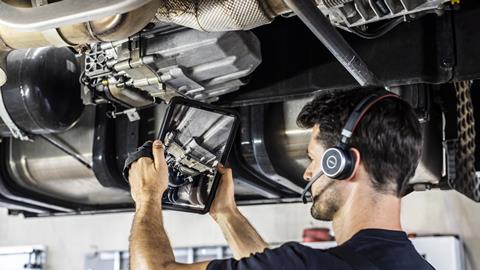
MAN also plans to accelerate its digitisation of workshop processes. Service advisors and technicians have already been equipped with iPads to handle service orders, documentation, and communication digitally.
In addition, app solutions and artificial intelligence will be used to support the end-to-end digitization of workshop visits and ensure more efficient processes, greater transparency, and improved service quality for customers.
Friedrich Baumann, MAN executive board member for sales and customer solutions, said: “A strong brand needs a strong service network. We have that – and we are now making it even stronger. Alongside our sales team, our workshops are our public face for our customers.
“Our strong network is a competitive advantage. We want to expand it further. That is why we are investing heavily here over the next few years, because the combination of product, service, and good quality will become even more important in the coming years, especially against the backdrop of new competitors.
“We want to set ourselves apart even more clearly and establish ourselves as a sustainable player.
“The commercial vehicle business is significantly more complex and service-intensive than the passenger car business.
“The daily availability of vehicles is essential for our customers’ businesses. To be successful, we need to be very close to our customers and offer top-notch service.”