





To support the electrification of parcel-centre linehaul routes across Germany, DHL is expanding its e-truck fleet and installing 400 kW depot chargers in partnership with E.ON Drive.
The first six high-power charging points are now operational at the company’s parcel centre near Munich, marking the start of a nationwide programme that will see 170 heavy-duty charging points deployed by 2027. The new infrastructure is designed to integrate into DHL’s parcel-centre operations, enabling electric heavy goods vehicles to charge between scheduled inter-hub movements.
DHL’s Post & Parcel Germany division currently operates 17 electric trucks, including 13 Volvo e-trucks and a Scania Extended Range Electric Vehicle. A further 42 heavy-duty electric trucks have been ordered via hylane, including the Mercedes-Benz eActros 600 and comparable long-haul models. The charging parks are intended to support this growing fleet and form the operational foundation for DHL’s aim to expand its electric truck numbers into the three-digit range.
The Aschheim location is the first DHL parcel centre equipped with 400 kW CCS2 chargers, supplied by Alpitronic and installed by E.ON Drive. According to E.ON, MCS is “not yet relevant for today’s vehicles”, and the current focus is on deploying charging power that matches the operational profiles of trucks already available. The new charging park allows an e-truck to charge in around one to one-and-a-half hours.
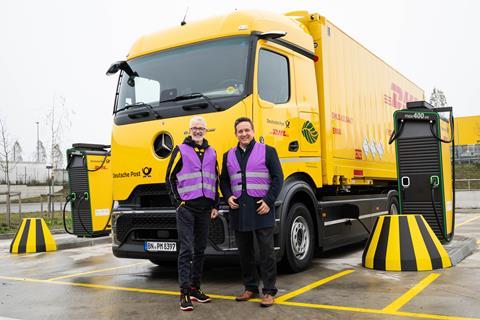
E.ON confirmed that the site operates on 100% renewable electricity and uses intelligent load management to control power demand. No grid reinforcement was required at Aschheim, although E.ON noted that future sites will vary depending on local conditions. Some locations will incorporate peak-shaving measures, such as on-site solar generation, to manage energy use during periods of high demand.
DHL’s operational requirement is for reliable, return-to-base charging that fits within the fixed schedules of parcel-centre trunking. The new high-power depot infrastructure is intended to support both overnight charging and opportunity charging between depot arrivals and departures, reducing reliance on public charging networks and aligning vehicle availability with parcel-centre workflows.
Thomas Schlickenrieder, head of infrastructure for Post & Parcel Germany at DHL Group, said the company now aims to make heavy-duty inter-hub transport as low-emission as its last-mile operations.
“In last-mile delivery we already operate 35,000 electric vans and more than 40,000 charging points. Now we want to make heavy transport between our parcel centres cleaner as well,” he said.