





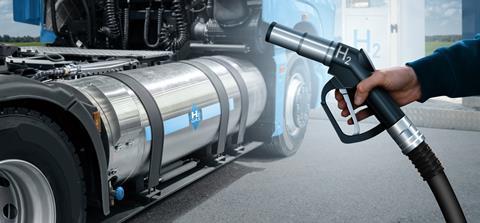
Hydrogen as a vehicle fuel is “overstated and might just be a parenthesis in history”, according to Christian Levin, chief executive of Scania and chair of ACEA Commercial Vehicles Board.
Levin made the comments at European energy lobby group Eurelectric’s annual EVision meeting on electric vehicles.
In an on-stage ‘fireside chat’, he was asked by Leonhard Birnbaum, chairman of the board & CEO at E.ON and president of Eurelectric, ‘Is hydrogen dead’ for the purpose of freight vehicles. Levin said “unfortunately not”, noting that some countries had gas infrastructure already. But he said if not, “why throw money at two infrastructures” rather than expanding the electricity network to accommodate battery vehicles.
Levin said the hydrogen’s disadvantage was “about physics”. Well to wheel energy efficiency for hydrogen was about 30%, while for battery vehicles it was 60-70%. That means “someone has to pay double” to use the same energy and that would not be solved by technology. He said even in countries where the electricity supply was currently carbon-intensive, the trend would be towards lower emissions as fossil plants were closed down.
One consequence of a shift to electric vehicles will be a radical change to truck manufacturers’ business models, it emerged.
Benedikt Nesselhauf, Head of Brussels Office, MAN Truck & Bus SE, did not challenge a claim that “20-25% of an OEM’s bottom line” was in repair and maintenance contracts and that would fall as “lots of friction disappears” in an electric vehicle. Nesselhauf said OEMs would have to move on from repair and maintenance and instead build competencies in software and provide other services, such as route planning. “It’s a change of business model and we have to adapt to a new world,” he said. He welcomed the change, saying it was exciting for engineers: “For so many years we we’ve had a very slow evolution of diesel engines” that date back a century “but the last five years have seen a transformation.”
A new European Commission Industrial Action Plan for the European automotive sector, agreed on 5 March and published the day after, named innovation and digitalisation as one its five pillars.
Clean Mobility is the second pillar. For heavy duty vehicles that encompasses plans to amend the Eurovignette Directive to maintain an exemption from road charges for zero-emission heavy-duty vehicles beyond the end of 2025. Otherwise most of the Action Plan for heavy-duty vehicles focused on charging infrastructure, in depots and along key highway corridors.
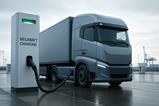
Apostolos Tzititzikostas, European Commissioner for Sustainable Transport and Tourism, said charging infrastructure for heavy duty vehicles needs a “particular push”. The Action Plan will see the Commission work with member states to fast-track deployment of heavy-duty vehicle charging hubs along key logistics corridors as critical infrastructure, including in related urban nodes and multimodal freight terminals.
By focusing on streamlining permitting, leveraging financing to de-risk investments, and linking to specific grid priority areas under the Renewable Energy Directive, the Action Plan aims to aim make its “first impact” before the end of 2025.
The Commission will also look into ways to accelerate non-grid permitting for heavy-duty vehicle recharging stations, for instance through changing zoning regulations to give explicit support for heavy-duty vehicles charging along TEN-T corridors. Tzititzikostas said the Commission would recommend that Member States classify charging points for heavy duty vehicles as “of overriding public interest” to help speed up permitting and added that the Commission “May make it mandatory”.
Member States will also be required to ensure their networks support smart and bi-directional charging to allow for flexible operation, including using taxation to create a business case for bi-directional charging and an electricity network code that will facilitate flexibility.
The Commission’s action plan promised to “swiftly present additional flexibilities, through a targeted amendment of the CO₂ emission performance standards for cars and vans”. But Axel Volkery, Deputy Head of Unit, Sustainable & Intelligent transport, DG MOVE, European Commission, stressed that heavy duty vehicles were not part of any discussion on relaxing vehicle carbon emission limits, saying “there was a clear requirement for regulatory stability” in the sector.