




Electric-powered semi-trailers can cut tractor energy demand across diesel, LNG and electric trucks, but do not always reduce total consumption. In battery-electric combinations, overall energy use increases despite the efficiency gain at the tractor.
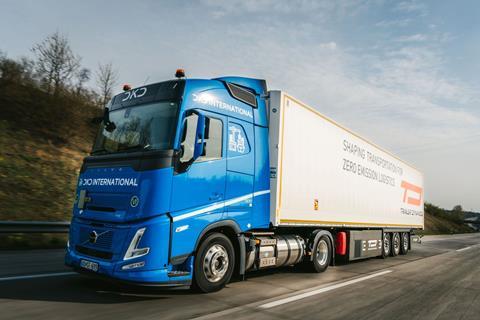
A joint trial by Volvo Hungaria, Krone and Trailer Dynamics in Hungary evaluated a powered semi-trailer using diesel, LNG and electric tractors. The tests were conducted over a roughly 90km route, run mainly on motorways. Each vehicle completed the same loop with both a conventional trailer and an electrically powered trailer, with the same driver and the same gross combination weight, isolating the effect of the trailer’s drive assistance.
The concept behind the powered trailer is straightforward. Instead of being pulled passively, the trailer contributes to propulsion using its own electric drive axle and onboard battery. This reduces the load on the tractor and lowers its fuel or energy consumption, while also allowing energy recovery during braking.
The trailer used in the trial was an insulated dry-freight box equipped with a 551kWh battery. Trailer Dynamics’ modular eTrailer system can also be configured with 187kWh or 367kWh packs and supports DC charging at up to 350kW.
At the tractor level, the efficiency gains were consistent. Diesel consumption fell from 27 to 15.4 litres/100km, a reduction of around 43%. LNG consumption dropped from 19.35 to 9.5kg/100km, an improvement of about 51%. For the battery-electric tractor, energy use decreased from 120.8 to 58.01kWh/100km, a reduction of roughly 52%.
However, the powered trailer also consumes energy, around 91 to 104kWh/100km depending on the configuration, which changes the overall picture.
This is most evident in the battery-electric case, where all energy use is measured in kWh. While the tractor’s consumption drops to 58.01kWh/100km, the trailer adds approximately 92.05kWh/100km, bringing the combined total to around 150kWh/100km. That compares with 120.8kWh/100km for the same tractor operating with a conventional trailer. In this configuration, the powered trailer reduces the load on the tractor battery and can extend usable range by adding its own stored energy, but at the cost of higher total energy consumption.
For the combustion-engined vehicles, the outcome is different. When fuel and electricity use are converted to a common energy basis, the combined energy consumption of the tractor and powered trailer is lower than with a conventional trailer. In these cases, the reduction in tractor demand outweighs the additional energy used by the trailer.
A further constraint is payload. In its current prototype form, the powered trailer’s electric drive system and battery add approximately 6 tonnes of weight. Under existing regulations, this reduces payload capacity by roughly the same amount. This is more acute for battery-electric trucks, which already carry substantial battery mass, making overall weight and payload more critical.