





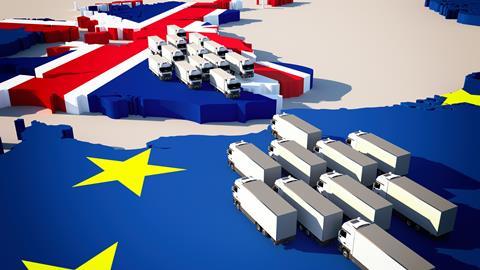
A decade on, the glut of comment pieces marking the Brexit referendum tells you two things. The decision we made has had serious consequences. And even now, much remains unresolved.

That is the case for the businesses moving goods and passengers we represent at the RHA. Leaving the EU has been a slow burn for firms grappling with ever-changing rules. For voters, Brexit was a moment at the ballot box. For road freight and coach operators serving Europe, it remains an ongoing process.
Plenty of change is still incoming. New rules on tachograph use for vans. The launch of the European Travel Information and Authorisation System (ETIAS). And given the troubled rollout of the Entry/Exit System (EES) since last October, plus reported outages with the Import Control System (ICS2), we can only hope they bed in smoothly.
Hauliers in Northern Ireland, meanwhile, still grapple with the imperfections of the Windsor Framework, a complex border that magnifies trade changes. Because Great Britain now sits outside the EU, changes such as steel tariffs or scrapping the EU’s de minimis threshold affect England, Scotland and Wales only indirectly. Northern Ireland is different. Sitting inside the EU’s customs territory, firms there must keep pace with how each change affects their customers and their ability to move goods compliantly. The recent Business and Trade Committee report ‘UK-EU relations a decade on’ references our evidence, and our recommendation that the UK and EU work with our sector on customs and border processes to significantly reduce trade frictions.
The RHA didn’t take a public position ahead of the 2016 referendum. Then, as now, strongly held views across our industry varied widely. Some foresaw the trade frictions of leaving the customs union and wanted to avoid them; others felt the EU had opened our economy up too much, exposing a high-wage, high-regulation UK to competition it wasn’t ready for.
Even so, you would have no trouble filling a room with hauliers ready to agree that leaving the EU hasn’t gone well. The data is unambiguous. Far fewer goods now move between the EU and UK, meaning less work for all hauliers. Road goods vehicle journeys to Europe remain around 18% below their 2017 peak and are still trending down, worse still for UK-registered vehicles.
Even where there are goods to move, new trade barriers make the process time-consuming, costly and painful. It’s common to find businesses that used to ‘do Europe’ but have given up, as it’s no longer worth the hassle versus domestic work. For those that still go cross-Channel, remaining profitable is a challenge. It is hard to see that changing soon.
Despite the political uncertainty at home and the planned UK-EU Summit being postponed for now, we still believe that, whenever they occur, the re-set talks remain an opportunity to drive progress, starting with an SPS deal to cut paperwork for moving food, plants and animals. An SPS deal would remove the need for Export Health Certificates on goods such as food, plants and animals. The RHA has highlighted the outrageous delays hauliers face at the border, and the government has rightly recognised the problem.
The sooner a deal is done the better. But it will not be the end of the story. Other paperwork and border checks will remain, and it covers only one form of goods movement. That’s a starting point: the end goal must be an environment where moving any goods to or from the EU is far simpler. Without that, restoring the relationship to growth will be difficult for hauliers to deliver.
There are opportunities to go further too. The most pressing is the 90/180 day Schengen rule, which caps how long British haulage, van and coach drivers can work in the EU. With EES being implemented more strictly, it becomes a hard barrier enforced to the day. Left unchanged, EES will limit the work British operators take on, push up costs, and have a detrimental impact on the industry, businesses and wider supply chain resilience.
We are asking for a professional drivers’ exemption to the 90/180 rules. With the driver shortage worsening, and the EU’s own Visa Strategy flagging it, there’s no sense in restricting British drivers. Alongside welcome progress on Youth Mobility, it would be a sensible, win-win next step. We hope it will be on the table in future UK / EU talks.
The other key area is aligning approaches to digitising trade. Done well, the UK and EU can prove that digital technologies radically transform trade on both sides of the Channel, making life easier for businesses.
As we await a date for the next summit, the message from our industry is not to mark the decade since the referendum by looking back at old debates. In the more turbulent world we now live in, a stronger, more workable UK-EU trade relationship is both necessary and achievable. Our sector stands ready to help deliver it.
Richard Smith - MD, RHA