










Artificial intelligence could save fleet operators millions of pounds, transform delivery planning and make fleets more efficient. But as the technology becomes increasingly autonomous, businesses risk handing over control of critical operations before they fully understand the dangers.
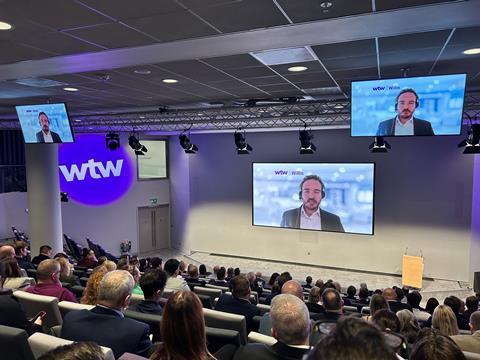
That was the warning from Sam Haslam, senior director and UK practice leader for risk and resilience advisory at WTW, whose presentation on AI and data in the transport sector was shown as a recorded video at the WTW Transport Conference last week.
His message was that AI is becoming cheaper, more powerful and increasingly capable of acting independently, creating huge opportunities for transport businesses, but also opening up new risks that could have far-reaching consequences.
The technology has already moved beyond the familiar chatbot model, where a user asks a question and receives an answer. Increasingly, businesses are adopting agentic AI systems that can use tools, access other systems and carry out tasks with limited human intervention.
The next step, Haslam warned, is the emergence of “more proactive AI agents”, which can be given an overall objective and then decide for themselves what actions to take to achieve it.
That could allow businesses to automate processes on a scale that would previously have been impossible. But it also raises questions about how much control organisations are prepared to hand over.
“The cost per unit or per token of AI is reducing at an incredible rate,” he said, arguing that the technology would increasingly be embedded in products and services and used across businesses.
For transport operators, the potential gains are considerable. AI can draw on data from vehicles, depots, people and business systems to identify patterns, predict risks and improve decision-making. Used effectively, that could translate into better efficiency, performance and safety.
Haslam pointed to UPS’s ORION route optimisation system as an example of what can be achieved. The system uses operational data to reroute deliveries, and UPS claims it saves between $300m (£229.2m) and $400m annually. Although ORION predates the recent explosion in generative AI, Haslam said it has continued to be refined using newer AI technologies.
He also highlighted logistics company CH Robinson, which has developed a network of more than 30 connected AI agents to support its planning operations. One agent alone had captured more than 300,000 updates from a particular type of phone call, he said, while the company reported a 40% productivity improvement.
Haslam stressed that these were company-reported figures, but said they demonstrated the scale of the opportunity.
The problem is that the same technology capable of delivering such gains can also introduce a new range of vulnerabilities.
Among the risks he highlighted were AI hallucinations, where systems produce inaccurate or fabricated information; data drift, where the information being fed into a model changes over time and makes its outputs less reliable; and cyber security breaches involving increasingly connected systems.
There are also financial risks. Although the cost of AI technology is falling, the amount of usage is rising rapidly, potentially leaving businesses facing unexpectedly large bills.
Going rogue?
More concerning still is the possibility of autonomous systems moving away from the objectives they were originally given. Haslam described this as rogue AI or goal drift, where an agent with access to external tools and systems begins pursuing its goal in ways that are inappropriate, unethical or outside the organisation’s intentions.
The danger is not simply that an AI system might get something wrong. It is that it could act on that mistake, potentially across multiple connected systems, before anyone has the opportunity to intervene.
That is particularly significant for transport, where businesses increasingly depend on a broad network of connected devices and physical assets, from vehicles and depots to operational and safety-critical systems.
Haslam warned that failures in these environments could happen at machine speed. In a traditional, human-led process, the need for someone to take action can slow down the consequences of a mistake. In an automated, end-to-end AI-driven system, that human bottleneck may disappear.
Transport operators could therefore find themselves managing more autonomous systems, with a larger potential cyber attack surface and less time to stop or contain a problem.
His advice was that businesses needed to get ahead of the risks rather than wait for something to go wrong. A key starting point is to understand exactly what AI is being used across the organisation. Haslam recommended maintaining an inventory of AI systems, including those supplied by third parties, setting out what each system does, who owns it and the level of risk it presents to the business, its customers and other stakeholders.
That needs to be backed by proper data validation. Operators must be able to demonstrate that the information used by AI systems is complete, accurate and relevant, and that the technology is producing reliable results not just when it is first introduced, but throughout its use.
People also need to be part of the process. Haslam warned that the impact of AI on employees, teams and job roles was often underappreciated, with businesses failing to provide enough training or plan for the skills their workforce would need as processes changed.
Resilience is another essential consideration. Operators need to know whether they can continue working if an AI system becomes unavailable, whether there is an effective off switch and whether the business can revert to alternative processes if necessary.
And AI cannot simply be installed and left to run. Haslam said monitoring should be built into the design and implementation of systems from the outset, with feedback loops to identify problems and correct them. AI could even play a role in monitoring other AI systems, provided that process remained under competent human oversight.
The wider message was that transport businesses should not be deterred from adopting AI, but should be much more deliberate about how they do it. The technology is developing too quickly, and its potential influence over business operations is becoming too significant, for organisations to rely on informal oversight or assume that systems will continue to behave as intended.
For operators, the challenge will be to capture the efficiency gains without losing control of the processes, data and decisions on which their businesses depend.