
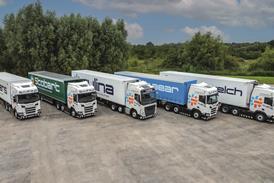




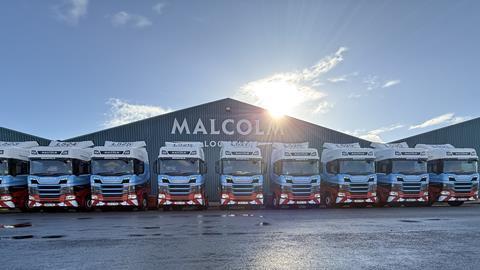

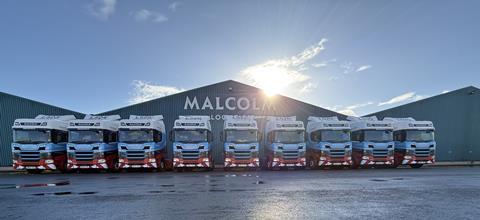
Malcolm Logistics picked up the Haulier of the Year Award at the 2025 Motor Transport Awards, the second time the company has collected this coveted award.
In 2016, a key part of its first win was Malcolm’s development of a 50ft extendable skeletal trailer. Since then CEO Andrew Malcolm MBE has gone on to propose an increase in vehicle weights to allow operation at 48 tonnes GVW with 48 miles of rail terminals to maximise load fill and take trucks off the roads.
“We got that through the UK government but not through Holyrood,” he says. “Scotland imports cube and exports weight. We have 40 of the 50ft trailers on the fleet and they are all getting used extensively. But we do lose weight going down south so 48 for 48 would be a game changer to get more volume onto rail.”
Despite external pressures including rising operational costs, skills shortages and the need to decarbonise, Malcolm Group remains a highly efficient and profitable operation. In the year to 31 January 2024 it reported turnover down to £242.8m (2022: £257m) but pre-tax profit up to £14.8m (2022: £12.4m).
Sustainability is key theme for Malcolm Logistics, and while that doesn’t just mean cutting carbon emissions that clearly is a high priority. The company recently employed John Mcrory as its first environmental and sustainability director to take the lead on this crucial part of the business strategy.
“Our company has always invested in the future,” says Malcolm. “We buy the most modern trucks on the road, the vehicles are all on full air suspension, we cut our empty mileage by maximising load fill – that’s ESG. We’ve been on this journey for years and the only question is when do we move on to the alternative options.”
Getting customers to come along on this next step of the journey is proving challenging however.
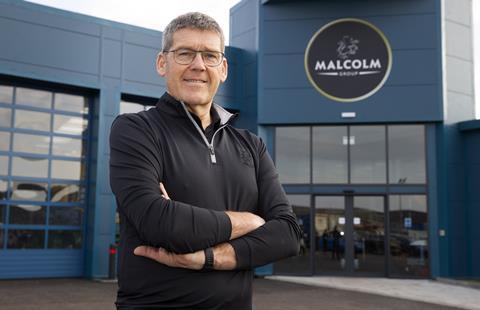
“Every customer is under massive pressure from above to cut their spend on logistics,” says Malcolm. “They all want decarbonisation but for a lot of them spend and health and safety are the two priorities.
“I always say to customers ‘do you want to cut the price or the spend?’ Taking 2.5% off the price is one thing but if I can get another two pallets on the back of that trailer and do one load less that is a real cut in your spend.
“Malcolm is a private company and we are not motivated by growth in turnover. We are motivated by the value we can deliver to the customer. We mostly target work now that fills the dead legs.”
One KPI Malcolm monitors every week is the number of other hauliers’ vehicles delivering to Malcolm-run sites and whether they run out empty or full.
“That isn’t about how we can target that business,” he says. “If we can reduce the number of vehicle movements it improves health and safety and turnaround times.
“That doesn’t mean we are acting as a 4PL – I call us a 3.5PL. We are big enough to compete with the 4PLs but small enough to care.”
Malcolm Logistics can often cut a customer’s overall logistics spend by offering a one-stop-shop for a range of services, cutting out wasted time and effort.
“The response we often hear to that is ‘that’s not my budget’ so even though we can save the company money getting people to look at that internally can be a problem,” says Malcolm. “We currently run about 12 customers sites where we coordinate everything from the line haul to merchant haul. We try to reduce where we can congestion at the customer site.”
A long-term member of the Transport Association, Malcolm clearly cares deeply about road haulage and wants to work with other hauliers to improve the efficiency of the whole industry rather than cut each other’s throats on the rate.
“Genuinely from the heart we need to work to make sure the transport infrastructure is still there in two or three years,” he says. “If I can help them out with a load from A to B and they give me a load from C to D we can sweat the assets.
“If hauliers cannot work together the industry will come to a standstill and there will not be enough capacity out there.”
Sweating the assets means Malcolm runs a fairly high ratio of trailers to tractors of 3.5 to 1.
“We want our guys in, drop, pick up and out,” Malcolm says. “We use shunters to position the trailers.”
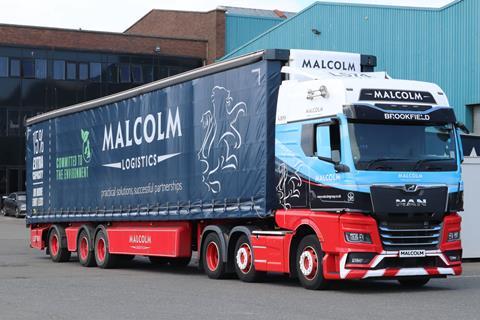
While the UK’s economic headwinds mean parts of the transport industry are struggling financially, Malcolm believes the market will recover within the next two years by when a lot of weaker operators without the financial strength to renew their fleets will have gone to the wall.
“We’ve just had a massive clear out of older trucks that went to export,” he says. “They were nine years old and we kept them longer than we should. We have added 20 new trucks so the fleet is now back to where it should be.”
While growing numbers of operators south of the Border are turning to low carbon fuels as a stop-gap before going zero emissions, Malcolm Logistics’ experiment with five LNG trucks in 2021 foundered on the rock of poor infrastructure.
“We did long-term trials with LNG and BOC put a tank in,” Malcolm says. “Then BOC pulled out of the market. Luckily we hadn’t bought the trucks so they went back to the manufacturer.”
One LNG trucks remains on the fleet, refuelling at the public station at DIRFT, and the company is using certified HVO down south where it is more readily available at lower prices than in Scotland.
“All our depots in England have been on HVO since last year,” he says. “It’s 3ppl cheaper in England than in Scotland. We have a mechanism where customers can sign up and pay a premium for HVO and we can give them proof of the carbon credit.”
Malcolm Logistics uses 100% on-site bunkering for its fuel and carries 14 days of stock at all times.
Like many in the industry Malcolm wants to see a revision of gross vehicle and axle weight limits for electric vehicles.
“Eighty per cent of UK tractors are 6x2 for 44-tonne operation,” he says. “How do we go electric? Out of 450 trucks on our fleet we have five that are not running at maximum weight. For us to decarbonise with full electric we would need more trucks to carry the same volume.”
Despite having plenty of offshore renewable wind power, Scotland has the same problem as the rest of the UK with inadequate electricity distribution networks to get the power where it is needed.
“We are keen on putting chargers into depots because we are moving to more electric cars and vans,” Malcolm says. “But the maximum any of our depots in Scotland can take is four chargers with eight points. To increase that would cost £100,000 – many of our sites would struggle to charge an HGV tomorrow.
“I’ve told Holyrood our company would need to spend roughly £50m just to put in infrastructure before we even start buying an electric truck.”
He is also talking to customers about installing chargers at their sites so electric vehicles can get a top-up charge while loading and unloading.
Malcolm Logistics has had an electric Volvo FM on trial since 2024.
“It’s going very well,” Malcolm says, “though the range goes up and down depending on the weather.”
This will be joined by an electric MAN eTGX early next year and Malcolm plans to replace the Volvo with the latest version when it is two years old.
“The main thing with electric vehicles is the range,” he says. “We are committed to the electric journey but our strapline is ‘practical solutions, successful partnerships’ and we have to put the theory into practice. If we can keep it simple, we can make it work.”
While Malcolm does not see autonomous trucks running on public roads any time soon, he is looking at driverless shunters for inter-site movements in controlled environments.
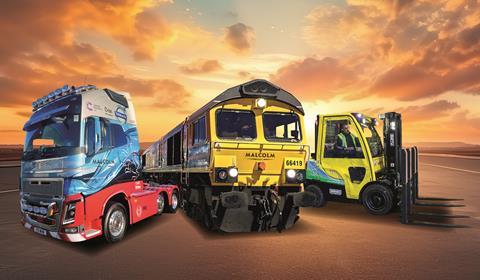
After being hit with a £2m increase in employer National Insurance contributions in the last Budget Malcolm has low expectations from the next one in November.
“Fuel duty is going to go up,” he predicts. “Eighteen months ago the Scottish Government pulled the Freight Facility Grant [to subsidise the movement of freight from road to rail] at two weeks notice. That cost us £172,000.
“This year we have gone from two trains a day to one-and-a-half longer, more efficient trains. We are losing on the trains because hauliers out there are cutting rates.”
As the third generation to run the family firm Andrew Malcolm is happy that the next generation is coming along behind him – though he would be content to see a non-family member take the CEO role.
“My brother has two sons on the civils side, my eldest son is operations director for the non-civils side, my son-in-law is UK warehousing director, my youngest son is regional operations manager for the West of Scotland and my daughter looks after our charity and community work,” he says. “They all started at the grass roots and have worked their way through the business.
“I don’t plan to go anywhere but my strategy is to see a non-Malcolm sitting in my chair. When you sit at the top, the heart can come before the head and it can be quite a lonely place.”
Malcolm wants everyone who comes to work for the company to have a career not just a job.
“We treat our employees as an extension of our family and we give them stability and security. All I want in return is a day’s work.”
“When I look at our organisation every senior operations manager is home-bred,” he says. “They are ex-drivers or ex-warehousemen. My MD of Logistics started with me as a forklift driver and worked his way up.”
Death of tramping greatly exaggerated
The need to double and triple shift expensive tractor units, a desire among drivers for more regular shift patterns and an inevitable shift to electric vehicles has led to predictions of the end of tramping. But Andrew Malcolm believes those predictions are premature.
“You will still have trampers,” he says. “Tramping has become a way of life for some people. A tramper knows he won’t be home for two or three nights but a local driver can plan virtually nothing.
“The trucks go out at 6am and while they are usually back by 5pm some don’t get back til 7.30pm so it’s hard for the drivers to plan their lives. Congestion, accidents, arriving at a DC 10 minutes late and being put to the back of the queue – we have no control.”
After a rise in driver wages in Covid-19, pressure from customers to cut costs is again depressing pay and Malcolm warns that this is a short-sighted move.
“I always ask customers ‘what is your resilience plan over the next 18 months?’,” he says. “It takes years to build an infrastructure that works but it doesn’t take long to destroy it.”
What is a cowboy operator?
Recessions always encourage a certain element of the transport industry to risk running on the wrong side of the law.
Technically the UK is not in recession though 1% annual growth in the economy is hardly a boom. This period of slow growth and consequent pressure on volumes and rates is having a similar effect, Malcolm argues.
“The desperation in our industry to get revenue is forcing people to move across that line,” he says. “I don’t think things are as bad as 15 or 20 years ago when the cowboys were certainly out there, but we are concerned now that pressure from customers and the cost of operating a fleet of trucks is forcing people to cut corners.
“We won’t do it and have lost customers – though they have since come back for the service. It has become survival of the fittest.”
Having said that, Malcolm does believe that the authorities have become over-zealous in their rigid enforcement of the letter of the law, especially when it comes to drivers occasionally running a few minutes over their hours.
“The problem is we are over-regulated and there is no room left for common sense,” he argues. “Even reputable hauliers are being forced to run on tighter margins. We try not to run our fleet into London because of the fines people are being hit with for something simple. The industry has become an easy target for local authorities.”