








Haulage insolvencies were finally dropping after peaking at 503 in 2023. But with RHA members now paying 30% more for fuel than in February, and further duty rises planned, cashflow pressure could push vulnerable operators over the edge. Industry bodies are calling for duty cuts and mandatory 30-day payment terms, while operators warn of the mismatch between weekly fuel bills and delayed customer payments.
The number of insolvencies in UK haulage was dropping, but recent fuel price surges are likely to reverse that trend.
UK freight transport insolvencies increased from 195 in 2020 up to a high of 503 in 2023. A further 471 closed in 2024 and 401 last year. That downward trend was a small win for haulage. The Office for National Statistics Business Demography data showed that while transport still has the highest number of business births and deaths, it also had the most significant decrease in business closures in Q4 2025, compared with Q4 2024.
However, the latest disruption to international supply chains has hit haulage where it hurts most – fuel. Overall the RHA says its members are paying 30% more in fuel now than they were in February. Prices have continued to rise since that figure was issued.
The trade associations including RHA and the Association of Pallet Networks (APN) are calling on the Chancellor to lower duty and VAT on fuel, and to insist on 30-day payment terms for haulage firms. They also want the Chancellor to reverse plans to increase fuel duty by 1ppl in September and 2ppl in December and March, which would return it to pre- March 2022 levels.
However, so far the government has only said that fuel duty will remain “under review”, preferring “a rapid de-escalation in the Middle East [as] the best way to keep prices low at the pump”.
The RHA is also asking for an Essential User Rebate – something the industry has requested countless times in the past 20 years and which has not once been granted. One reason for this is that successive governments have preferred to spend their money supporting households, rather than industrial sectors. An extensive parliamentary paper from 2011, which considered the fuel strikes, which almost toppled the Blair government and subsequent calls for fuel duty reform, sums up arguments which don’t appear to have changed:
• Granting a fuel duty rebate would cost the Treasury dearly at a point when public finances are significantly stretched. Fuel duty overall brings in £25bn; £15bn from diesel and £9bn from petrol (calculated using 2025 consumption figures). Red diesel usage has been very restricted since 2022.
• There is an argument that hauliers can and should pass on costs to customers (although in practice this can still leave them out of pocket unless they hedge fuel prices in advance). While technically this is inflationary, it has little immediate effect – and certainly little effect compared to the volatility of fuel prices themselves.
• Who qualifies as an essential user could be a politically fraught issue. Are doctors, nurses, teachers or care workers who rely on self-funded personal transport to get to work not “essential”?
• Diesel consumption in the UK is decreasing and must continue to decrease in order to meet the UK’s net zero targets. In 2025, the UK consumed a little under 29bn litres. Government has two levers here: EV incentives which are expensive and only effective when other barriers are removed; and the disincentive of high fuel costs.
At the time of writing Fuel Map UK shows the average pump price of diesel at 180ppl. As VAT is levied on the base fuel price and the duty, the government currently claims 30p on every litre sold. By MT’s rough calculation, that means the Chancellor is claiming an extra £229m on diesel for each month at the current price.
Although VAT can be reclaimed by hauliers, in effect it’s simply offset against the VAT raised on invoices, while remaining a drain on cashflow.
The National Institute for Economic and Social Research suggests that the government is likely to reverse the fuel duty rises in September, although it warns that the original March 2022 cut cost the Treasury £2.4bn. Of the policy levers available to the Chancellor, however, cuts in duty are more predictable for both fiscal rules and the effect on motorists than cuts in VAT.
Diesel cars are in decline, with 2.8m fewer in 2024 than in 2019. However, they still account for 60% of all diesel miles driven and are an important demand factor.
The Institute for Government argues that prices should be allowed to suppress demand and that government should do more to encourage motorists to drive less and more efficiently in order to preserve fuel supplies. So far the government has resisted any demand-management messaging around fuel to prevent panic buying.
Profit or cashflow?
The average profit margin usually quoted for haulage is 2% but, of course, averages hide wide variety. The industry is very diverse in terms of size, scale, financing and the ability to pass on costs.
It’s also possible to continue running on low or non-existent profit margins. Abrupt closures and bankruptcies don’t arise from a lack of profit, so much as a lack of cashflow. And this is where surging fuel costs is a killer, because fuel payments are typically made weekly or fortnightly. Customer invoices, however, are typically set for 30 days and often take far longer to be paid. It is this discrepancy between cash in and cash out which puts many hauliers in jeopardy.
Economic vulnerability
Hauliers are also vulnerable to customer closures. The latest Red Flag Alert from BTG Begbies Traynor highlighted 67,369 companies in critical financial distress in Q4 2025, a 43.8% year-on-year increase. Consumer-facing industries, including hotels, restaurants and leisure services, faced the highest surges in economic vulnerability - all of which are reliant on road haulage.
A further 11% increase in significant distress was noted.
Hauliers were, therefore, already relying on a more vulnerable customer landscape, before the latest crisis, which lowers the likelihood of many being able to pass on sudden increases in cost.
Why does the Strait of Hormuz matter?
The main oil producers are in the Persian Gulf, west of the Strait of Hormuz. Their route to market is directly through the strait, which normally sees 20m barrels of crude per day (bpd) or 20% of global oil consumption pass through. The shipping channel also carries around 25% of the world’s LNG and 10m bpd (10%) of global refining capacity.
President Trump’s attack on Iran effectively ended that shipping overnight, which in turn reduced oil supply by 20%. Ironically the only Persian Gulf state which can still ship its oil unimpeded through the strait is Iran which has benefitted hugely from the rocketing prices – earning it an extra $200m at the time of writing, according to York-based fuel risk-management company Portland.
It says: “The effect on prices has been savage and deeply worrisome. The International Energy Agency has gone as far as to say that the current blockage of the Strait of Hormuz is the most severe oil and gas supply disruption ever.”
Crude oil prices have increased by 60% since February, with wholesale diesel prices moving from 92ppl on 1 March to 147ppl on 27 March according to the RAC Foundation.
Could we run out of diesel?
It’s unlikely but it depends on the length of the Israeli-US-Iranian conflict. The last oil-carrying ships to leave the strait are predicted to reach their destinations in mid-April. After that the UK supply of diesel is predicted to dip by about 10%.
The UK currently has more than 90 days of stock, which it can release to the refineries. However, the government does have contingency plans in place, which include reserving diesel for emergency vehicles and commercial transport should supply dip significantly, as well as forecourt rationing.
How fast could diesel supply normalise?
If the Iranian conflict ends, and the Strait of Hormuz opens to shipping once again, then prices of crude oil could go down as quickly as they rose.
The supply problem doesn’t end there, however. There is very limited refining capacity in the UK. So even if the supply of crude oil is plentiful, the refineries are limited in how fast they can meet market demand. The UK typically imports half of its diesel, and the Continental refineries which produce it are also dependent upon Middle Eastern crude.
Impact on hauliers
Ross Edden, MD of Banbury-based TWE Haulage, says: “All our customers are on a fuel surcharge escalator, however, there is a delay in us being able to increase the fuel surcharge. We cannot react overnight like the fuel companies do, so there are periods where the fuel surcharge is lower than needed. Even then a fuel surcharge does not always cover the actual increases we are facing.
“In regards to cash flow, it makes a big impact. Our customers are on 30 days end of month terms, some longer. However, we are paying the fuel companies weekly as you can get a slightly cheaper price if you pay weekly. So it’s a trade off, reduced cash flow but we save a tiny bit on the price.
“I honestly do fear for many transport companies who aren’t quite as commercially prepared with cash reserves and some that I know of aren’t passing the fuel costs on at all!
“What can be done to help? I cannot for the life of me understand why the government does not impose a temporary fuel reduction for essential industries like logistics and buses/coaches because making essential users pay this money on fuel is doing nothing but increasing costs a lot and in turn will push inflation back up. In Covid, transport companies were classed as essential to the economy and encouraged by the government to keep working so shops didn’t run out of supplies. However, now it might hurt the government’s pocket, they don’t want to recognise us as essential users.”
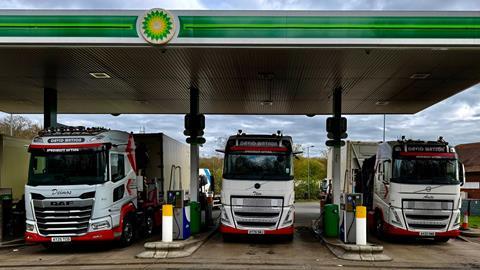
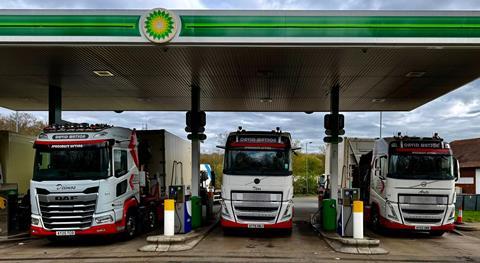
Mark Watson, MD of specialist haulier David Watson Transport, says that the fuel surge has been only the latest cost issue facing haulage, following on from two years of double-digit cost increases across the board and high interest rates which suppress market demand.
“We run 108 vehicles and every 1ppl on diesel costs us another £30,000 a year,” he says. “Our average diesel cost in January was 105ppl, in February 107ppl and the last week of March was 147ppl. AdBlue has also gone up by 33%.”
He is sure that the relentless price increases will send some hauliers to the wall, especially small businesses and those without fuel escalators.
“We have to honour the fuel price given for at least a week when we quote for work, so we requote every week, based on a Friday forecast of Monday pricing,” he says. This still causes problems because not all customers can afford to absorb the cost, or can manage increases on short notice.
He thinks the government response inadequate. “Delaying an increase is not the same as saving us money,” he says. “It’s just spin.”