




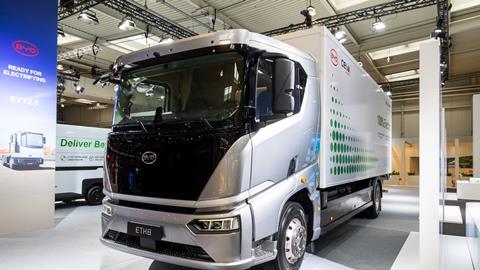

Loyalty among operators for a particular make of truck is eroding and is likely to be exploited by Chinese manufacturers, according to a new report.
Bain & Company’s European Truck Market Outlook found fleet operators were largely dissatisfied with manufacturers’ current offerings and performance.
The global consulting firm relied on a customer loyalty metric called Net Promoter Score (NPS) and following a poll of more than 500 decision makers across Europe, found that the industry’s average NPS in 2026 had decreased by 21 points compared to 2022.
It said large and medium fleets posted the lowest NPS, with owner operators recording the highest.
“This meaningful shift in NPS suggests large fleet operators potentially have more complex needs that aren’t being fully met,” the report said.
“This is a troubling sign for manufacturers fighting for share in an increasingly consolidated market.”
Companies in the UK were among the most open to switching brands and to considering Chinese manufacturers and were twice as likely to buy from a Chinese firm as operators in Germany and Poland.
“This loyalty erosion is creating an opening for all brands, but especially Chinese manufacturers,” the report said.
“Roughly one in three fleet operators has already been in contact with a Chinese manufacturer and reported being ‘likely’ or ‘very likely’ to purchase a Chinese vehicle in the next three years.
“Among operators willing to adopt BETs [battery electric trucks], more than half said they are open to buying Chinese trucks.”
Bain & Company said its survey also found operators expected a significant shift in their fleets’ drivetrain composition.
Their predictions were that only half of new trucks would be ICE vehicles by 2030, falling to approximately a third by 2035: “While these projections are generally below regulatory targets, they reflect operators’ current assumptions about what is realistic.”
It also found an additional wave of disruption on the horizon in the form of autonomous HGVs. Bain & Company said about 43% of respondents were currently assessing the business and operational implications of adding autonomous vehicles to their fleets and nearly 40% thought that 26%-50% of their transport volume could be handled autonomously.
“At this inflection point, there is no single lever European OEMs can pull to retain share or grow,” it concluded.
“Instead, OEMs need to focus on a series of highly targeted, segment-specific initiatives, tailoring execution to match operators’ fleet size, market and drivetrain transition stage.”