




Palletline has revealed plans for a significant increase in pallet volumes as part of a five year growth plan that includes expansion in mainland Europe and signing up two major UK haulier members.
In an exclusive briefing for Motor Transport and its sister publications, Palletline group CEO Graham Leitch said that the member-owned network would not be pursuing growth at the expense of quality of service but there were significant opportunities for expansion despite the maturity of the UK pallet market.
“Our current volumes are over 4 million pallets p.a.,” says Leitch. “We are not the biggest but are clearly the best on service. We want growth and we have a plan to increase capacity in the next five. years”
This plan will see a £10m investment in growing hub capacity by another 6,000 pallets per night, including further upgrades to the network’s IT systems.
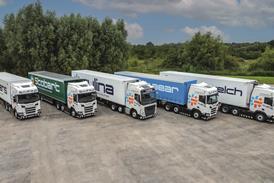
Palletline is unique in being wholly-owned by its 76 members who run 97 depots, which together with seven in-house hauliers, give 100% postcode coverage of the UK.
This avoids “caretaker fees” where external hauliers are paid to handle deliveries in areas not covered by network members.
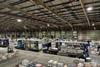
Unlike many rival networks, Palletline eschews the concept of “superhubs” based in the East Midlands, preferring two purpose-built 250,000fq ft national centres in Birmingham and Coventry supported by regional depots based at member sites in Glasgow, Haydock and Greenford in north London.
According to COO Glenn Baker, this approach helps Palletline achieve the lowest damage rate of any network at just 0.06% of pallets delivered.
“We don’t think the concept of superhubs is right,” asserts Baker. “We own our main hub which is built for purpose unlike some other networks which lease their sites and so tend to be multi-purpose.
“Our service levels are 98.5% which are consistently 1.5% to 2% better than the industry average. Our multi-hub model also cuts annual mileage by 4.5 million miles each year.”
Part of the expansion could be the construction of another building at Birmingham within the next two years and adding extra canopies at Coventry. If this proves insufficient there is the possibility of relocating the Coventry operation to a larger site in the same area. More regional hubs based at member depots are also under consideration.
Perhaps unsurprising for a network owned by the members, Palletline’s hub fees are claimed to be the lowest in the industry with no additional charges for IT or marketing.
As well as the regional hubs, Palletline welcomes direct trunking between members if it reduces stem mileage and it operates as a “virtual” huband provides excellent fees to encourage the practice.
“We reward members properly, so no one has left Palletline for another network in the last decade other than through our risk management process” says Leitch. “We are the only network to do that because we are not trying to drive hub volumes at the expense of our members.”
Palletline’s volumes are expected to rise slightly to 4.1 million in 2025 and grow again to 4.3 million next year as a result of onboarding “the biggest inputter” from a rival network in January 2026, which will bring an extra 1,300 pallets a day. Another two significant member signings are confirmed for 2027. The new members will be accommodated by some existing hauliers giving up small parts of their existing territories, which will help improve delivery density and cut the cost per pallet.
Another part of the growth plan will be an increase in Palletline’s European operations in the form of partnerships with potentially four unnamed “European domestic networks”, according to CFO Bali Bandha. “We have already started work with one large logistics operation,” he says. “They all have very similar values to Palletline.”
There will also be some growth in the limited number of central or “strategic” accounts Palletline takes on, though the policy of members rather than customers delivering product to the hubs and the ban on B2C traffic for these accounts will remain. Leitch is adamant that these strategic accounts will never account for more than 5% of Palletline volumes, up from just under 2% today.
Palletline led the way in limiting tail-lift deliveries to 750kg, with pallets over this weight only accepted on its Lift Assist premium service that sees pallets of up to 1,000kg delivered using powered pump trucks. Some accounts which left Palletline when this restriction was imposed in 2015 have since returned to the fold, according to Leitch.
Meet the Palletline management
The Palletline management team was restructured in 2023 with the appointment of former Menzies CEO Forsyth Black as the first external chair to lead the strategy review.
Group CEO Graham Leitch has been with Palletline for 11 years having previously worked at member haulier ARR Craib and Palletways. Leitch replaced Kevin Buchanan as MD in 2015.
COO Glenn Baker has also been with the company 11 years having worked with Leitch at Palletways..
An accountant by profession, group CFO Bali Bandha is the “new boy” having joined in January 2024 after a spell as interim CFO and a career involving several senior positions at multinational engineering groups.
Director of business information Harpreet Sohal has been with Palletline for a decade, having previously worked for DX and City Link.
Earlier this year, the group appointed its first head of HR, Leighton Hughes, to overhaul employment and training practices, and have recently appointed Carl White as network director to lead member development.
What next for UK pallet networks?
Despite a number of changes of ownership among the UK’s nine pallet networks in recent years, none have disappeared, which Leitch admits he finds surprising. The fierce competition among the networks as well as national 3PLs keeps atight lid on the prices customers will pay and securing good quality haulier members to maintain national coverage is a constant challenge.
Total volumes delivered by APN members rose to 29.3 million pallets in 2024, up 3.2% on 2023 and 8.4% higher than pre-pandemic levels in 2019. Next-day accounted for 62% of 2024 volumes with economy services making up the balance.
A number of the UK’s nine pallet networks have changed hands in recent years, with TPN being bought by GreenWhiteStar (now part of Culina Group), Palletforce being acquired by EV Cargo, DP World acquiring Palletways from Imperial, Pall-Ex being bought from founder Hilary Devey by members and management and then Fortec being taken over by Pall-Ex.
Following the review of ownership structure by Palletline members in 2023, the shareholders instead chose to support ongoing investment in the network.
Palletline frowns on dual running, though there is a legacy agreement with Gregorys going back to their acquisition of Kay Transport in 2009Palletline is comfortable with “group companies” such as Kinaxia – on the basis that their other pallet network operations are run by entirely separate subsidiaries in different geographical areas.
Profit is sanity for Palletline Logistics
Palletline Logistics owns seven haulage companies which run 300 trucks and trailers and while three have recently been returned to independent ownership there are no plans to “repatriate” more in the near future.
Hauliers come into Palletline ownership for a variety of reasons, the most common being a lack of succession among family owners who did not want to see the operation sold to an external buyer or folded.
The slimming down of Palletline Logistics turned a 2023 loss into a profit last year albeit at the expense of a significant drop in turnover. The majority of this “lost revenue” was repatriated to members whick tookover these post codes.
Working with The Multibank
Group CEO Graham Leitch hails from Edinburgh and Palletline works closely with The Multibank, a charity focused on alleviating child poverty in the UK founded by Scots former PM Gordon Brown, Palletline’s Member in Fife Purvis Group and Amazon.
The Multibank collects and distributes a wide range of non-food products at six centres across the UK, taking in millions of items of surplus new and nearly-new goods and sending them to local charities.
Amazon diverts a proportion of its returned goods to Multibank and as the online retailer’s sole appointed inbound pallet network Palletline is instrumental in delivering these to the charities’ regional centres.