








The Port of Dover is warning that hauliers could face significant disruption this summer as congestion caused by the EU’s Entry/Exit System (EES) threatens to bring traffic through Kent to a standstill.
In a letter to Business and Trade Committee chair Liam Byrne MP, Dover Port chief executive Doug Bannister said freight operators risk becoming trapped behind tourist traffic despite most HGV drivers being exempt from the new biometric border checks, raising the spectre of another summer of gridlock on roads leading to the Port.
The warning follows a Critical Incident during the May half-term getaway, when just a few hours of EES processing resulted in queues of up to four-and-a-half hours and widespread gridlock around Dover.
With summer holiday traffic expected to be considerably heavier, the port says the situation could deteriorate further unless the UK secures operational easements from France and the EU.
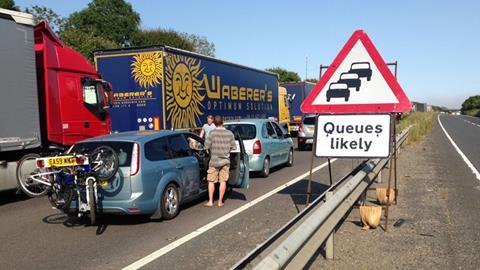
“Behind the British tourist and community disruption will be the freight traffic, with HGVs being held on the M20 motorway whilst the authorities attempt to clear the disruption,” Bannister wrote.
He added that the situation was particularly frustrating because “the vast majority of hauliers exiting the UK hold European passports and so do not need to get caught up in EES, but will do so because of the inability to bypass the queues of tourist and local traffic.”
The Port argues that delays to freight traffic would have consequences well beyond Kent. Dover handles around one-third of UK trade in goods with the EU, much of it consisting of time-critical cargoes including medicines, automotive components and fresh food.
Bannister said these “just-in-time” supply chains rely on Dover because it remains the quickest cross-Channel route, even during periods of disruption.
Alternative ferry routes would only become commercially viable after delays of more than 16 hours or around 20 missed sailings, while the necessary spare capacity simply does not exist elsewhere.
“The only arrangement to keep HGVs and trade moving is to keep tourist vehicles moving,” he said.
The Port has invested £40m in dedicated EES infrastructure, including a purpose-built processing facility in the Western Docks with 84 kiosks designed to process passengers before they reach the ferry terminal.
However, Bannister said the facility is not being used as intended because the EES kiosk technology is not yet operational.
Instead, French authorities are processing motorists in the more constrained Eastern Docks ferry terminal, reducing border capacity at the busiest time of year.
Port traffic modelling suggests queues could extend for miles onto the public highway during peak summer weekends if no changes are made to the operation of EES.
Bannister said the Port has repeatedly urged ministers to seek a formal agreement with France and the EU to either defer EES during the busiest weeks of the summer or allow greater operational flexibility when traffic reaches critical levels.
Although the government has acknowledged the Port’s preparations and confirmed the issue has received attention at the highest levels, Bannister said there is still “no workable solution agreed and time is rapidly running out”.
Responding to the Port’s concerns, Byrne backed calls for urgent action.
“The Port of Dover has sounded the alarm,” he said. “Without an agreement with France to pause the new EU border tech this summer, Britain risks border chaos again. Ministers must urgently secure that agreement now. Once queues stretch for miles through Kent, it will be too late.”
The RHA has also raised concerns that the introduction of EES is now seeing the strict enforcement of the EU’s 90/180-day rule, which restricts UK truck drivers to spending a maximum of 90 days within any rolling 180-day period in the Schengen area.
In a statement this week, the RHA said: “The Entry/Exit System (EES) is now fully operational - and it’s hitting UK transport operators.
“Stricter enforcement of the 90/180 day rule means lorry and coach drivers will rapidly run out of days for international work.
“We’ve heard from a number of firms - both haulage and coach - already running into difficulties.
“This isn’t solely a UK problem. EU businesses rely on these drivers and operators too. Left unchanged, EES will continue to limit the work British operators take on, push up costs, and damage businesses and wider supply chain resilience.
“That’s why we’re asking for a professional drivers’ exemption to the 90/180 rules.
“We’re also calling on EU states to take a pragmatic, light touch approach to enforcement and to suspend penalties for at least two years.
“We want the next Prime Minister and the government to put this high up the agenda in any future talks with the European Commission.”






![rsmith[1] 1](https://d2cohhpa0jt4tw.cloudfront.net/Pictures/100x67/4/1/0/24410_rsmith11_453221.jpg)