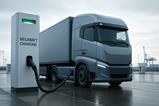
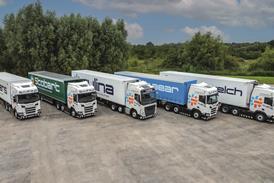






In some regions and vehicle categories, including heavy- and medium-duty trucks in China, and vans in India and China, electric vehicles are cheaper over their lifetimes than their diesel counterparts. In other regions, cost parity is expected before 2033, according to new research funded by the UK government’s Department for Energy Security & Net Zero as part of the Economics of Energy Innovation and System Transition (EEIST) programme.
The assessment echoes comments in the UK’s Financial Times by Robin Zeng, chief executive of battery maker CATL: he said half of all trucks sold in China will be electric-powered by 2028.
In a report, Driving The Transition To Zero-Emission Trucks, the authors say this presents an opportunity for lower-cost road freight and with global sales of trucks worth over $200bn per year, there will be benefits for countries whose manufacturers increase their market share over the course of the transition. They say that co-ordinating regulatory policies in markets across Europe, China, India, Canada and US states could bring forward the cost-parity tipping point by up to two-and-a-half years, since trucks and their component technologies are traded internationally.
The report finds that regulatory policies, such as zero-emission vehicle mandates and fleet-wide emissions reduction standards, “have an outsized effect on adoption early in the transition, as they create a market for low-carbon trucks” and they are likely to achieve the fastest reduction in zero-emission vehicle costs.
Real-world data and modelling from the International Council for Clean Transportation (ICCT), suggest that in heavy-duty vehicles, lifetime costs of battery options are slightly higher than those of petrol and diesel trucks in the USA and Germany, but lower in China and India. China is the furthest ahead in the trucks transition. Its industrial policy has supported battery development and manufacturing of “new energy vehicles”, while subsidies, procurement requirements, clean air zones at city levels and clean transportation requirements in some heavily polluting industries have driven deployment and cost reduction. For example, the cities of Shenzhen and Chengdu implemented zero-emission zones, in addition to bans on diesel trucks during certain times of the day.
The large battery packs required for electric medium- and heavy-duty vehicles make electric trucks expensive at the point of purchase - up to twice as expensive as diesel trucks globally.. However, the cost of lithium iron phosphate batteries, the main choice for electric truck batteries, fell by 86% between 2013 and 2024, according to Bloomberg NEF, and they are expected to fall further. The report says the operating costs of battery vehicles are significantly lower than diesel, lowering their overall lifetime costs. That was again echoed by CATL’s Zeng, who told the Financial Times that trucks powered with his batteries would be 35% cheaper per tonne-kilometre than petrol versions. He said a dozen Chinese truckmakers would use CATL’s standardised battery, dubbed ‘Number 750’ in 30 electric truck models.
However, the report authors say that reducing the cost of battery electric trucks is not on its own sufficient to drive a rapid transition. Other barriers include charging times, lower payloads in some regions and lack of supporting infrastructure. The authors did not consider the impact of the slow rollout of charging infrastructure.
When modelling hydrogen fuel cell vehicles the authors found the option did not have traction in any of the scenarios. They are more expensive than battery vehicles, and still more costly if a carbon tax or emissions regulation is introduced. The report authors say only that “there may be niche applications where their faster refuelling and payload advantages outweigh their higher costs”.