





Green hydrogen may offer a low-carbon alternative to diesel for the UK’s heavy goods sector — but not without clear government planning, infrastructure support and regulatory reform.
That was the view of Matthieu Guesné, chief executive of Lhyfe, a French producer of green hydrogen for industry and mobility, speaking at an international press briefing on 20 May.
Asked about the prospects for hydrogen trucks in the UK, Guesné was blunt:
“It’ll likely be the bigger companies that go first. The ones who can afford to bet on regulation changing.”
While momentum is building across Europe, several major barriers still stand in the way of widespread adoption.
Hydrogen pricing remains one of the biggest obstacles. Lhyfe estimates current costs at around €8/kg for large industrial customers, €12/kg for refuelling stations, and €20–30/kg for smaller or short-term contracts. Without government-backed incentives or long-term guarantees, most operators are unlikely to see a viable business case.
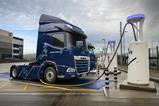
Another sticking point is infrastructure. There are currently only a handful of hydrogen refuelling stations in the UK suitable for HGVs. But Guesné pushed back on the idea that a nationwide rollout is needed immediately.
“In Germany, for example, existing hydrogen refuelling stations are being upgraded to accommodate both cars and trucks,” he explained. “To establish a robust national network, you don’t need tens of thousands of sites. Our assessment suggests that a country like France or Germany would only require around 200 to 400 well-placed hydrogen refuelling stations to get started. That’s a relatively small number compared to the 10,000 to 20,000 diesel stations currently in operation.”
Even Lhyfe itself cannot yet use hydrogen trucks for distribution. Under current ADR regulations, hydrogen-powered vehicles are not certified for transporting dangerous goods, meaning the company must rely on subcontracted diesel vehicles.
Lhyfe is already supplying hydrogen to Hyundai regional trucks in France and delivering to customers in several European countries, including Germany, Austria, Sweden and the Netherlands. But adoption rates vary, and policy plays a decisive role.
“Energy is a regulated business,” Guesné noted. “If you get frequent political change, it’s very hard to have a steady strategy for hydrogen infrastructure.”
Guesné also called for a rethink of the UK’s hydrogen support mechanisms. While he welcomed the Contracts for Difference (CfD) model, he argued that subsidies should go to offtakers rather than producers.
“I’d like to see subsidies go to the customers, not the producers. Let them decarbonise their own operations, and let us compete to offer the best price.”
Lhyfe is not yet supplying hydrogen to UK-based hauliers but is working with large firms, including Centrica, to prepare for future mobility demand.
Two of the company’s proposed production sites — Kemsley (80MW) and Wallsend (20MW) — were recently shortlisted under the UK government’s Hydrogen Allocation Round 2 (HAR2), which aims to bring up to 875MW of low-carbon hydrogen production online by the end of 2025.
“We’ll do our job on the production side,” said Guesné. “But mobility and freight need a plan — with infrastructure, incentives, and a clear route for hauliers to switch from diesel to hydrogen.”