









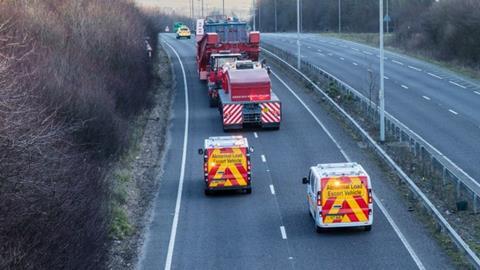

An overhaul of the laws governing abnormal load movements would help hauliers move large loads efficiently and cut out confusing guidance applied by many police forces, according to the RHA.
The trade association said that while it was continuing to work with the police to ensure the rules were being applied consistently, its long-term goal was legislative change of the Special Types General Order (STGO) regulation, which allows vehicles exceeding standard size and weight limits to be used on public roads.
The RHA said: “The legislation hasn’t been reviewed for more than two decades during which time transport technologies, equipment, and standards have developed.
“We believe an update of the legislation is overdue and we’re confident we have a clear case to campaign for it.
“Refreshed legislation would give police and industry the certainty and clarity they need to ensure these vital loads can be moved safely and most efficiently.”
The confusion that arises with escort services for loads travelling through different police force areas was recently summarised by Mervyn Lambert Plant Hire:
“Herts and Essex wanted a police escort; Cambridgeshire didn’t,” said workshop manager Ed Morley.
“Norfolk did and Suffolk didn’t. How is that supposed to work? It just becomes so difficult.”
The RHA said that there was a “clear economic argument” to overhaul the law following the publication of its economic impact assessment last year, which found the total costs of police restrictions on abnormal loads cost the UK economy £584m a year.
The RHA spearheads the Abnormal Loads Group (ALG), a collective of trade bodies, operators and stakeholders, which liaises with the government, as well as the Association of Chief Police Officers, National Highways and Network Rail
The ALG is also working with the National Police Chiefs’ Council to update police guidance to set out clear directions for officers on embargoes, notification timeframes and police escorts to help move abnormal loads.