



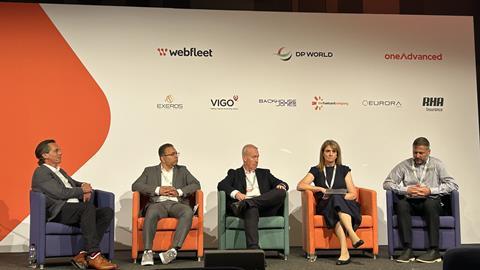

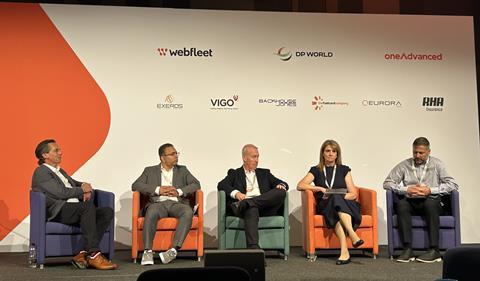
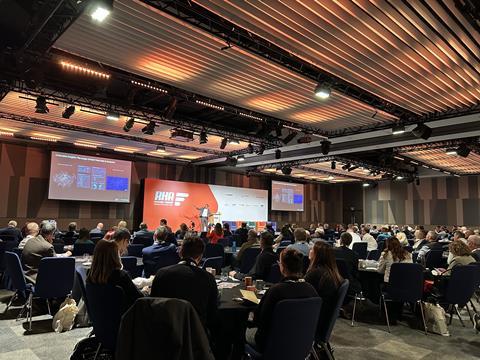
The RHA Future Forum in Birmingham saw industry leaders share how digital technologies are already driving big savings and smarter operations in logistics. From cutting empty miles to predicting maintenance and supporting decarbonisation, these emerging tools are making a real difference. If you’re not exploring them yet, now’s the time to start
TMS systems & operational optimisation
Aaron Peters: A combination of industry practitioners and technology partners will talk today about real-world applications, and the challenges of integrating new technologies into existing operations. So let’s start with the operator on the panel. Helen, Wincanton has a dedicated transport management system. What is EyeQ, and how does it work?
Helen Flanagan: EyeQ is a consolidated platform we’ve developed to give our customers full transport visibility, whether that’s through our core operations or subcontracted partners, and integrated with a range of other systems.
There are four key pillars to EyeQ. First, optimisation - getting our vehicles fuller, reducing empty miles, and ultimately helping customers reach their lowest cost while improving service levels. The second is visibility. Is my operation on time today? Is today a good day? Do I need to intervene? But it’s also about insight - using that data to help our customers do better next time.
Third is community. By that I mean connecting all the assets and people in our transport ecosystem - core fleet, subcontractors, support functions - and driving real collaboration. The logistics sector has talked about collaboration for decades, but we’ve not always been good at it. EyeQ is one of the ways we’re trying to change that. And finally, it’s about people. The system is built and run by people - and we’re continually evolving it to include new functionalities, like AI. EyeQ is not just a system; it’s a living platform.
Connectivity, AI and data in fleet operations
Aaron Peters: How is technology enabling operations managers to optimise fleets more effectively?
Raghunath Banerjee: I look at this in three parts: connectivity, data, and business intelligence. Let’s start with a basic example - tracking a vehicle from point A to point B. What happens when the driver stops unexpectedly or there are delays during unloading? Traditional systems may miss that. That’s why connectivity is so critical.
At Webfleet, we use mobile applications to keep drivers fully connected. They can update their status in real time, so there’s no information gap. Every activity is tracked and digitised because if we want true optimisation, we must have end-to-end visibility. AI also plays a crucial role. For example, our dashcams generate massive volumes of video data. The first layer of AI filters events at the edge so only the most relevant ones are sent to the Cloud. A second layer then prioritises those events for fleet operators, helping improve safety and efficiency.
Ultimately, technology is maturing - from basic tracking to real-time processing, AI and beyond. But the business must understand where to invest. It’s also the role of technology providers to help raise AI literacy across the industry so everyone knows how to use it effectively.
Where does AI belong for operators?
Aaron Peters: Adrian, where does AI sit within an organisation? Is it an IT issue, a performance issue, or something else entirely?
Adrian West: It’s a great question, and one a lot of companies are grappling with. For me, AI is first and foremost a board-level discussion.
It touches the entire organisation. Yes, it can optimise today’s processes but more importantly, it can give you a competitive edge tomorrow. The business must set the vision. That said, once the strategy is defined at the top, IT needs to be brought in early. They’re the ones who’ll bring the vision to life, connecting data, building integrations, and ensuring scalability.
Finance also has a key role, because any AI investment needs a clear ROI. And let’s not forget HR. People are often afraid AI will replace them, so communication, training, and change management are essential.
In short: AI is a cross-functional challenge. But leadership must come from the top.
The role of payments in decarbonisation
Aaron Peters: Paul, how does payment technology fit into the journey to net zero?
Paul Holland: Technology plays a key role in enabling access to alternative fuels, whether electric, hydrogen or something else.
We saw the ‘chicken-and-egg’ problem early on with EVs - no infrastructure, no vehicles, and little financial support. It was hard for operators to act. But payment platforms can now aggregate different fuel types and help operators manage and control those costs in real time.
Being able to pay at different types of charging stations - or fuel types - and reconcile those payments centrally is crucial.
It’s also about measurement: knowing what’s being spent where, and using that data to inform future decisions. Payment tech plays a foundational role in enabling that transition.
Customer integration and collaboration in logistics
Aaron Peters: Helen, going back to EyeQ… how does it integrate with both customers and subcontracted providers? What are the benefits and challenges?
Helen Flanagan: The top-line benefit for customers is really about cost and carbon savings - optimisation and collaboration reduce empty miles and help meet net-zero targets.
There’s also a cash flow benefit. If we receive a clean proof of delivery (POD) through the driver mobile app, we can invoice customers more quickly. In the same way, we can pay hauliers faster. That speeds up the whole cash cycle.
For subcontractors, working closely with us—and being compliant—can lead to more work. We don’t see third parties as a threat. We see them as partners.
That said, the biggest challenge is cultural. We need both our core drivers and hauliers’ drivers to adopt mobile apps, and there’s still some resistance there. There are so many different apps in the market - and drivers are being asked to use multiple ones depending on the job.
So, we work with drivers, provide training, and engage with unions. We’re also looking at APIs to help hauliers integrate data without relying on multiple separate apps. But it’s a challenge and one we’re continuing to work on.
Digital tools and regulatory compliance
Aaron Peters: Raghunath, I look after the compliance team. How can digital tools help operators stay ahead of regulation, without adding unnecessary complexity?
Raghunath Banerjee: Technology has a major role in reducing manual workload and improving compliance readiness.
Let me give you one real-world example. In the UK, trailers must go through brake testing four times a year. At Webfleet, we use electronic brake performance monitoring through trailer EBS data.
This proactive system lets operators see exactly when a test is due, potentially reducing how often they need to visit testing centres and cutting downtime.
We’re also helping fleets prepare for new regulations, not just meet current ones. One of the big areas is carbon reporting. Operators need to understand their emissions today, and how that links to future fleet strategies, especially around electrification.
We’re building a platform that includes everything from CO₂ insights to readiness for EVs, all in one place.
So overall:
- Automate current compliance workflows
- Get ready for what’s next
- Avoid panic by having full visibility well in advance
Fuel visibility and cost control
Aaron Peters: Paul, how can payment technology help operators gain better control over fuel spending?
Paul Holland: Payment platforms have always been about control - and that’s still true today. But now the tools are far more advanced. Historically, fuel cards helped manage where and what drivers could buy. Now, we’re offering real-time control over fuel and charging transactions.
For example, through Corpay’s systems, fleet managers can make proactive decisions -about where a driver fills up, how much they buy, even whether to approve the transaction. It gives you visibility in the moment, not just in hindsight.
Then there’s the data layer. We don’t just provide transactions—we feed that data into other platforms, so fleet managers, finance teams, and planners can make smarter decisions. Whether that’s around driver incentives, vehicle replacement cycles, or carbon strategies, payment data becomes part of the operational intelligence.
AI: cost saver or revenue driver?
Aaron Peters: Adrian, when people talk about AI, it’s often framed as a cost-saving tool, but is it also about growth?
Adrian West: Great question, and yes, it’s both. There are obvious cost-saving opportunities. Take the example of GXO, who used a route optimisation platform powered by AI. Just from one depot, they saved:
- 925,000 km
- 250,000 litres of fuel
- 720 tonnes of carbon emissions
Those are hard savings—direct and measurable.
But AI also supports revenue generation. A McKinsey report found that 65% of companies improved their service levels after adopting AI automation in customer interactions. That helped them win more business.
Then there’s monetising insight. If you’ve got data on what’s moving, where, and why, you can turn that into business intelligence, either for internal gains or for clients. So yes, it’s about efficiency, but also about competitive advantage and creating new revenue streams.
Rolling Out AI: training, fear & facilities
Aaron Peters: Helen, from an operator’s view, what was it like to implement EyeQ? And what changed for your planners?
Helen Flanagan: Digitisation always comes with fear and resistance - especially when it affects jobs or centralises decision-making. Our transport planners’ roles changed. Instead of doing the same manual tasks repeatedly, they now focus more on using data to make better decisions.
We invested heavily in training and development, and in change management. It wasn’t just about software - it was about culture and environment. We gave teams input into how the system was developed. We also moved them into better working environments - out of the old transport cabins and into high-quality offices - which helped with morale and productivity.
It’s been a full transformation - not just in tech, but in how people work and what they work on.
Reducing downtime through smarter maintenance
Aaron Peters: What role can tech play in improving maintenance routines and reducing downtime for better safety?
Raghunath Banerjee: A massive role. Let’s start with scheduled maintenance. Most operators run mixed fleets - different OEMs, different assets, different suppliers. Just managing the booking and scheduling is a challenge.
We’re launching a new maintenance platform that integrates tyre data, vehicle diagnostics, and more -so you can plan better and act faster.
Then there’s predictive maintenance, which is where it gets exciting. We’re starting to use machine learning algorithms to predict failures - on engines, filters, batteries.
Right now, it’s available in pockets - specialist tools for specialist issues - but it’s evolving. Eventually, we’ll see holistic predictive systems that use telematics and diagnostics to flag risks before a failure happens.
The aim is fewer breakdowns, lower downtime, and safer, more efficient fleets.
Adapting to electric vehicles & future fuels
Aaron Peters: Paul, what role does payment tech play in helping fleets transition to EVs or other alternative fuels?
Paul Holland: It’s not just about EVs - it’s about multiple fuel types. The future is unlikely to be all-electric; it’ll be a mix of EV, hydrogen, biofuels, and more.
That complexity creates problems. Just look at how challenging EV adoption has been in cars - it’s not just about charging, it’s about workflow, cost, and driver experience.
Through our Allstar brand, we’ve helped fleets figure out where EVs work and where they don’t. We also provide total cost of ownership analysis, using payment and usage data to make smarter decisions.
The key is aggregation. Drivers, vehicles, fuels - all viewed through a single lens. That’s where payment tech plays a critical role: making complexity manageable.
Decarbonisation and getting ‘fit for the future’
Aaron Peters: Helen, on Wincanton’s decarbonisation journey - how does EyeQ support it, and what’s the forward strategy?
Helen Flanagan: We’re working with various alternative fuels and exploring how EVs can be used more seriously going forward. We recognise that the wider rollout of EVs and other clean fuels is still a few years away - it’s tied to infrastructure, vehicle availability, and cost. So while we’re preparing for that future, we’re also focused on getting fit for it - and that means optimising what we have now.
One in three vehicles on UK motorways still runs empty. That’s not sustainable. By cutting wasted miles now, we reduce the scale of what we’ll need to transition when cleaner fuels become the norm.
We’re also learning where EVs work best, where they don’t, and what the ideal fuel mix might look like. EyeQ plays a big part in supporting that data-driven learning.
Final thoughts: Where should operators start?
Aaron Peters: One last question for all of you. What would you say to an operator wondering how to get started with all this emerging technology?
Adrian West: AI can seem daunting, and the tech can be confusing. So my advice is: don’t start with the technology, start with a business problem. Pick one recurring issue you want to solve. Build a clear ROI case around it. Start small, fail fast if you need to, and use that learning to scale.
And don’t forget the people. AI is still new. It needs strong leadership to guide your teams through the journey.
Raghunath Banerjee: Absolutely agree. Tech is the enabler, not the driver. The business must decide the direction. And the people side is so important. Many AI projects stall because frontline staff feel overwhelmed or left out. So invest in training the users, not just in the software. When people feel empowered, the tech delivers far more value.
Paul Holland: I’d say events like today are a great first step - talk to peers, hear what’s working. And yes, focus is everything.
Right now, we’re budgeting for next year, and I’ve got 150 AI use cases in front of me. But we can’t do them all. So it’s about asking:
- What moves the needle for your business?
- Where can you make a meaningful impact?
Then double down on just one or two areas. Make them work, and scale from there.
Helen Flanagan: I’d add something we’ve learned at Wincanton - partner with startups. There’s a talent shortage in the market, especially around AI and emerging tech. Startups bring the innovation and skills, but they often lack real-world testing environments.
We provide that. And in return, we get to work closely with emerging solutions. If something works, great. If it doesn’t, we move on fast. So yes: start small, think big, and don’t be afraid to quit what’s not working.