








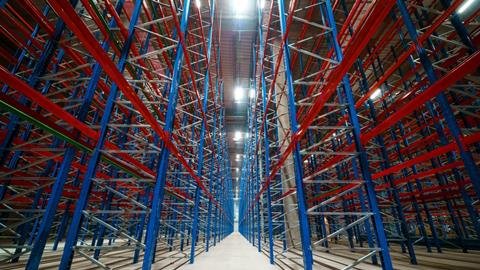

A 50% increase in the height of warehouses over the last 20 years has been driven by the growth in e-commerce and a need by operators to manage larger inventories with greater efficiency, according to a new report.
The average clear height of UK warehouses over 20,000 sq ft has risen from 7.6m to 11.5m and is due in large part to occupiers’ need to minimise costs while maximising operational efficiency, property firm Knight Frank said.
It added that as land and labour costs continue to rise and automation becomes more affordable, the economic case for building upwards rather than outwards will strengthen.
Knight Frank said the increase in national minimum wage and NI contributions meant that the salary and tax costs of employing a 21-year-old on minimum wage working 35 hours a week had increased by 61% in the past five years.
This supported the case for adopting automation systems within warehouses instead and, by extension, relying on taller structures.
The property company said rising land costs also made vertical expansion more cost effective.
A shift to online retail had changed how goods were now stored and processed, with warehouses used for order fulfilment and not just bulk pallet storage.
This necessitated more efficient, high-density, high-velocity storage solutions and taller structures enabled significantly greater pallet capacity by accommodating multiple levels of racking within the same footprint.
Johnny Hawkins, partner at Knight Frank, said: “Height is increasingly a defining feature of logistics facilities, playing a key role in driving value and performance.
“For investors, taller buildings can improve income resilience, support long-term value growth and reduce obsolescence risk.”