







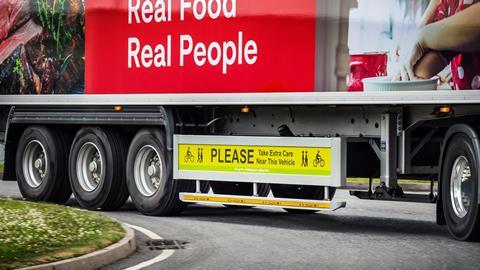

A device designed to close off the gap between axles on HGVs and still allow clearance when crossing uneven ground or speed humps is now available to operators.
Twomey Precision Engineering said its RotaRail created an extra barrier against the risk to vulnerable road users, such as cyclists and pedestrians, of becoming caught under the wheels of a truck.
Legislation dictates that most trucks over 3.5-tonnes must be fitted with lateral protection devices, which partially cover the area between front and rear wheels, below bodywork.
However, to enable clearance crossing uneven ground, these still leave a gap of up to 500mm between the lower edge and the road surface.
Twomey said RotaRail’s hinge mechanism allowed it to swing backward or forward to avoid obstacles before returning to its locked vertical position.
MD Ronan Twomey said: “The idea for RotaRail came about through conversations with a group of friends, all of whom are involved in the transport industry.
“We were all aware that the gap between a vehicle’s axles poses a serious risk to vulnerable road users – including pedestrians, cyclists, parents with prams and others.
“Unfortunately many of us have heard of, or even witnessed, incidents where individuals have become entangled in this exposed space.
“UK government research into annual incident figures shows that, alarmingly, more than 2,000 people per year are seriously injured in accidents involving transport vehicles – and there are well over 300 fatalities.”
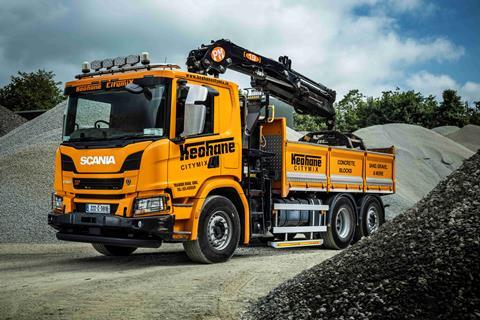
Twomey said the extra rail added to the lateral protection device reduced the gap to the road surface down to 220mm and added that a series of reviews and refinements to the initial design have created a product which has been proven to work: “RotaRail has undergone rigorous independent testing by the Transport Research Laboratory in Wokingham and it has also been in service with operators in the UK and Ireland, including a large London-based building materials supplier and a major Irish foodservice provider, for several years.”
He added: “This extended trial in real-world conditions has helped us not just to confirm the basic effectiveness of the product, but also to make some key improvements to the design and materials to reduce weight and improve durability.”