
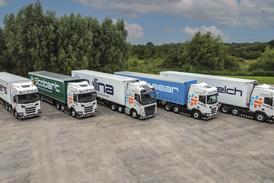








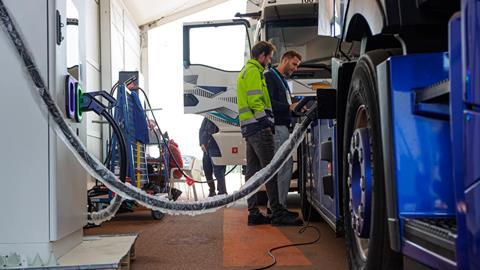

Six of 36 electric truck and charger combinations ran into trouble when their charging power was adjusted automatically in Dutch tests. Four failed to restart after a pause and two stopped when they should have carried on.
When hauliers invest in smart charging, they probably don’t expect to have to babysit it. But if a charging session pauses overnight and never restarts, they could wake up to a truck that’s nowhere near ready for work.
The tests followed problems already identified by a Dutch heavy-duty charging project, including interrupted charging sessions and differences in the power delivered by particular truck–charger combinations. Some had failed to reach their advertised maximum charging power.
To investigate these issues, Dutch charging research organisation ElaadNL and government agency Rijkswaterstaat tested trucks from BYD, Iveco, MAN, Renault Trucks and Terberg along with charging equipment from several manufacturers.
During the experiments, conventional charging worked in all 36 combinations, with power flowing 27 seconds on average after authorisation and 63 seconds at worst. The problems appeared when the testers imitated a depot energy management system by pushing power limits up and down. Thirty combinations coped but the other six did not.
Delayed starts were a weak spot too. In an overnight test, two of the four chargers could not begin a session when the power limit was initially set to zero, so a late start could not be scheduled. All four could pause a session already under way, though most continued drawing around 1 kW to keep it alive and prevent the connection from going into sleep mode.
One concern the researchers wanted to investigate was whether a truck might effectively fall asleep during a lengthy charging pause. Its electronic control units could enter sleep mode and then fail to wake up when the charger tells the vehicle to resume charging.
Drivers and fleet managers also get little help working out why a truck is charging slowly. Stations show that power has dropped, but neither they nor the trucks say whether the vehicle, the charger or the grid is the limit. Maximum power was not always reached either, because current was the limiting factor and the power delivered depends on battery voltage. One truck could not end a session from the cab at all, which the report says should always be possible.
The tests were run under controlled conditions, so they say nothing about how often these failures happen in daily operations. What they do show is that a truck and charger that start a session without fuss may still struggle once a schedule is involved.