




Maritime Transport is set to be one of the most influential fleets in the UK as the logistics industry moves to reduce emissions. The company is part of three of the four ZEHID consortiums: eFREIGHT 2030, Electric Freightway and ZEN Freight. To understand Maritime’s position on decarbonisation and its involvement in ZEHID, Freight Carbon Zero spoke with deputy CEO, Tom Williams.
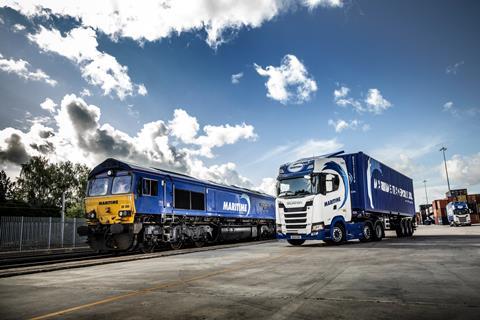
This year marks Williams’ 15th anniversary with the business having worked his way up through a variety of different roles before securing his most recent appointment in 2023. With a strong background in the intermodal side of the company, Williams’ approach to sustainability encompasses rail and road operations.
“If we look at the strategy of the business, it’s to be pragmatic and continually try to improve and explore new technologies and new opportunities,” Williams says. “Also, decarbonisation doesn’t just have to be alternative fuels, certainly not today, because we’re still so early in that transition journey.”
A key part of Maritime’s holistic approach is to utilise rail where possible. Williams says: “Our use of rail has grown significantly. In 2019, circa 8% of our road moves involved rail. Fast forward to today, we’re at just under 30% of our journeys now include some form of rail. So that is a huge transition for the business, and it’s reduced our emissions significantly.” Another side benefit of rail is the potential to ease pressure on truck drivers amidst shortages in the industry.

Williams adds: “Trains are already priced into the supply chain because they’re used by our customers today. When you look at an electric or hydrogen fuel cell truck, the cost impact could be massive. If you can use a train to complete the majority of a journey, and complement it with an eHGV to do the first/final mile of the journey, then whilst the price will increase, it is mitigated, and the emissions will be significantly reduced.”
To help reduce emissions in its diesel fleet, Maritime is using responsibly sourced HVO. “We know it’s second life cooking oils, for example, so we’re not contributing to deforestation of palm. We’re starting to use HVO as there isn’t a huge cost differential between diesel so our customers won’t be significantly impacted,” Williams explains. “It is little things like this that we are doing today as pragmatic steps in addition to operational excellence ensuring fewer empty miles and better utilisation of the asset.”
ZEHID progress
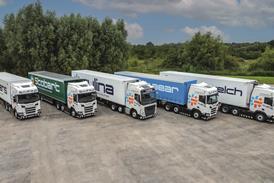
Planning out how to reduce emissions across a fleet of nearly 1300 6x2 tractor units is a massive undertaking. The ZEHID programme will be a huge learning experience with 56 new eHGVs joining the fleet. Maritime will take on 18 eHGVs under the eFREIGHT 2030 consortium, 20 as part of Electric Freightway and 18 in the ZEN Freight consortium.
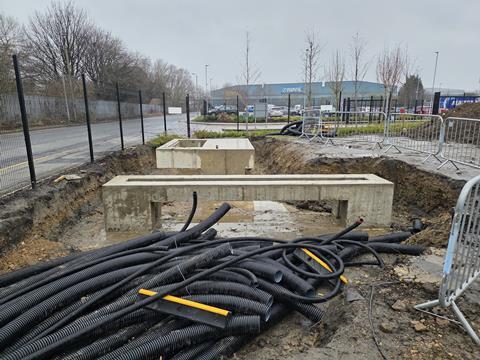
To support the new eHGVs and other hauliers in the consortiums, Maritime plans to partially electrify 12 of its depots. “They will cover as far south as Southampton, all the way up to Mossend near Glasgow. To the west it extends to Avonmouth and to the east, Felixstowe,” Williams says. Charging capabilities will range from 100kW to 400kW with readiness for megawatt charging.
With fast charging facilities installed, Williams hopes to be able to double shift the trucks running in and out of rail heads by quickly charging in between driver changes. For the trucks operating on one way routes, the vehicles are more likely to be charged overnight ready for the next day.
“By the end of the year, I would expect us to have roughly 40 electric trucks on the road and have seven or eight depots electrified out of the 12. I think a big chunk of the project will be delivered before the end of the year so we’ll be the first operating at scale across the consortiums,” he says. Charging infrastructure at Wakefield and Tilbury is expected to be installed by the end of April. Rail heads at Tamworth and Manchester will be the next to receive an electrified upgrade.

Challenges and opportunities
Once the trucks and infrastructure are deployed, the aim of the ZEHID project is to push the capabilities of the technology to the limits to showcase how these vehicles can be utilised. Considering the current makeup of Maritime’s transport movements, Williams says: “On the distribution side, a lot of our customers move food and drink. The cargo is typically heavy and a lot of the routes are one way, so we believe electrifying that business is going to be difficult.”
As infrastructure starts to pop up at depots across the UK, Williams believes it will be easier to arrange movements where vehicles travel to and from locations with charging. He sees the logistical complexities and cost of public charging prohibitive. “The charging infrastructure is really important. The best option is your depot. The second best option is to do a partnership with a local company and use their chargers, it’s this idea of semi public charging. For me we will only use public charging when we absolutely have to.”
On the container side of the business, Williams predicts it will be much easier to transition to eHGVs with the help of rail freight. “The UK is a consumer nation so the majority of what we do is import goods like clothing, furniture and white goods which aren’t going to be very heavy,” he says. “Cargo weight is fine and typically because we let the rail do the long haul, the trucks can do the short haul. The majority is back to base. So, it’s a round trip, it’s a good cargo weight and the distances are not huge, which is everything you need for an electric truck.”
While there are some routes that eHGVs can easily be deployed on, Williams says, “The operational challenge comes when you’re trying to do exports. This country exports a lot of recyclables like paper, cardboard, metal, plastic, and typically with this low value commodity, you’ve got to ship as much of it out as possible making the containers heavy. Where we would use one truck to do an import and then an export, we may not be able to do that, and that lack of utilisation will impact cost, and that’s going to be a challenge.”
Overcoming these challenges as an industry will take collaboration with other logistics providers and software companies to share insights. Visibility over state of charge and the impact of towing different weights will be key to effectively plan and manage electric fleets.
Williams adds: “It could even allow us to request smaller batteries if we see the average number of miles a type of truck does is less. We could charge more frequently and use a lighter battery that makes the truck weigh less so we can take more payload. There’s many different variables to look at but data will inform future decisions.”
What can the government do to support operators?
It goes without saying that introducing electric trucks is currently a very costly exercise. Williams says: “I think the government has a massive part to play. The plug-in truck grant is £25,000 for a certain number of trucks and if you don’t like those trucks then there’s no subsidy for your truck of choice. And, that £25,000 doesn’t even touch the sides.
“My real hope is that ZEHID gives some great data that the government can look at and see where they need to pump money in to get some quick wins. I’m hopeful that ZEHID will help inform legislation and subsidies and whatever else it can do because that will really help. Hopefully the government can change the permissible weights as well because that’s the other big challenge. If we want to replicate diesel, they need to allow us to pull more weight - 44 tonnes on a 4x2 tractor, and 48 tonnes on a 6x2.”