








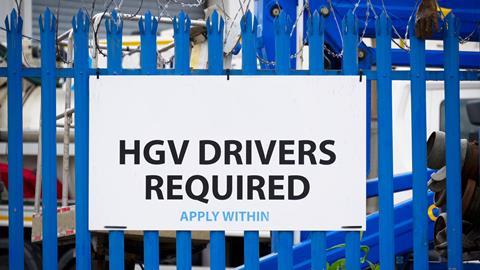

The government is axing its HGV driver training programme after just three years, despite the ongoing HGV driver shortage crisis.
The 16-week Skills Bootcamps programme was launched in 2022 and since its inception over 20,000 new HGV drivers have been trained and employed as a direct result of Skills Bootcamps
The decision to axe the programme, despite concerted lobbying against the move by the Logistics Skills Network, means existing contracts with training providers for Skills Bootcamps will not be extended.
All driver training must be completed by 30 September, which means recruitment has now stopped with thousands of applications being turned away.
The Department for Education (DfE) has ruled that any future Skills Bootcamps programmes will be commissioned by devolved authorities.
However, The Logistics Skills Network is warning that of the 12 established mayoral combined authorities only three currently have any funding allocated to HGV Skills Bootcamps – London, Liverpool and the North East. None of the others have announced any plans to commission any new HGV programmes.
David Coombes, The Logistics Skills Network chair, said: “This leaves a situation where for most of the country the only funded HGV driver training is through an apprenticeship which requires learners to be employed for the 12-month duration of the programme.
“The Skills Bootcamps offered unemployed people and those wanting to change career a chance to gain an HGV licence and move up to a better paid job in the haulage sector.
“DfE research shows that 72% of HGV Skills Bootcamps completers have moved into gainful employment earning on average £13,000 a year more than the National Living Wage.”
Coombes said the Logistics Skills Network has warned that the axing of Skills Bootcamps could quickly lead to a spike in the driver shortage, adversely affecting economic growth.
“It will also give rise to a catastrophic reduction in training capacity which will constrain the country’s ability to deliver any large-scale HGV driver training programmes for the foreseeable future.”
“The economy may not have the transport infrastructure it needs to deliver the government’s growth ambitions – including the delivery of building materials for 1.5 million new homes,” he warned.
Recently, the RHA published a report that estimates the future demand for new HGV drivers at over 40,000 a year just to maintain current levels.
The DfE decision also endangers the future of many training schools. The Logistics Skills Network has recently conducted a survey of training schools and identified that nearly all of them are involved in HGV Skills Bootcamps delivery to some extent and for 36% of them the HGV Skills Bootcamps represent over half of their income.
Coombes said: “These providers may now be forced to sell off their training vehicles and lay off instructors and undoubtedly, many will be forced into closure.
He added: “Without the hoped for Skills Bootcamps contract extension there will be a deficit of at least 15,000 new HGV drivers to replacing drivers leaving the sector each year.
“The impact of this would be 150,000 tonnes of freight per day, not collected nor delivered. It will also create a critical gap in training provision and disrupt the supply of newly qualified HGV drivers,” he warned.
RHA also expressed concern at the DfE’s decision this week.
Sally Gilson, RHA skills policy lead, said:“The bootcamps have proven to be hugely popular, giving both learners and employers a more flexible training option.
Ahead of the Spending Review, we’ve been lobbying the Treasury to continue investment in skills which will help attain the government’s ambitious housing targets.
“The stated aim of the new Growth and Skills Levy is to provide greater flexibility. Allowing employers to utilise funds for training schemes such as bootcamps would enable them to avail of flexible training options that work best for them and the learner.”
She added: “The RHA driver report calculated that 40,000 new drivers will be required each year for the next five years to maintain the current workforce, keep up with demand and future proof the sector. Continuing courses such as HGV skills bootcamps would help us achieve that.”