









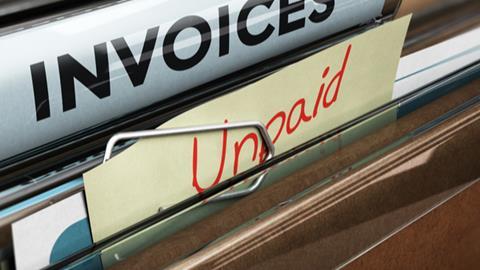

The RHA has welcomed government plans to crack down on late payments, which aim to cut the maximum payment time down to 45 days and introduce mandatory interest charges for late payers.
Under the government’s Time to Pay Up strategy, announced last week, the Small Business Commissioner will be given new powers to carry out spot checks and enforce a 30-day invoice verification period to speed up resolutions to disputes.
The upcoming legislation will also introduce maximum payment terms of 60 days, reducing to 45 days, giving firms certainty they’ll be paid on time.
Audit committees, under the proposals, will also be legally required to scrutinise payment practices at board level, placing greater pressure on large firms to show they’re treating small suppliers fairly, backed by mandatory interest charges for those who pay late.
Richard Smith, RHA MD said late payments impact businesses throughout the supply chain, including many of RHA’s members.
Pointing to research by the Federation of Small Businesses, which found that late payments cost the UK economy £11bn annually and shut down over 38 firms every day, Smith said: “Late payments are one of the biggest barriers to business growth.
“We’ve continually argued that these antiquated payment terms pressure businesses who must pay for fuel, maintenance, and wages upfront.
“These new reforms, particularly the legal cap on payment terms and increased oversight, directly address those concerns, and this is to be welcomed.
“Companies across our sector are run by working people. Many are smaller, medium-sized firms, often family-owned and economic anchors in their communities. These businesses cannot afford additional costs.”
Smith also put in a call for greater government consultation with the sector to ensure the strategy is effective.
He said: “If implemented and enforced effectively through continued dialogue with industry, these plans could go some way to significantly improving financial resilience.
“As the Autumn Budget approaches, businesses want clarity and certainty through ongoing engagement. Investment is the lifeblood of the economy.
“To encourage business investment, firms need conditions that allow them to thrive, conditions best developed through partnership between government and industry. This work continues and we’ll be engaging with ministers in the weeks and months ahead.
“Ensuring businesses are paid on time and creating conditions where everyone has a chance to succeed are crucial priorities for companies, communities and the economy.
Looking ahead, Smith added: “There’s much work to do, but this is a good start from government, and an important stepping stone in the process of kickstarting economic growth through collaborative policymaking.”
Good Business Pays produces a six monthly Late & Slow Payment Watchlist based on government data.
Its latest report, published in March 2025, revealed that Ceva Logistics was classed as a “serial late payer” taking an average of 79 days to pay with 51% of invoices not paid within agreed terms.
Boughey Distribution was classified as a “late payer”, taking an average time of 51 days to pay suppliers, with 83% of invoices not paid within the agreed terms.
Other late payers included on the list were Arla Foods, taking an average time of 52 days to pay,d with 63% of invoices not paid within the agreed terms, Travis Perkins also features, taking an average of 47 days to pay suppliers and having 59% of invoices not paid within the agreed terms.