



Hundreds of road deaths each year are caused by the inadequate protection provided by rear impact guards on trucks and trailers, EuroNCAP has revealed this week.
Consumer association Euro NCAP issued the warning following a major testing campaign that exposed critical vulnerabilities in both structural safety guards fitted to the rear of trucks and trailers and vehicle crash-avoidance technology.
The investigation, which was was initiated and supported by the UK’s National Highways, examined trailer rear underrun impacts – collisions where, in some circumstances, a passenger car slides beneath the back of an HGV. This crash type is linked to around 400 fatalities across the EU and UK every year.
By conducting real-world track tests alongside crash testing at international research facilities, Euro NCAP has exposed a double-failure in road safety: the physical safety guards fitted to the back of trucks and trailers are failing to stop cars from sliding beneath them in some circumstances when a crash occurs, leading to significant injuries and fatalities. and sensors of some older Advanced Driver Assistance Systems (ADAS) are failing to see trailers.
Yet in North America, a superior solution that can prevent deadly rear underrun impacts already exists and is fitted to most new trailers.
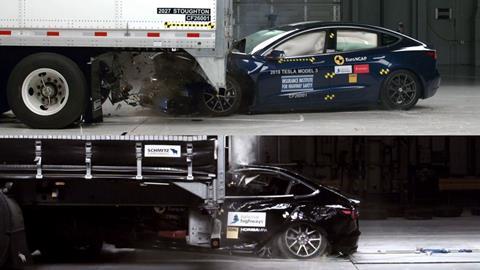
To evaluate physical guard strength, Euro NCAP and its international partners in Germany, the UK, Sweden and the US took a popular passenger car that carries a five-star Euro NCAP safety rating and subjected it to crash testing into the rear of trailers with different RUPS solutions.
In the UK and Germany, it was tested using trailers built to Europe’s latest mandatory standard, UN ECE R58.03 (enforced since 2022). In the US, it was tested using trailers that meet the voluntary IIHS TOUGHGUARD standard. To perform the crash testing, the cars’ ADAS systems were deactivated.
Two different commonly used trailers were selected, both fitted with the regulated rear underrun protection system designed to protect car occupants when a car runs into the back of the trailer.
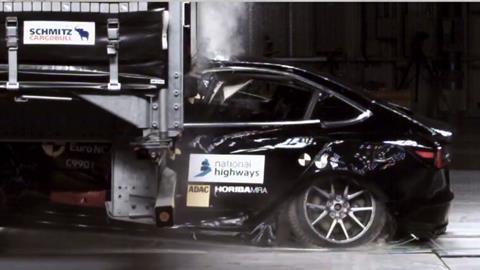
The outcomes were severe. In a 56 km/h (35 mph) passenger-side 30% frontal offset crash performed at HORIBA MIRA, the guard fitted by trailer manufacturer Schmitz Cargobull offered little structural resistance.
The trailer bed sliced directly through the passenger compartment, tearing the side out of the vehicle structure, and inflicting fatal head and neck injuries to the crash test dummy.
In a subsequent 75% frontal-rear impact conducted at the same speed by Germany’s ADAC, the Krone Trailer’s rear underrun bar failed, and the test car’s occupant compartment was destroyed, resulting in no protection for the driver or passenger.
Both crash tests showed that the high-performing crash structure of the car could not deform and protect the occupants as designed due to the poor impact resistance of the rear underrun protection structure. This reveals that the current R58.03 European regulation could be improved significantly and is currently not fit for purpose.
A viable engineering solution that would help prevent such crashes occurring already exists. When the same make and model of Euro NCAP’s five-star car was subjected to the same 56 km/h (35 mph) offset impact against a trailer built to the voluntary IIHS TOUGHGUARD standard in the US, the guard allowed the car’s safety structure to deform and protect the occupants as designed.
Since its introduction to the US market, in 2017, it is estimated that 70% of the latest trailers on the road are now fitted with TOUGHGUARD-rated rear underrun devices. In the EU and UK, meeting this life-saving standard requires adding reinforcement to the trailer.
The research also exposed flaws in the ability of older ADAS systems to identify stationary trucks and trailers. To measure the performance of modern Autonomous Emergency Braking (AEB) systems, Euro NCAP compared vehicle performance against the standard Global Vehicle Target (GVT) and a fleet of real commercial trailers under varying real-world conditions. All tested passenger cars’ ADAS systems featured both camera and radar sensors.
When driven toward the standard laboratory GVT used in all manufacturer tests, the test vehicles successfully detected the threat all the time. However, when tested against real HGV rear-ends – such as curtainside and skeletal trailers, and impact protection vehicles used in roadworks (IPVs) – the detection rate fell in several cases.
The testing highlighted a divide between the latest generation of ADAS systems compared with previous generations. And with the average age of cars on the road continuing to rise, it will take more than 15 years before most cars are able to avoid stationary trailers, NCAP is warning, hence the need for improved crash protection today.
When both a driver and vehicle ADAS systems fail to detect a trailer and avoid a collision, it is then the role of the trailer’s Rear Underrun Protection System (RUPS) to prevent a potentially fatal type of collision where the car slides beneath the trailer structure, known as a rear underrun.
Following its findings, Euro NCAP is calling on EU and UK legislators to implement changes to the R58.03 legislation, which would mirror those of the US IIHS TOUGHGUARD voluntary standard.
Euro NCAP is also urging trailer manufacturers to proactively introduce voluntary upgrades and retrofit solutions for existing fleets that could save lives.
Euro NCAP also strongly encourages truck fleet operators to request trailer manufacturers to install retrofit solutions for existing trailer structures to replace the thousands of inadequate, legacy guards currently operating on roads throughout the EU and UK.
Matthew Avery, EuroNCAP strategic development director, said: “International research has revealed the devastating flaws of the rear safety guards fitted to the hundreds of thousands of trailers and trucks operating throughout Europe and the UK.
“This is grave cause for concern. We have spent decades improving the safety of passenger vehicles, but those structures and restraint systems are rendered inadequate in the event of a trailer rear underrun, which is why we are seeing such a high fatality rate associated with this type of accident. And that is unacceptable.
“The legislation behind Europe’s truck and trailer safety needs to be updated as a matter of urgency to help prevent this type of impact that can prove potentially fatal.
“The good news is that the template already exists in the US with the IIHS voluntary TOUGHGUARD standard; the sooner the rear impact guards on Europe’s and UK’s trucks and trailers are updated, the better so future lives can be saved.”