




There is a ‘significant’ risk that the heavy goods vehicle (HGV) sector will lag behind its planned trajectory to reduce its carbon emissions, the government admitted in its response to the Climate Change Committee’s (CCC) latest advice on future carbon budgets.
As required by law, the government was responding to the CCC’s advice on the seventh Carbon Budget period (ie 2038-2042). UK Carbon Budgets are designed to successively restrict the UK’s carbon emissions to meet its target of net zero emissions by 2050. The government published a Green Growth Plan alongside, setting out the existing and potential new policy measures that would deliver the reduction in emissions. It highlighted support for HGVs in the form of new vehicle purchase grants, depot infrastructure funding and funding to research, develop and demonstrate zero emission technologies at scale, promising “funding of up to £200 million for the Zero Emission HGV and Infrastructure Demonstrator programme”.
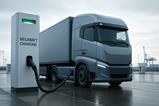
It said HGVs were responsible for 16% of domestic transport emissions in 2023 and admitted, “The market and policy framework for the transition to zero emission HGVs is less mature than for cars and vans, and new zero emission models remain two to three times the price of diesel equivalents.” In addition to costs and charging deployment barriers, fleet operators have concerns about ranges and technology options (for both battery electric and hydrogen fuel cell technology options). The government said, “Market nascency means risks to our assumed trajectory are significant” with infrastructure still a challenge, such as charging points that meets operators’ needs, including at depots.
The plan named heavier applications in the road vehicle sector, along with the aviation and maritime sectors, as having technologies still in development or that are not yet available at scale. The government said it was planning to consult on regulatory options for phasing out the sale of new non-zero emission HGVs and it is “developing a zero-emission HGV and coach infrastructure strategy to provide industry with certainty”. Some bus depots have opened their charging facilities to eHGV partners and the government highlighted the Bus Services (No. 2) Bill which would end the use of new non-zero emission buses (ZEBs) on registered local bus services in England, expanding the number of bus depots with charging facilities.
On the likely timetable, the plan said the government would be “consulting on our regulatory approach to reduce CO2 emissions from new non-zero emission HGVs and to phase out the sale of new non-zero emission HGVs up to 26 tonnes by 2035, with all new HGVs being zero emission by 2040”.
The plan had little to say on hydrogen for transport, but referring to heavy goods, maritime and air transport government said it was “aware that the low carbon fuels that will play a role in reducing emissions from these modes of transport during the Carbon Budget 6 period [ie 2033-2037] will be in increasingly high demand globally, with associated risks to supply for UK transport”. The plan said “Government is implementing policy and funding the research, development and demonstration of clean transport technologies to mitigate these risks and position the UK to capture a share of growing global markets.”
On biomethane, it promised “potential future support” in the form of a “policy framework to deliver increased production of biomethane and associated carbon savings, subject to consultation”. The measure will follow the current Green Gas Support Scheme and aim to increase the amount of biomethane injected into the gas grid.