





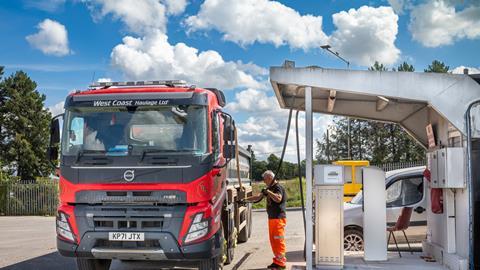
Chancellor Rachel Reeves has confirmed that fuel duty will remain frozen for now, extending the current 5p-per-litre cut only until September 2026 - before beginning a staged reversal that will see duty start rising for the first time in 16 years.
The Treasury plans to unwind the 5p cut from late 2026, with fuel duty then increasing annually from April 2027 in line with RPI. Fuel duty has been frozen since 2011, a strategy the OBR says has cost the Exchequer £120bn in foregone income.
The Road Haulage Association said the decision to restart annual increases risks piling pressure on operators already battling rising costs.
“The Chancellor’s decision to reverse the 5p cut after September 2026 and increase fuel duty with inflation from April 2027 will be a hammer blow for many businesses and push up the cost of living for families across the country,” said RHA MD Richard Smith.
He welcomed the short-term extension of the freeze but stressed that future rises “loom large for families struggling with the cost of living and for the many small businesses who keep our supply chains moving”.
Logistics UK described the decision as an “inflationary timebomb” that threatens to choke economic recovery.
Acting chief executive Kevin Green said heightened fuel duty would mean “hundreds of millions in increased taxes for logistics businesses… fuelling inflation across the economy”.
He added: “Increasing the tax burden on our industry shows a disregard for a sector that generates £170 billion for the UK economy, employs over 8% of the workforce and is key to the growth agenda. We urge the Chancellor to reconsider at the earliest opportunity.”
Other fleet bodies also called for a rethink of the government’s strategy. The Association of Fleet Professionals (AFP) said the staged rise from September 2026 was “unexpected and definitely unwelcome” at a time of squeezed budgets, urging the Chancellor to rethink the measure. The group welcomed the rollout of a national “fuel finder” in 2026 but warned it would not offset the broader cost impact.
FairFuelUK founder Howard Cox praised the extension of the freeze but cautioned that rises later in the decade risk undermining consumer confidence and stoking inflation.
The Budget also confirmed that the UK will introduce road pricing for electric vehicles from April 2028, but crucially, electric vans will be exempt, softening the impact on the commercial vehicle sector.
Under the plans, private electric cars will face a 3p-per-mile charge, while plug-in hybrids will pay 1.5p. Both will increase annually with CPI and sit alongside standard VED.
What it means for electric trucks and vans:
- Electric vans: exempt from pay-per-mile, following Treasury acknowledgement of the need to maintain fleet confidence.
- Electric trucks: not explicitly addressed in the statement. Current policy suggests heavy goods vehicles will remain outside the system initially, though industry groups expect a future consultation on how — and whether — mileage charging will apply to zero-emission HGVs as adoption increases.
- Industry concern: fleets stress that any future scheme must avoid slowing the shift to zero-emission logistics.
The AFP added that the 2028 introduction of mileage charging had long been expected, but urged the government to ensure the system “shouldn’t arrive in a form that could hamper electrification or cause hesitation among potential business and private EV buyers”.
The Chartered Institute of Logistics and Transport (CILT UK) said the move “must form part of a coherent, long-term national strategy” and warned that fragmented or short-term measures risk undermining decarbonisation.
CILT UK policy director Daniel Parker-Klein said the UK needs “a clear, integrated plan” for funding roads and transport as fuel duty revenue declines, and stressed that logistics operators require predictability to support investment in electric fleets and infrastructure.
Aegis Energy CEO Michael Shaw said exempting electric vans was essential: “Any additional tax burden could have discouraged businesses from investing in cleaner vehicles at a time when confidence is critical.”
He added that a well-designed system could support “a modern and mature” EV market for commercial transport.
With the sector still overwhelmingly diesel-powered and government pushing aggressively toward decarbonisation, operators say they need clear signals, predictable taxation and a joined-up strategy if they are to invest confidently in zero-emission trucks and vans.