










Trade association EnergyUK has claimed that electrifying the HGV market could save fleet operators £2.3bn per year, compared with diesel, but only if policy changes are made to reduce the cost of electricity and fleet operators can benefit from using flexible charging arrangements.
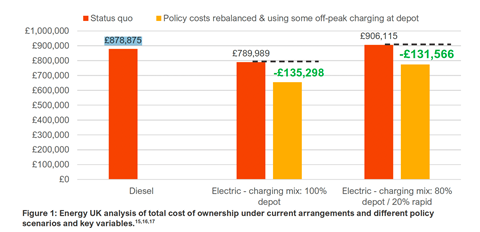
In a new report, Driving electrification in the road freight sector, EnergyUK calculated the total cost of ownership (TCO) of a diesel HGV at £878,875, under the status quo. To run e-HGVs, it estimated the TCO at £906,115 if charging was split between the depot (80%) and fast-charging on route (20%), and £789,989 if charging was all at the depot. If policy changes were made that would relieve the burden of policy costs on business customers, and minimise network usage costs, the TCO figures were lower by £131,566 (to £774,549) for mixed charging and by £135,298 (to £654,691) for all-depot charging. That translated to an economy-wide saving of £2.3bn, it said.
EnergyUK assumed annual mileage of 125,000 for both diesel and electric and total annual freight mileage of 19.5bn km; an eight-year life and £150,000 upfront cost for diesel HGVs; and a nine-year life and a £270,000 upfront cost for eHGVs. It also assumed VAT is reclaimed and not paid for both diesel and electricity used to charge.
However, EnergyUK said that to grow beyond the current uptake of eHGVs targeted financial incentives are essential. It said the government must move beyond high-level emissions targets to short-term interventions which drive market adoption.
The charging network
Necessary interventions included a clear strategy to deliver the charging infrastructure needed. EnergyUK said that in addition to £30 millions of funding for a depot charging scheme, targeted government support for eHGV charge points is required in areas that are not commercially viable for private investment alone, and sustained support will be needed to scale beyond pilot projects.
It suggested targeting investment at key hubs on key routes (East Midlands, the Northeast, Bristol) to enable optimised network upgrades, saying the National Wealth Fund should be used to ‘crowd in’ private finance. The investment should be de-risked through shared infrastructure agreements and leases that incentivise landlords to install and share charging.
Electricity should be included in the Renewable Transport Fuel Obligation (RTFO) to provide charge point operators with a market-based mechanism to fund infrastructure rollout. The Government should also consider options being developed by the Green Finance Institute to help SME fleet operators cover upfront costs. It should make sure the site offers smart charging and, where possible, incorporates options such as batteries and on-site solar generation.
It should undertake detailed modelling to understand the electricity network upgrades required and feed the results into Regional Energy System Plans, and it should make sure there is consistency between the process and cost in different regions.