







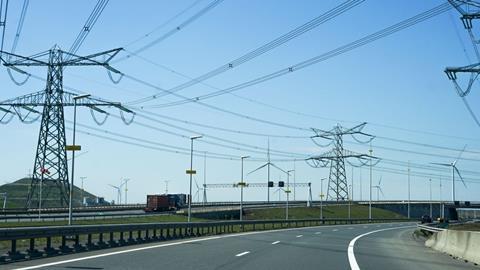

A new training course for lorry drivers covering the dangers of overhead cables has been launched to address the lethal hazard.
E-Training World said cables and HGVs were a hazardous combination because high-sided vehicles, tipping trailers, cranes and other tall equipment can easily come into contact with live power lines.
Even approaching a cable can cause an electrical arc, leading to severe injury, fire, or fatalities.
Last year UK Power Networks requested farmers and landowners warned hauliers about any overhead cables on their sites.
Its call followed the death of a skip driver in the east of England, which occurred when part of the driver’s vehicle was raised and came into contact with overhead lines.
Farming and road haulage contributed to 30% of all overhead line accidents in the East and South East regions in 2024 and two people are killed across the country every year.
E-Training said it was essential HGV operators planned routes, knew vehicle heights and followed GS6 safety guidance to avoid accidental contact.
Its online driver training module is designed to train drivers on the potential risks and provides clear, practical guidance on what action to take if they suspect they may have been impacted by an overhead cable.
Graham Hurdle, MD of E-Training World, said: “Drivers often underestimate just how invisible overhead cables can be.
“They blend into the sky and are harder to spot in rain, fog or low sun. When a driver is focused on the load or the task ahead, it’s easy to overlook what’s above. That moment of distraction is all it takes to enter a dangerous zone.
“Weather, temperature and even the age of the cable can all affect how high a cable sits.
“A line that was safe last week might be lower today, and that small change can be enough to put a driver and their vehicle at risk.
“Employers must equip their HGV drivers with the skills to react in a potentially life-threatening situation if their vehicle makes contact with a power line,” he added.
“Staying calm, staying inside and keeping others away can save lives.”