









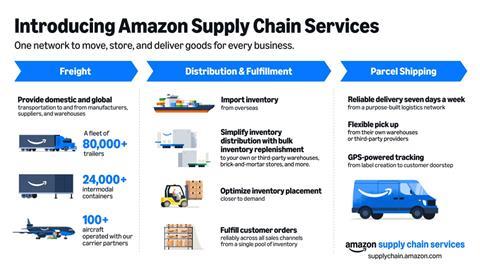
Amazon has launched Amazon Supply Chain Services (ASCS), opening its global freight, distribution, fulfillment, and parcel shipping capabilities to businesses of all types and sizes, in a move which has sent shock waves around the logistics market.
The launch sees Amazon expand its third-party logistics capacity to support businesses in industries such as healthcare, automotive, manufacturing, and retail.
Brands including Procter & Gamble, 3M, Lands’ End, and American Eagle Outfitters have already signed up to the service, which sees them use Amazon’s logistics network across their supply chain.
The move has already seen supply chain stocks tumble in the US, with UPS and FedEx falling by over 8% following the announcement.
Peter Larsen, ASCS vice president, said: “Amazon is bringing the infrastructure, intelligence, and scale of its supply chain services—proven over decades—to businesses everywhere, much like Amazon Web Services did for cloud computing.
“Supply chain wasn’t just a function at Amazon—it was core to providing an exceptional shopping experience. Our differentiator. The reason we could offer fast, dependable delivery that nobody else could. And with the launch of ASCS, we’re confident we can give any other business access to the same cost efficiency, reliability, and speed that we’ve built for Amazon customers.”
Amazon said Procter & Gamble is using Amazon’s freight services to transport raw materials to production facilities and move finished goods across its distribution network, whilst 3M is using Amazon’s freight services to move products from its manufacturing sites to distribution centers worldwide.
Lands’ End is using a unified inventory pool within Amazon’s network to fulfill orders across multiple sales channels and American Eagle Outfitters is using Amazon’s parcel shipping network to deliver online orders from its American Eagle and Aerie website directly to customers nationwide.
Andrew McLean, Lands’ End chief executive, said: “Amazon is one of our key ecommerce partners, and we’re excited to leverage Amazon Supply Chain Services to position inventory closer to customers so we can reach them even faster.
“This consistency is central to our solutions-based approach, enabling us to serve customers with confidence and agility, especially during peak seasons.”
The size and scale of Amazon’s operation could see competition on price intensify, particularly in e-commerce fulfilment and last-mile delivery, some analysts are predicting.
Amazon is also throwing down the gauntlet to 3PLs by targeting the same high-margin business-to-business logistics market, offering integrated solutions that include inventory management and end-to-end visibility.
However, on the upside, some UK logistics firms may benefit from subcontracting opportunities within Amazon’s expanding network, particularly in middle-mile transport and specialist services.
And Dylan Carden of equity research analyst William Blair questioned ASCS’ disruptive reach this week, pointing to numerous announcements from Amazon over the years, such as in the grocery delivery sector, which despite being hailed as game changing, have failed to live up to early expectations.