









Despite intense pressure on margins, UK transport fleets are still wasting thousands of pounds a year by failing to regroove and retread tyres properly, according to the fifth annual Vaculug Sustainability Forum, sponsored by Hankook and Hireco and supported by Volvo Trucks.
Introducing the forum, Vaculug chief growth officer Glenn Sherwood said that just 25% of the UK truck tyre market was made up of retreads, partly because of the influx of cheap new tyres from Asia.
“The UK annual retread market is 475,000 tyres, which is down 62% in the last 15 years,” he said. “US tariffs will see more cheap Asian tyres infiltrate the European market.”
While larger fleets often have better than average tyre management policies, Sherwood pointed out that the average UK fleet size was less than 10 trucks, and it was among the smaller fleets that awareness of the advantages of retreading needs to be raised.
Around 90% of the replacement tyres fitted to its 8,000 vehicles by truck and trailer rental operator Hireco last year were premium retreads – a total of 3,676 tyres.
Because they only use 70% of the virgin materials and energy required to make a new tyre, retreads reduce both costs and environmental impact, and perform just as well when it comes to mileage and grip. Retreads do not currently have to carry the ratings for noise, wet grip and rolling resistance required by EU law for new tyres, but in 2021 Vaculug launched its 385/65R22.5 Kinetik KT01, the first retread truck tyre that would achieve an A rating for rolling resistance.
With around half of UK operators working on what is classed as regional rather than long haul applications, the benefits of low rolling resistance tyres are however harder to realise than for continental operators running greater distances on long, straight highways.
Guy Heywood, vice president of Hankook Tire Europe, said that as well as low rolling resistance tyres, the autonomous vehicles of the future would also need connected tyres that used built-in sensors to communicate the state of the road surface to the vehicle, and these would be ready in the next two years.
Hankook has also developed a tyre specifically for electric vehicles which can destroy conventional rubber with their high torque output at low speed. While fewer than 5% of trucks on European roads were electric in 2024 he predicted that take up would increase as vehicle prices come down. “An electric truck costs twice as much as a diesel because of the batteries,” he said. “It will never be the same price as a diesel but prices will come down.”
He added that while BEVs were expensive, investing in hydrogen for road transport would be a “mistake”.
The UK has only 800 electric trucks on the road, most of them being refuse collection vehicles, and Heywood acknowledged that for the next “20 to 30 years” internal combustion engines would still power the majority of trucks.
“ICE will be around for a long time so we need to get back to basics,” he asserted. “Low rolling resistance tyres can save £210,000 per annum on a fleet of 50 trucks according to Bridgestone. Keeping tyres at the correct pressure can save 10% compared with under-inflated tyres - and around 10% of UK truck tyres are under-inflated.
“In the UK we only regroove 18% of our tyres and across the EU we only retread 20%. Most tyre manufacturers would retread at least 45% of the tyres on a managed contract to get the full value from the tyre.”
The tyre companies are researching alternative materials to make tyres that will be more sustainable. Around two thirds of the raw materials such as natural rubber used in today’s tyres are classed as unsustainable and these will have to replaced with sustainable products by 2050.
Particulate emissions from tyre wear will be included for the first time in the new Euro-7 regulations coming into force in July 2027, putting pressure on tyre manufacturers to reduce abrasion while also cutting rolling resistance.
Meeting this challenge will be assisted by the use of AI to digitally design tyres and 3D printing allowing more advanced tread patterns. “This ensures better wet grip later in the tyre’s life,” said Heywood. “It also keeps the tyre cool which reduces wear.”
Josh Spencer, EV and sustainability manager at DAF dealer Ford and Slater, told the forum that his customers were putting 60 electric vehicles on the road in the next six months as part of the government-funded ZEHID programme.
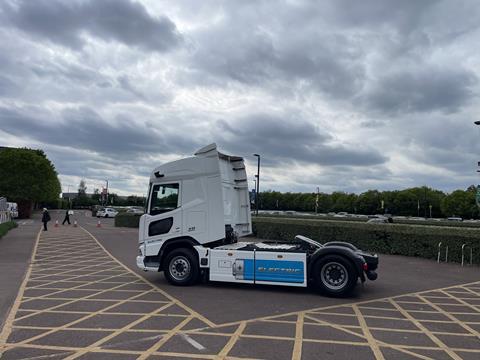
He had brought along a DAF XD 350e 4x2 electric tractor unit which attracted a lot of interest from delegates. Pulling 24 tonnes, it has a range of up to 500km and the cab is rated four stars under the London Direct Vision Standard. A range of power outputs from 170kW to 350kW and battery packs from 210kWh to 525kWh are available. The vehicle can DC fast charge at up to 350kW or AC charge at 22kW and DAF is putting in 180kW chargers at 35 dealerships which can increase charge by 40% in an hour and go from 20% to 100% charge in around three hours. DAF is also able to supply mobile chargers that connect to a standard 120A three-pin industrial socket.
More importantly to drivers, with torque outputs of 930Nm to 1,370Nm, “they will sail past V8s up hills”, according to Spencer.
He said that 25% of the 300,000 trucks sold in China last year were electric, and in comparison only 3,000 of the 300,000 trucks on EU roads are currently electric.
Depending on the cost of electricity used to charge electric trucks, Spencer said a typical operator could save around £2,000 a month on fuel costs by switching from diesel to electric.
“If we can move the lease cost of an electric truck to within £1,000 a month of diesel, we are there,” he said.
DAF uses batteries made by Chinese manufacturer CATL, which makes 40% of the batteries used in EVs worldwide. These are based on lithium ferro phosphate technology which requires no rare minerals such as cobalt, nickel or manganese and are robust and reliable in service.
“DAF warrants these batteries for eight years and 4,000 complete charging cycles,” Spencer said. “Based on experience with thousands of electric buses, they degrade at about 1% a year.
“Not a single diesel vehicle will be warranted for that life cycle.”