




New types of fuel cut down your emissions, but to cut them out completely you have to go electric. Scania explains the options and what operational changes do you need to make?

There is a lot of noise about the need to move to zero-emissions vehicle technology. But what does that mean? How are the legislators defining this technology? The phrase on its own seems fairly self-explanatory – however, there are various takes on it.
One thing is clear, though: all the options we have covered so far wouldn’t qualify as zero-emissions.
A zero emissions vehicle (ZEV) is defined as any vehicle using propulsion technology that does not produce carbon emissions while in operation.
Today, the most mature technology is battery electric drivelines. They are highly efficient and already we are seeing the technology mature, with the transition from heavy-duty vehicles designed for urban operations to the first generation of electric tractor units on the road.
Next on the horizon will be more variants as the truck manufacturers electrify their line-ups, with improvements made to the range and battery chemistry providing greater flexibility.
In addition, we will see the network of megawatt chargers begin to become available, with the capability of charging vehicles up to 1MWh in the future.
The other fuel source, hydrogen, is still in its infancy. While it is considered a promising energy carrier, the technology and supporting infrastructure is not as mature.
You can potentially use hydrogen in two ways. Either as a combustion fuel, which would produce a tiny level of emissions, or in a fuel cell set-up designed to power an electric propelled vehicle.
What muddies the water is that the former is considered by some European legislators as zero-emissions technology.
However, at the point of publishing, the main zero-emissions powered vehicle type you can buy is battery electric.
Battery electric vehicles
Available today are a variety of battery electric trucks, which in essence have one or more electric motors powered by charge held within the battery packs.
Truck manufacturers have gone about building their electric vehicles in a variety of ways.
Some have opted for the traditional chassis, propshaft and axle configuration, with their electric motors sitting where the traditional engine would have been. Others have opted to include a gearbox to regulate the torque curve and some have chosen to put an electric motor on each axle.
Even where the batteries are located differs by manufacturer. Some are where the diesel and AdBlue tanks currently reside. Others are accommodated between the chassis rails, and some lay the batteries out across the floor plan of the truck.
Despite all these variants, there are several commonalities that they all share:
• There is a range of e-motor outputs covering most of the traditional internal combustion engine range.
• There are variations of battery configurations, so you can opt to keep weight and cost down by choosing fewer packs, if it fits your operating window, or maximise range with more, if that’s important to your business.
• They are super-efficient compared with their diesel counterparts and offer an effortless and quiet driving experience.
• They can also be plugged into existing electric vehicle charging infrastructure.
• All are available with PTOs – most are electric and some are mechanical, to ensure you can still connect all the equipment you need to do your job.
• Finally, there are workshops and technicians ready to fix, repair and maintain these vehicles in the UK.
The biggest challenge for battery electric vehicles (BEVs) is not the vehicles or their capabilities. Already we have seen and proved that the technology is ready and making the switch is possible. But three things are hindering uptake.
As it is still considered maturing technology, compared with diesel and gas, there are some areas that aren’t in place today that will be in the future.
Currently, BEVs are considered more expensive than their diesel counterparts. And UK government incentives have been slow in coming, as the vehicles and the technology develop and become more mainstream.
Another issue is the supporting infrastructure. At a public level, there is not enough heavy-duty vehicle infrastructure in the UK. But there is rapid growth of such infrastructure in Europe and we expect to see similar growth in the UK soon, too.
This proposed infrastructure will be most beneficial to those operating long-distance operations. Most charging will be done back at base or at the final destination, in a similar way that many operations fill up with diesel or gas currently.
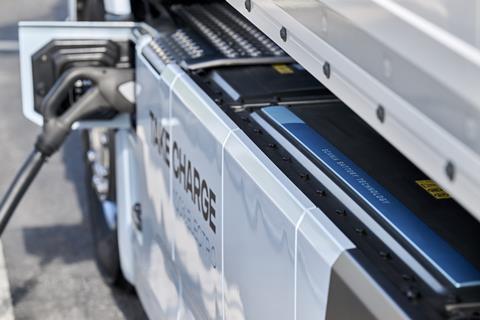
Whether you make the transition today or in the future, one thing that needs serious consideration is how to recharge your vehicle efficiently and cost-
effectively. This could be at your own sites, at operating locations or utilising other available infrastructure.
More tools to support you
Before you make your final decision on the vehicles you choose, there is more you need to take into account first.
This next section focuses on the other considerations and requirements you may need to account for or address to make your operations run more efficiently.
The first step is to do some route and operational analysis of your current vehicles – because better understanding of how they are used today will give you greater insight into how you can use them more efficiently tomorrow.
Another consideration is to assess the telematics and connected services available – because real-time data will be crucial for you to ensure these vehicles remain working hard for you, no matter how they are powered. This also leads into how you prefer to maintain and repair your vehicles to limit unnecessary downtime.
A requirement that will need careful due diligence will be your own supporting infrastructure. A publicly available infrastructure is nice to have but may not be easily accessible or efficient to use, meaning you will need to consider your own supporting infrastructure for refuelling or charging. With that comes a number of questions that may require some serious decisions to be made.
The final area is around being cost-¬effective – what to consider when assessing your finance and driver and fleet operator training options, or to assess whether there may be other opportunities to gain some additional revenues.
Let’s delve into these areas in a bit more detail.
Tailored services
There is no one-size-fits-all approach to decarbonisation. We have seen that already from the myriad of options available to you today when it comes to the fuel or power source for your fleet.
The same applies to the ancillary services you will need around you to support you from the start – and to be by your side at all times.
Making a change to the way you power your vehicles could prompt you to consider assessing how you use your fleet day-to-day, to realise potential efficiency gains – and even how you keep your fleet moving.
All these areas need to be considered, as they should be tailored around your ¬business and your needs.
This is why everything that follows – from operational analysis to infrastructure and finance – won’t be the same for everyone. Your chosen suppliers will be able to tailor a package to suit you.
Operational analysis
The promise from the manufacturers is to go beyond making and supplying great vehicles. The intention is to make sure you can approach decarbonisation and implement it in a manner and at a pace that suits your business and operation.
As soon as you have considered your first steps towards decarbonisation, the focus will quickly shift to a conversation about where you want to go and what you want to achieve.
This process is all based around your needs, your wishes and your prerequisites.
Whether you have an ambition to electrify or take small decarbonisation steps, there will be a way to achieve it in a way that suits your business. This is equally true whether you want to be at the forefront of the transition or following more cautiously behind. Either way, the planning phase is critical – so that you can stay in control.
Nothing shows a clearer picture of your operation than real data from your own vehicles. There is a variety of deep analysis tools that take into account all the vehicle data from your existing fleet to map out how you use your vehicles today. This assessment is designed to find efficiencies and solutions that drive value into your business at the point of transition.
This deep analysis will provide you with insight into how your business is operating and where the opportunities lie. At Scania, for example, the operational route analysis team will assess a large variety of data to help determine which technology is best suited to your business.
Data areas include: operational behaviour, payloads, climate, topography and even speed, traffic fluidity and vehicle uptime.
Then the analysts will align their proposal to your prerequisites. Do you have one depot or multiple depots? Fixed transport routes? Are just-in-time deliveries more important than energy cost? What is your grid capacity and upgradability at your depots?
What you end up with is a detailed report, which outlines the proposed solution that works from day one – but at the same time gives you a scalability programme for the future too.
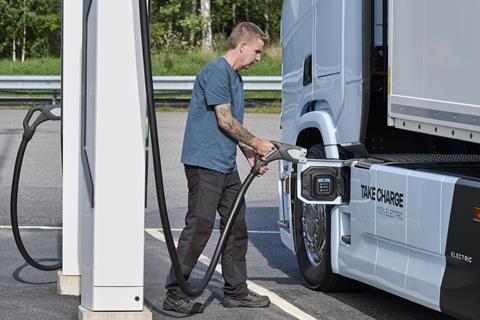
Scania has adopted a consultative sales process, which results in a turnkey solution where the company takes holistic responsibility, and will be your trusted adviser throughout the process.
This means guiding you through the transition and ensuring that you will get a high-quality solution that works for you, your operation and your business – for the short term, the long term and into the future.
Telematics and services
Having real-time data will become critical as you transition from fossil fuels and decarbonise, utilising different vehicle technologies along the way.
And while you will be comfortable with the way you run your diesel fleet today, the operational analysis could provide you with reason to change and adapt the way you work your fleet to be more efficient, cost-¬effective and, ultimately, productive.
However, the telematics and connected services available today –and being considered for tomorrow – provide unique insight into the operations of your business, at both a holistic and granular level, allowing you to find opportunities to increase efficiency and productivity.
For example, you could gain an understanding of how your vehicle and infrastructure are being used, so you can maximise any windows for opportunity or scheduled charging.
Every heavy-duty vehicle is available with a suite of smart technology, advanced sensors and wireless connectivity. If you want to add more data to your arsenal, there are third-party suppliers who provide systems and services that may give you that additional insight and peace of mind.
That means that there are hundreds of thousands of constantly connected vehicles all over the world today – providing data that improves truck manufacturer’s ability to engineer better products. It also allows them to create services that can provide you with direct business value.
This can equate to anything from lowering energy consumption to reducing wear and maintenance needs, all the way to automating tedious administrative work. Simply put, they focus on the data – so you can keep your eyes on running your business.
The options and services available to you will vary, but, regardless, they have been designed to greatly enhance your business operations.
Having access to connected services that create true value and increased productivity for your operation – whether that’s increasing vehicle efficiency, minimising downtime, or improving your administrative workflow – gives you full visibility of the impact your fleet is having.
Some of the features available include:
• Your fleet position – allowing you to monitor your most valuable assets 24/7.
• Service planning – allowing you to plan and track repairs and maintenance.
• Driver evaluation – allows you to track your drivers’ driving behaviour to improve efficiency and safety.
• Vehicle performance – track how your fleet is being used as well as the impact it is having on the environment.
• Environmental report – allows you to calculate emissions values for your vehicles, including CO2, fuel and energy consumption.
• Monitoring report – your insight into how your fleet is being used.
• Tachograph services – stay compliant and on top of your drivers’ activity and rest times.
• If you are considering adding electric vehicles, there are some bespoke connected services to keep you on top of the new challenges this technology brings.
Below is a collection of digital services that directly focus on aspects specific to battery electric operation and vehicle performance – bringing real-time insights, data and information directly to your fingertips.
• Charging services – allows you to plan, monitor and analyse the charging of your fleet.
• Fleet position – gives you BEV data visualisation, information and tracking of state-of-charge (SOC) in map view, supported by trucking map data.
• Range support – helps you to map and simulate possible scenarios to learn about battery performance in real life operations. Knowing your range estimation time/distance helps you to plan accurately, depending on weight and weather.
Repair and maintenance
This won’t be a new topic. But it’s worth considering how you will approach R&M with your new vehicles. Do you take the same approach you have taken with your current fleet? Or make some changes?
If at present you choose to do all your own servicing and repair work, do you keep doing so? Are there operational benefits to in-house maintenance over giving it to a dealer?
This will evolve over time, but you need to make the decision that is right for you today and with a view about tomorrow.
There is plenty to ponder and, thankfully, there are plenty of options available from all the truck manufacturers – whether that be full R&M contracts, servicing only or being a support and parts function for your own maintenance teams.
The critical point will be assessing how you plan your fleet’s downtime – to maximise their uptime – and who ultimately completes the work on your behalf.
Driver training
To get the best out of your new vehicles, you will need your drivers to be performing at their best, with a view to looking after your business.
Driving more efficiently and utilising all the assistance technology on modern trucks not only saves you money. It also means you operate more safely and it limits the emissions that your fleet produces. This is why one consideration for your decarbonisation journey is getting your drivers trained.
It’s a service offered by all the truck manufacturers, and one you should leverage – even if you are making the switch to a newer diesel truck. There will be new functionality, technology or settings to get used to. And, of course, there will be differences with refuelling or the operation of these alter¬natively powered vehicles.
Driver trainers can make sure your drivers are comfortable with the vehicles in your fleet, and show them how they can be better, more efficient drivers – to make them a real asset for your business.

Finance
Another aspect worth considering is how you are going to acquire these new low-emission vehicles.
Are you planning to pay cash and buy them outright, finance the vehicles, or even lease or rent them? You will need to assess your options to find the right fit for you.
If you are looking to fund your new trucks, it is worth exploring your finance and insurance options to ensure they are tailored towards your business needs.
Funding the transition from diesel to a new diesel or gas vehicle shouldn’t be too complex, seeing as the running costs are almost on par with each other.
On the other hand, a BEV truck will be more costly to buy as an upfront purchase at the moment, as the technology is still fairly new and developing. Some providers may help you finance your infrastructure needs, too.
This is why assessing all your finance options is a worthwhile exercise. There are many providers all looking at sensible solutions to help support businesses make their first step on their decarbonisation journey and beyond.
Infrastructure
The transition to decarbonise your fleet brings with it new, complex challenges. One of those challenges is ensuring you have the right infrastructure at your disposal. Finding the right solution for your specific needs can feel like a demanding undertaking, but it doesn’t have to be.
Whether you are looking to move to biodiesel, gas or electric vehicles, you will have to make some changes to how you refill these vehicles at base.
For example, switching to biodiesel will be easier if you have tanks and refuelling sites already in place at your depots and locations. But there may still be some changes required.
However, installing gas and electric charging points comes with some challenges, considerations and decisions that need to be made from an installation and an operational perspective to make the transition viable.
But as we have said from the start, you are not alone. The manufacturers and other third-party companies are available to support you on this journey.
A key component of every refuelling or recharging project is finding a tailored solution that fits your needs. The first and most vital step is the operational analysis. This is performed to get a complete picture of your operation and identify your needs.
During this phase we will provide you with:
• Vehicle overview – taking a closer look at the vehicles in your current fleet.
• Fleet and flow analysis – creating route simulations and range estimations.
• Energy consumption analysis – taking geography, topography, climate, payloads and consumption into consideration.
• Energy needs analysis – taking infrastructure, vehicle and system fuelling needs, and losses into consideration.
Through your vehicle and fleet data, you will be provided with analysis that defines the refuelling or recharging needs of your vehicles – as well as an energy requirement forecast for your operation’s decarbonisation roadmap.
Everything done is based on your real operational data, providing the best possible starting point for tailoring the perfect solution.
Once the analysis has given you the complete picture, the next step is to look at your site’s geospatial data and fleet needs to provide you with the best products and most suitable equipment – both in terms of what is needed for your vehicles today, and to prepare your fleet for future scale-up.
For example, with BEVs the key to efficiency is charging when the vehicle is already planned to be stationary – whether that’s a driver’s break, overnight, or during loading or unloading.
It is at this point that long-term decarbonisation planning will be critical, because it is advisable to do any necessary groundwork once.
For example, there is the matter of whether you choose to move to gas-powered trucks or BEVs. You will need to find out whether you have enough grid capacity to support your operations. And, yes, even gas refuelling stations can require a boosted electrical system to support the refuelling of your vehicles.
Doing this forward planning is essential because of the time it will take to implement the changes you need, which will be a costly exercise as well. Doing it once is better in the long term.
Before you get to the point of breaking ground and upgrading your electrical infrastructure, you will need to have numerous conversations with various stakeholders. These could include landlords, energy providers, council officials and the National Grid.
Doing the hard work today means you are ready, in control and able to make the changes you need to make the next step on your decarbonisation journey.
First published in the Scania Decarbonisation Guide in summer 2024.