
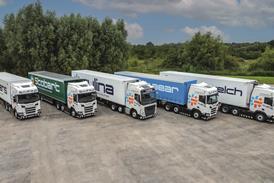








Battery technology is developing rapidly, but is it evolving fast enough to meet the demands of the heavy-duty truck sector? Staffan Lundgren, senior advisor, propulsion and energy conversion technology at Volvo Trucks, takes a look at the promises, the pitfalls, and what it really means for fleet operators. 

volvofmelectrcshutterstock_2511560927_493893

In the world of zero-tailpipe-emission transport, battery technology is often held up as the great enabler—the key to a future where diesel-powered trucks are a thing of the past. But while much progress has been made in recent years, particularly in the passenger car market, questions remain about how far and how fast those gains can realistically be applied to heavy-duty trucks.

The lithium-ion battery is at the heart of this story. Since their commercial introduction in 1991, these batteries have transformed everything from mobile phones to cars—and now, trucks. The cost of lithium-ion cells has plummeted from around £1,100 per kWh in 2010 to roughly £110 today. That’s a significant drop, driven largely by economies of scale in consumer electronics and passenger cars.

For commercial vehicles, this cost reduction has helped make battery-electric trucks viable for specific applications, particularly urban delivery and regional haulage. Battery energy density has also improved, meaning vehicles can now travel further between charges.

But that doesn’t mean we’re on the verge of a battery-powered trucking utopia. Battery packs are still heavy, expensive, and dependent on critical minerals with complicated supply chains. For all the progress, the cost of a battery-electric heavy truck is still roughly double that of its diesel equivalent.

The changing chemistries

One of the big drivers behind recent battery improvements has been evolving battery chemistries. Early lithium cobalt oxide (LCO) cells gave way to nickel manganese cobalt (NMC) batteries, offering better energy density and thermal stability. NMC remains popular today, particularly in high-performance applications.

More recently, lithium iron phosphate (LFP) batteries have started to dominate, particularly at the lower end of the market. They offer a more stable and safer solution, with a longer lifespan and lower production costs—although at the expense of energy density, meaning reduced range and payload capacity for trucks.

What’s next: Solid-state and sodium-ion

Looking ahead, the most talked-about innovation is solid-state battery technology. By replacing the flammable liquid electrolyte in today’s batteries with a solid material, these batteries promise increased safety and higher energy density—potentially unlocking longer ranges and lighter vehicles.

Staffan Lundgren

But there are caveats. Solid-state cells are still in the development phase. Manufacturing them at scale is proving complex and expensive, and there are question marks over their durability and charging performance. Toyota, one of the main advocates, has pushed back its commercialisation timeline more than once, with its latest target set for 2027.

Further down the line, sodium-ion batteries are being touted as a low-cost alternative. These use sodium instead of lithium—an abundant and inexpensive material. However, sodium-ion cells currently offer only half the energy density of lithium-ion equivalents, making them unsuitable for long-haul trucks. They may find a place in lighter-duty applications such as urban distribution vehicles.

Is there a “perfect battery”?

It’s unlikely. The commercial vehicle sector is too diverse for one technology to fit all. Operators will need to weigh up cost, range, charging time, weight and availability depending on the job at hand.

The reality is that many of the biggest gains in battery technology so far have benefited passenger cars, where energy demands are lower and cost pressures different. Heavy trucks are a much tougher proposition. Until solid-state or another breakthrough technology reaches maturity, fleet managers will still face trade-offs.

The infrastructure question

And even the best battery in the world is only half the story. Without reliable and widespread charging infrastructure, electric trucks—whether powered by NMC, LFP or solid-state batteries—can’t fulfil their potential. Range, charging times and grid capacity will all shape how quickly the sector can shift away from diesel.

Battery technology is moving in the right direction, but progress is incremental rather than revolutionary. For now, electric trucks will continue to be a solution for certain applications rather than a one-size-fits-all answer.

Fleet managers looking to invest need to think strategically: understanding how battery developments might impact running costs, payload capacity and operational flexibility. The promises of battery technology are significant—but they won’t rewrite the rulebook overnight.

Battery timeline: Milestones in battery development

1980: Lithium cobalt oxide battery invented

1991: First commercial lithium-ion battery released

1996: LFP batteries developed

2001: NMC batteries introduced

2020s: LFP dominates low-cost sector; solid-state under development


Common battery chemistries – strengths and weaknesses

Lithium Nickel Manganese Cobalt Oxide (NMC)

Strengths: High energy density, good thermal performance, widely used in electric vehicles.

Weaknesses: Expensive, uses cobalt (linked to ethical and supply chain concerns).

Lithium Iron Phosphate (LFP)

Strengths: Safe, long lifespan, thermally stable, lower cost.

Weaknesses: Lower energy density than NMC, meaning less range or more weight.

Solid-State

Strengths: Higher energy density, improved safety (non-flammable electrolyte).

Weaknesses: High production cost, difficult to manufacture at scale, durability challenges.

Sodium-Ion

Strengths: Cheaper raw materials (sodium abundant), lower environmental impact.

Weaknesses: Currently lower energy density, not yet commercially viable for heavy-duty applications.


Topics