

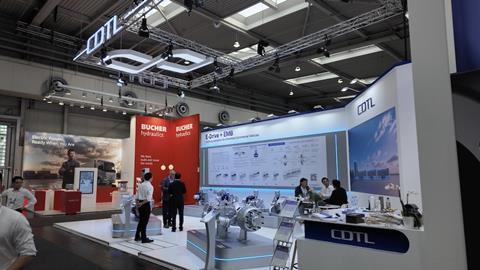
Chinese commercial vehicle technology specialist CDTL is developing an ambitious new approach to the future of heavy transport, combining distributed electric drive and X-by-wire technology with a vision of autonomous ‘road trains’ capable of hauling multiple trailers.
Speaking to Commercial Motor at IAA Transportation in Hanover, Denver, chairman of the board at Hangzhou Contemporary E-Drive Technology Co (CDTL), explained how the company is bringing together propulsion, braking and, ultimately, steering technology for future driverless commercial vehicles.
Founded in 2018 and headquartered in Hangzhou, CDTL specialises in distributed e-drive systems and X-by-wire actuation technology.
“We like to think from the final picture first,” said Denver. “We believe driverless road trains will be one important direction, one autonomous tractor pulling two, three, or even more trailers.”
He believes multi-trailer combinations could dramatically reduce labour requirements, while closely coupled trailers could cut aerodynamic drag and energy consumption. As an example, he said one autonomous tractor hauling 10 trailers could theoretically replace nine drivers, representing an annual labour saving of almost RMB2m (£221,000) at current Chinese driver costs.
Central to the concept is distributed propulsion. Denver compares the approach with high-speed trains, which distribute propulsion and braking throughout the train rather than relying solely on a locomotive at the front.
“We’re doing the same thing for trucks,” he said.
While the road-train vision looks to the future, much of the underlying technology is already commercialised. CDTL says its distributed drive systems are in use in heavy-duty trucks, buses and intelligent transport applications, and that it ranks number one in China by installation volume for distributed drive solutions for 4x2 tractor units. Its EMB electromechanical braking technology has also accumulated more than 100,000km of real-world vehicle operation.
The distributed drive system allows propulsion and braking to be controlled wheel-by-wheel, enabling precise torque management as well as traction and vehicle stability control.
CDTL also claims significant packaging benefits, with its compact e-axle saving almost 300kg compared with a conventional driveshaft arrangement. Energy consumption on a fully laden 4x2 vehicle has fallen below 1kWh/km, it says.
CDTL sees EMB as the other key part of the system, providing fast-response independent braking at each wheel. The distributed drive also provides redundancy, with the motors able to slow and stabilise the vehicle should EMB fail.
Importantly, CDTL develops both the hardware and control software in-house.
“We’re not just putting an e-axle and an EMB together, we’re doing integrated drive-and-brake control,” said Denver.
The next stage is a steering corner module integrating drive, braking and steering at each wheel, ultimately creating a complete X-by-wire architecture.
“Driverless commercial vehicles need a completely new actuation system,” Denver concluded. “At CDTL, we are defining X-by-wire actuation for driverless commercial vehicles.”