









Reed Boardall’s decision to replace low-powered charging units for an ultra-fast charging system at its its Boroughbridge depot has enabled the operator to triple daily electric vehicle output, according to research by charging provider Chargepoly.
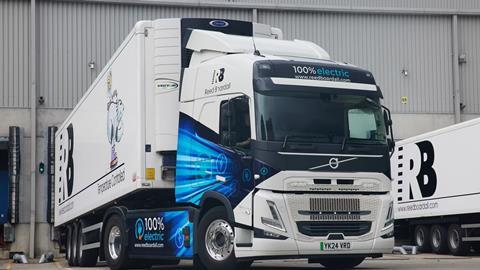
The temperature-controlled logistics operator uses two Volvo FM Electric tractor units on 24-hour shuttle operations, supported by a 360kW charging system supplied by Chargepoly. This replaced two legacy 43kW AC chargers supplied by another charging provider.
According to a report from Chargepoly, by replacing the lower-powered units which required charging periods of up to 12 hours, Reed Boardall’s decision to invest in the 360kW DC system has boosted daily vehicle use significantly at the site.
The report notes: “Upgrading to Chargepoly’s 360 kW HDPU ultra-fast charging architecture enabled Reed Boardall to double or triple daily vehicle output.
“While the initial CAPEX for ultra-fast DC infrastructure is undeniably higher, the Total Cost of Ownership (TCO), particularly when taking into account the 75% UK Government Depot Charging Scheme grant award, improves significantly because fewer vehicles are required to achieve the exact same daily mileage and revenue.”
Chargepoly’s findings are based on six months of telematics data from the site. The research also identified scope to expand the electric fleet without installing additional charging equipment.
It calculated that active charging currently accounts for 9.1% of the available powered-position hours across the site’s charging positions, equivalent to 7.5% of the system’s total rated energy capacity.
Based on its modelling, Chargepoly estimates that the existing installation could accommodate up to 12 additional electric truck charging events per day within a practical 12-hour charging window, using a 70% planning ceiling.
With optimised scheduling through its Lucie software, Chargepoly estimates that the hub could support up to 20 electric trucks over a 24-hour period.
The telematics data, collected between March and September, recorded 884 charging sessions, delivering a total of 104.6MWh of energy. The two vehicles cover approximately 450km per day, with each truck consuming around 500kWh during daily operations.
The charging sessions delivered an average of 191.1kWh, with an average active charging time of 58 minutes. Chargepoly reported average charging power of around 200kW during these sessions.
Reed Boardall’s operating model at the site is based on fitting charging into existing vehicle turnaround times. On returning to the Boroughbridge depot, drivers position refrigerated trailers at warehouse loading docks, unhitch their tractor units and move them to the charging station. While the vehicle charges, drivers collect another loaded trailer from the company’s fleet of approximately 250 units.
This allows charging to take place alongside routine trailer changes and loading activities, rather than requiring separate periods of vehicle downtime. Chargepoly said the operation recorded no disruption attributable to charging during the monitoring period.
The charging system has also been tested with a Scania electric truck, which Chargepoly said drew power at up to 360kW without a reduction in output during peak charging sessions.
Chargepoly’s report concludes: “Reed Boardall’s 24/7 operation proves that heavy-duty logistics and fleet electrification can be both reliable and commercially sound.
“By leveraging intelligent high-power charging, operators can scale their electric fleets seamlessly, unlocking hidden capacity and maximising vehicle utilisation without requiring immediate additional capital investment.”