







For many HGV operators, the pressure to start testing out the eHGV option is growing. But how do you go about getting an EV charger installed on your site?
Stories about a ‘connections queue’ with waits of several years may make this seem like a daunting process. But in fact that headline refers to just a small subset of connections and for many users the process may be relatively straightforward – not least because there is a busy industry of specialist providers keen to take on your project.
Assume you are starting fairly small, with one or two electric trucks, and you want to install a charger somewhere between 150kW and 400kW. (Watts is an indication of how fast charge is being put into the battery, so 1kW is a thousand Watts and 1MW is a million Watts.)
For comparison, public EV charging company BP Pulse serves the car market with ‘Fast’ chargers that deliver at 3kW AC, 7kW AC and 22kW AC, ‘Rapid’ at 49kW AC, 50kW DC and 75kW DC chargers and ‘Ultrafast’ of up to 150kW or 300kW. If you have a home charging point the RAC says it typically charges at around 7kW. AC (alternating current) varies like grid supply at 50Hz, so it makes for simple (ie cheaper) connections, but it delivers less energy than DC (direct current). There is a choice to be made between AC and DC at higher power levels.
Who is the gatekeeper?
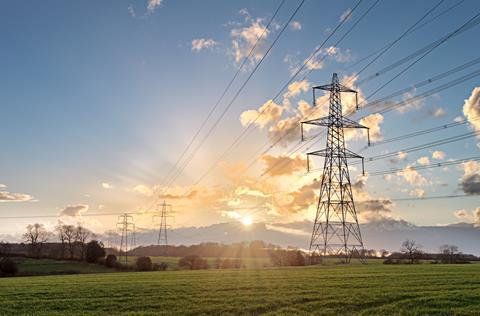
Great Britain, like most other countries, has a high-voltage electricity network for long-distance bulk transmission from large power stations – these are the pylons (or transmission towers) you see marching, for example, alongside the M40. The queue to make connections to this high-voltage electricity network is a problem that has to be addressed to bring more large-scale renewable energy online and transmit it to where it will be used.
But installing one or two chargers for a handful of eHGVs is usually too small an addition to be of interest to the transmission network operators (except for limited circumstances described below). Instead, you have to talk to the local low-voltage distribution network operators (DNOs) that deliver power to homes and businesses.
The distribution networks are fed from the transmission network via grid supply points and, increasingly, from small local power plants. The latter include dedicated power system assets such as onshore wind turbines, solar PV farms, gas engines and batteries, but more and more there are also times when on-site generation, such as rooftop PV, spills onto the network when it generates more than the site is using.
The DNOs are the owners and operators of these local networks and there are 13 geographical monopolies across GB. There are just five DNO companies, because some own more than one network. They are SSEN, SPEN (which recently acquired ENWL), NPG, NGED and UKPN, and it is easy to find out which DNO operates in your area, via a postcode search at the Energy Networks Association website.
DNOs are gatekeepers in adding a new connection to the network or increase the capacity of the existing one, whether that is because you want to be able to increase site demand (with an EV charger) or because you have energy to export.
At distribution level it is less certain that there will be a queue to connect. The distribution network is far more extensive than the transmission network - compare the single transmission line mentioned above along the A40, for example, with the thousands of miles of cable that transports electricity along every street in Oxford to each home and business. The issue here is that the capacity of the network varies across its area, and so do the users. This reflects the history of the network, which was originally designed to passively cascade power to users, and which operates at a range of voltage levels to serve different users. Rural areas with traditionally low numbers of homes and businesses, for example, often have very thin (low capacity) connections.
An eHGV charging point may require a bigger or a new connection because it will add to your site’s maximum demand.
The connections process
As part of its connection process, the DNO will consider the physical requirements (how long is the cable to the nearest available connection point, for example) and it will also consider whether a bigger connection will present any problems for the network, by analysing potential power flows. It is assessing whether the increased flow will be too much for the system, causing faults that result in unplanned blackouts for some customers – in which case the DNO may have to upgrade some part of its network nearby to accommodate the connection. The complex nature of the network means that the effect of new or bigger connections may not be local. It may trigger upgrades miles away, if a connected asset is very close to maximum capacity.
If your new connection triggers network upgrades, part or all of the cost may fall to you, although the trend in recent years has been for more of the non-local costs to be socialised to all network users.
Networks operators have tried to ease the connections process for transport operators with a dedicated web page and tool to prepare for the process. It will ask for the following information:
• Whether you need electricity for a single site or multiple sites
• An understanding of your existing transport assets
• A rough idea of timescales - when you would like to electrify your transport assets
• A copy of a recent electricity bill
• A copy of your electricity supply agreement (also known as agreed supply capacity or ASC)
Most companies will have this available, either directly or via the organisations that bill and manage your electricity supply (contracted directly with an electricity supplier or via a third party provider).

The outcome of the DNO process is a connection offer and DNOs have strict targets set for the time taken to respond. The DNO process became slightly less onerous recently, because in most cases the DNO modeller no longer has to consult with the transmission network operator over whether the new connection will result in a change on the transmission network. This has removed both a potential cost (for reinforcement) and a potential delay.
Once the connection offer is made, however, most of the installation is contestable, which means that the DNO does not have a monopoly on the work. Far from it. So-called independent connections providers can do anything from early planning to the installation and Lloyd’s Register Quality Assurance (LRQA) lists nearly 500 companies that are qualified via its National Electricity Registration Scheme.
Connections may seem simple but the complex nature of distribution networks means sites that are adjacent geographically may be able to connect to different parts of the network. In the past, this meant that project developers might send several requests for a connection offer to the DNO, with the connection made at different parts of the network.
The electricity industry has tried to manage this by publishing much more information about distribution networks and where they have spare capacity (described as heat maps) as part of an open data initiative. In making connection offers DNOs do not act as consultants and, for example, they do not give advice on where you should request to connect and a consultant may be able to make alternative suggestions. There are many companies who will act as connection consultants and work with you to find ways to connect more quickly. Your chosen EV charge point provider will no doubt have regular providers.
There are other ways to reduce the cost of making or using your connection, which may affect the way you use the chargers. The cost is partly determined by maximum connection capacity (see above) and usage, so some options would require the company to restrict the use of the chargers at certain times of the day. We will be exploring these options – and other ways you can be a flexible customer to manage the cost of electricity on your site - in a later article on FCZ.