
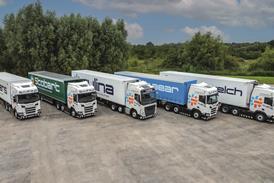










A £1bn funding package to accelerate the move towards electric trucks will not solve low uptake because operators need to see they are economically attractive, according to an e-fleet solutions provider.
The government this week announced a grant programme that gives companies up to £81,000 off zero emission HGVs and £5,000 off electric vans.
At the same time, its depot charging scheme will cover up to 70% of the cost when installing charging infrastructure.
The investment was broadly welcomed, but concerns are growing that just throwing money at the problem would not be enough to overcome significant structural challenges in the market.
Mike Nakrani, chief executive of end-to-end EV solution provider VEV, said the government’s announcement was “a big step forward”, but he also said:
“Let’s not pretend this solves the problem.
“The barrier to fleet electrification was never just funding – it’s complexity. Fleet electrification isn’t being held back by ambition; it’s being held back by execution.
“The hard part isn’t buying electric vehicles, it’s making them work in the real world with the right infrastructure, energy strategy and operational model behind them.”
Nakrani acknowledged that the funding would help companies make the transition, but he said that the industry needed to move beyond pilots and start delivering electrification that worked at scale.
He added that haulage operators “have to see this as economically attractive before they make the move themselves.
“We’re seeing more operators ready to move, but many are still underestimating what it takes to get there.”
Voltempo said firms needed to see that electric trucks can run reliably, at the right cost, within existing logistics models – and that incentives alone would not be enough: “This is where government backing and private sector investment must work hand in hand,” said Voltempo CEO Simon Smith.
“At Voltempo, we see infrastructure as the deciding factor, delivering depot-based charging as part of a fully integrated solution that enables fleets to operate with certainty.
“Scaling eHGVs at pace depends on more than hardware alone; grid access, energy pricing, site readiness and long-term scalability are fundamental constraints that must be solved in parallel and will ultimately determine how quickly the sector can move.”
The Association of Fleet Professionals (AFP) said it supported the deadline for 26-tonne non-EV trucks by 2035 and vehicles over that weight by 2040 but that it would only succeed if infrastructure delivery kept pace with vehicle supply.
Paul Hollick, AFP chair, said: “Government ambition should be accompanied by a credible eHGV infrastructure delivery plan, with particular attention to distribution network operator capacity and connection timescales.
“We need to especially learn lessons from the way infrastructure issues have played a part in the slow uptake of larger electric vans.”
He added: “We urge the government to engage more deeply with HGV fleet operators to better understand how workflows impact on vehicle selection and are managed in practice, how UK policy design can affect fleet operations, and how greater recognition of specific complexities such as cranes and gritters can impact the electrification journey.”