





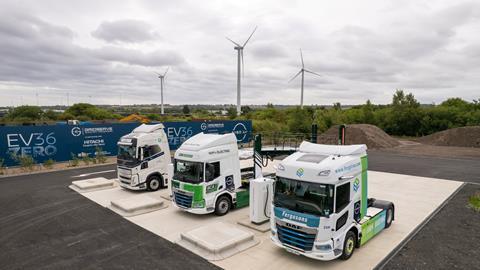

A report into the use of zero-emission HGVs has confirmed what many already suspected: getting infrastructure in place remains a constraint and vehicles are typically being used on short to medium-sized routes.
The first annual study from the government-funded zero emission HGV and infrastructure demonstrator programme (ZEHID) said more than 85,000 trips have so far been recorded, 2.2 million miles have been travelled and over 550,000 tonnes of freight have been moved as part of the trial projects.
The environmental benefits included an estimated 81% reduction in greenhouse gas emissions compared with equivalent diesel operations and cumulative CO₂ savings of more than 4,000 tonnes.
But it also acknowledged that charging infrastructure was a key bottleneck for early eHGV adoption, with delivery following “complex and sometimes fragile timelines”.
Over 40 ZEHID-funded charging sites have been commissioned across depots, shared sites, public sites and customers’ sites and six chargepoint providers are being used for its projects; it said this represented substantial early deployment from a base of very few dedicated eHGV chargers, but barriers needed to be reduced to speed up roll-out more widely.
“Interventions could cover issues such as the need for grid reinforcements, multi-party land negotiations, and planning and permitting constraints,” the report said.
“Few stakeholders can navigate this complexity efficiently without support.”
The report also found that long distance and heavy-duty use cases remained a harder sell: “Initial data indicates the eHGVs are typically (but not exclusively) deployed on short-medium routes, currently averaging approx. 1,350km per week during early deployment, compared to approx. 2,600km per week for a sample of diesel trucks.
“However, a few eHGVs have demonstrated long-distance operation up to 800 km/day or 4,000km/week.”
Larger batteries and reliance on en-route charging meant there was slower progress to TCO parity.
“Payload and weight constraints remain a key challenge affecting vehicle deployment and commercial viability.
“eHGVs are typically approx. 3.5 tonnes heavier unladen than diesel, reducing payload by approx. 1.5 tonnes for a 42t 4x2 and up to approx. 3.5 tonnes for a 6x2, although hauliers report axle limits can be reached before gross weight limit, which can reduce their effective capacity (and productiveness) further.”
Claire Spooner, director at Innovate UK, which published the report in partnership with WSP, said: “Zero-emission HGVs are already demonstrating their potential in real-world freight operations across the UK.
“This first annual report marks an important milestone for the ZEHID programme, providing valuable insight into what is working, where challenges remain and what will be needed to support the wider transition to zero-emission freight.”
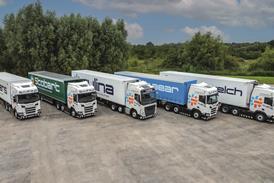
ZEHID’s active projects: Electric Freightway, eFreight 2030 and ZENFreight have so far deployed more than 240 zero-emission trucks and established over 40 charging sites across the UK.
By the end of 2026, they are expected to reach around 300 vehicles and 70 infrastructure sites. ZEHID has entered a five-year monitoring and evaluation phase that will run until 2031.