


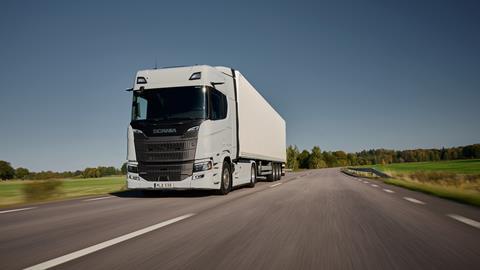

Scania delivered a “resilient” performance in the third quarter, with profits up compared to Q3 2025, but market uptake of its electric trucks continued at a glacial pace, the manufacturer revealed this week.
Reporting its third quarter performance, Scania said sales revenue increased by 5% to SEK 49.1bn, while deliveries rose by 3% to 22,086 vehicles, of which battery electric vehicles (BEV) amounted to 247 units, up from 159 in the same period last year.
Order intake decreased by 2% to 20,098 vehicles, of which BEV totalled 511 units, up from 133 in Q3 2025.
Scania said its profitability improved, supported by higher truck deliveries, a favourable product mix, continued growth in the services business and favourable currency effects.
Overall truck order intake remained at a stable level although regional market trends varied. Activity strengthened in parts of Asia and Africa, while orders declined in Europe and Latin America.
Battery-electric truck orders increased compared with the same period last year, although the manufacturer said overall adoption still lags behind where it should be.
Scania added that it continued to invest in future competitiveness through new products, digital services and industrial capabilities during the period while maintaining a strong focus on efficiency and cost discipline across the business.
Commenting on the third quarter results, Christian Levin, president and chief executive of Scania and Traton Group, said: “In Q3, Scania delivered a stable performance despite geopolitical uncertainty, with the development in the Middle East resulting in higher fuel costs and ongoing supply chain disruptions.
“Scania showed operational resilience and handled a varying truck market with flexibility, maintained strong cost efficiency and continued to focus on delivering value for our customers.”
He added: “Operating result (6,033 MSEK) and return on sales (12.3%) improved compared with Q3 last year and reached their highest level since Q1 last year.
“Higher truck deliveries, a favourable product mix, continued growth in our services business and favourable currency effects more than offset increased R&D investments and China ramp-up costs.
“Our continued efforts to increase efficiency and strengthen cost discipline across the business also contributed to the improvement in profitability.
“Regional trends differed: activity was stronger in parts of Asia and Africa, while orders declined in Europe and Latin America. In Europe, battery-electric truck orders increased, although at levels that are still too low.”
Turning to BEV truck orders he said that while these were improving, aided by Scania’s development of long range electric trucks, “the pace of adoption is still not moving quickly enough”.
He said that while there is no lack of customer interest, the lack of cost parity with diesel equivalents and the inadequate charging ecosystems are continuing to hamper uptake.
He added: “That ecosystem is now at least three years behind, and still not developing fast enough.
“For electric transport to reach full scale, much more must be done to put the necessary infrastructure, grid capacity and policy frameworks in place.”