

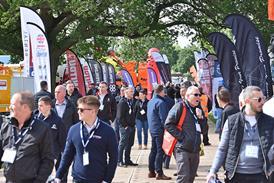

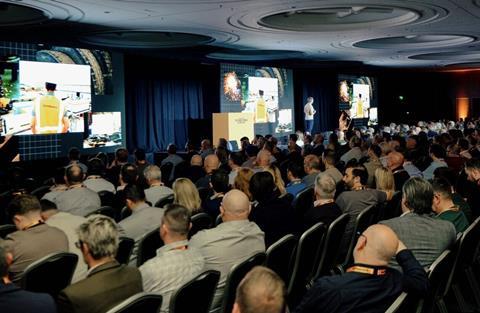
Samsara used its Go Beyond Europe conference in London to unveil a series of AI-powered tools designed to help operators tackle some of the industry’s biggest challenges, from rising operating costs and safety risks to regulatory compliance and vehicle maintenance.
The telematics and connected operations specialist used the event to showcase how artificial intelligence is moving beyond reporting and analytics into active decision-making, with a new generation of AI agents capable of identifying risks, prioritising interventions and automating routine tasks. Speakers throughout the event argued that fleet operations are entering a new phase in which AI can help transport businesses act on data rather than simply collect it.
After Chris Vik, VP of sales, EMEA at Samsara, welcomed the almost 700 delegates to the conference, David Gal, vice president of product and engineering for connected equipment at Samsara, said operators across Europe, North America and other regions are facing remarkably similar challenges despite differing regulatory environments. Gal highlighted rising fuel costs, increasing insurance premiums, stretched supply chains and vehicle downtime as common concerns among fleet operators.
He said the average cost of a van being off the road in the UK now exceeds £1,100 per day, adding to mounting pressure on fleet managers already grappling with growing workloads and increasingly complex operations.
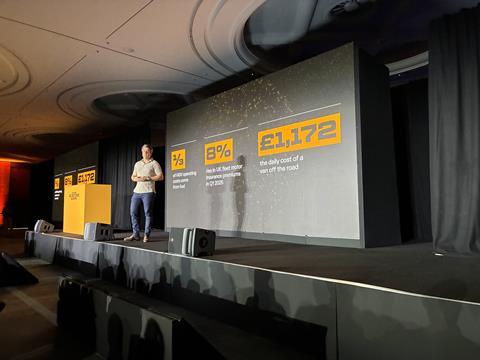
“We heard a lot about the same things over and over,” Gal told delegates. Rising costs, operational complexity and information overload were themes repeatedly raised during customer meetings around the world.
According to Gal, technology now offers an opportunity to combat those challenges. While last year’s conference focused on what he described as the beginning of the “age of intelligence”, this year’s event centred on a more practical proposition: using AI to automate operational tasks and drive action directly within fleet workflows.
“We are now able to not just glean insights from this data. We’re able to take action,” he said. “We’re building AI agents that can help our customers get ahead.”
Safety remains the starting point
The first major product announcements focused on road safety.
Arpan Podduturi, VP of product management at Samsara, said effective safety programmes remain one of the most powerful tools available to fleet operators seeking to improve profitability.
Podduturi said risk needs to be identified early, understood quickly and addressed before incidents occur. He claimed Samsara customers have collectively helped prevent an estimated 380,000 crashes through the adoption of the company’s safety technologies and coaching tools.
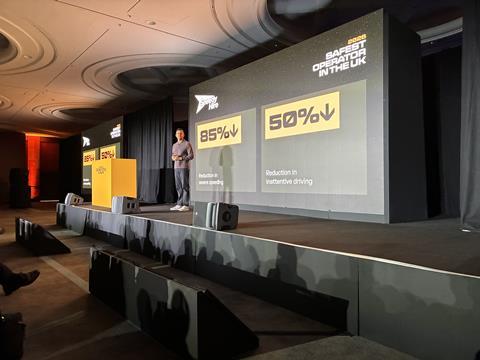
He highlighted equipment hire specialist Speedy Hire as an example of a customer that has achieved significant results through the use of Samsara’s safety platform, describing it as “the UK’s safest operator in 2026”. The company has embraced multiple safety technologies including driver identification, AI-powered detections, group coaching programmes and automated workflows.
A central theme of the safety presentation was the industry’s shift from reactive incident management to proactive intervention.
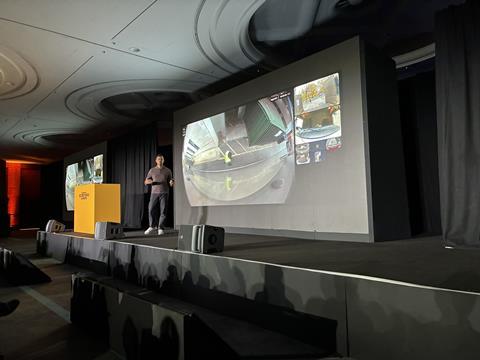
Much of that capability is being driven through Samsara’s AI Multicam technology, launched last year and enhanced through collaboration with fleets operating in congested urban environments including London, Paris and Amsterdam. The latest development introduces a stitched bird’s-eye camera view that gives drivers a complete picture of their surroundings, helping them manoeuvre safely through yards, depots and densely populated city streets.
Podduturi said the technology also provides fleet managers with greater visibility into operational processes such as loading and unloading activities, PPE compliance and driver ingress and egress procedures.
Alongside the bird’s-eye capability, Samsara has introduced new AI-powered safety warnings, including vehicle blind spot detection, forward collision warnings, rear collision warnings and pedestrian collision alerts. These systems are designed to intervene in real time, helping drivers avoid incidents before they occur rather than generating reports after the fact.
“What resonates is that this product is less reliant on back-office intervention,” Podduturi said, stressing that the technology aims to assist drivers in the moment rather than relying solely on retrospective coaching.
360-degree camera
Recognising that many fleet operators also manage vehicles in warehouses, airports, ports and construction environments, Samsara used the conference to launch a new ruggedised 360-degree camera system.
The camera has been designed for use on a wide variety of off-highway and specialist vehicles and provides complete visibility around equipment operating in challenging environments. According to Samsara, the unit combines front and rear 180-degree lenses, is resistant to dust and high-pressure water and can operate in temperatures ranging from -40°C to +60°C. It also continues recording when cellular, Wi-Fi or GPS connectivity is unavailable.
Demonstrating the system using an example from Alaska Airlines, Podduturi showed how operators can zoom in on incidents, review driver behaviour and gain visibility previously unavailable within specialist fleets.
The camera is integrated with Samsara’s existing safety workflows, allowing AI detections and alerts to flow into the same systems already used by transport and fleet teams.
AI ride-alongs
One of the most controversial announcements was Samsara’s AI ride-along (in-cab driver assessment) capability.
Traditional driver ride-alongs remain one of the most effective methods of assessing driver performance, but they are notoriously resource intensive. Coaches need to spend hours accompanying drivers, reviewing footage and conducting follow-up sessions.
Samsara believes AI can dramatically reduce that burden.
The ride-alongs agent automatically captures footage, analyses driving behaviour and generates coaching recommendations. Rather than requiring hours of human involvement, the process can be completed in minutes. According to Podduturi, the AI-powered approach is approximately 20 times cheaper than traditional ride-alongs.
The system evaluates drivers across six core performance categories, identifying both strengths and areas requiring improvement. Examples demonstrated at the conference included detecting fatigue, mobile phone use, eating while driving and other distractions that may increase risk.
Podduturi argued that the system can sometimes provide a more accurate reflection of driving behaviour than traditional ride-alongs because drivers are less likely to modify their behaviour when an assessor is not physically present but stressed that drivers must be informed that an AI ride-along is being planned to avoid privacy breaches.
The technology can be scheduled weekly, monthly or quarterly and targeted at specific driver groups.
Identifying high-risk drivers
Another major enhancement introduced at the event was Coaching Priority, a tool designed to identify the drivers most likely to be involved in collisions.
Drawing on data from across Samsara’s network, which the company says processes more than 160bn kms of driving activity each year, the system analyses driver behaviour, operating conditions and risk factors to predict where intervention is most needed.
The company said its analysis revealed that crashes rarely occur without warning signs and that the highest-risk 10% of drivers account for almost half of all collisions across its customer base. It also found that risk increases significantly when factors are combined, such as speeding at night during poor weather conditions.
Using those insights, Coaching Priority highlights drivers requiring attention and helps managers decide where coaching resources should be focused. Risk indicators include distraction events, speeding, fatigue, exposure to hazardous conditions and the driver’s length of service within the organisation.
Samsara has also introduced direct voice communication through vehicle cameras, allowing fleet managers or AI agents to contact drivers without requiring them to use mobile phones. The feature could be used, for example, to intervene when signs of fatigue are detected during overnight operations.
Cadent’s safety journey
To provide a customer perspective, Podduturi welcomed Lucy Stuart, head of fleet and logistics at gas network Cadent, onto the stage.
Stuart explained that she first attended the Go Beyond event two years earlier shortly after taking responsibility for the utility company’s fleet operation. At the time, Cadent was experiencing too many road traffic collisions and was relying heavily on reactive intervention rather than proactive coaching.
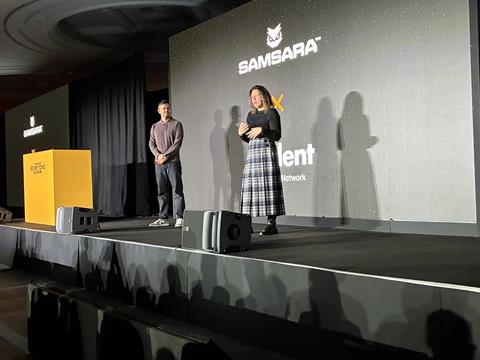
“We were crashing our vans and vehicles,” Stuart told delegates. “We’d had a fatality the year previously.”
She said Samsara appealed because it offered more than traditional telematics, instead positioning itself as a technology partner focused on innovation and behavioural change.
Looking ahead, Stuart believes AI and automation will become increasingly important as managers seek to support large fleets with limited resources.
“When you’ve got a busy fleet, seeing that support with our supervisors is brilliant,” she said, referencing AI-generated reports, in-cab coaching capabilities and operational assistance.
However, she stressed that successful technology deployments require careful engagement with drivers and trade unions.
Cadent involved engineers, vehicle users and union representatives from the very beginning of its implementation programme. According to Stuart, transparent communication, pilot schemes and employee input into policy development helped overcome concerns about new technologies.
“Actually bringing those drivers and the trade union along in the conversations we’re having was really key,” she said.
Re-imagining compliance
The next section of the conference focused on compliance management.
Ryan Yu, VP of product management at Samsara, argued that despite increasing digitisation, compliance remains heavily dependent on manual processes, fragmented systems and spreadsheet-based analysis.
Last year Samsara launched Smart Compliance, a platform designed to help operators manage driver hours infringements and coaching interventions within a single environment. Yu said customers have already reported measurable benefits.
Irish logistics company Mulgrew has reduced infringements by 30% since adopting the platform, while utility contractor Lanes Group has significantly reduced administrative workload by allowing drivers to review and sign infringement reports through the Samsara mobile app.
At this year’s event, Samsara announced several enhancements to the platform.
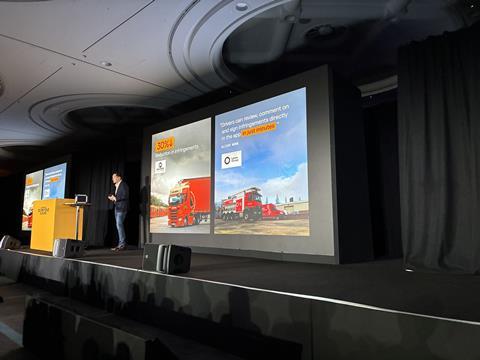
Smart Compliance now supports additional countries and domestic rule sets, provides multi-rule-set management for international fleets and incorporates agency drivers within the same compliance processes.
The company also introduced a new AI-powered reporting capability called Spaces.
Rather than forcing managers to build fixed dashboards and reports, Spaces allows users to ask questions in natural language and have bespoke dashboards generated automatically. In one demonstration, the system identified repeat infringement offenders, highlighted emerging trends and combined compliance data with broader driver risk information.
Yu said this would help operators move away from manually exporting data into spreadsheets and toward faster, more dynamic decision-making.
Tackling avoidable infringements
Samsara also used the conference to address one of the industry’s most common compliance mistakes: drivers leaving their tachograph cards in vehicles overnight.
According to company data, approximately 20% of infringements across its network are linked to cards being left inside tachographs.
To tackle the problem, Samsara has integrated its driver app with compatible next-generation tachographs via Bluetooth. Drivers can now trigger automatic card ejection directly through the app when ending their shift, helping eliminate a frequent source of compliance issues.
The same Bluetooth connection also enables remote driver card downloads, potentially simplifying compliance administration and reducing disruption when drivers are away from base.
Protecting the O-licence
Further compliance enhancements include integrated DVLA licence checking and MOT management.
Fleet managers can now order licence checks directly through Samsara and automate checking frequencies based on individual driver risk profiles. Higher-risk drivers can be monitored more frequently while lower-risk drivers can be reviewed less often.
Importantly, Samsara is linking compliance data to operational workflows.
In one example demonstrated during the conference, a driver whose licence had been revoked was automatically flagged when route allocation was attempted, preventing inappropriate vehicle assignments and allowing planners to reallocate work immediately.
Developed partly in response to customer feedback, Samsara also unveiled a new operator licence dashboard designed to provide transport managers with a consolidated view of regulatory risk.
The dashboard combines information from maintenance records, walk-around checks, tachograph data, infringements and driver qualification records, highlighting issues that may threaten an operator’s licence.
Using AI-driven analysis, managers can drill into problem areas, identify underperforming depots and direct remedial action quickly. One demonstration highlighted a depot with walk-around completion rates below 70%, enabling targeted intervention.
Yu said the system has been designed to support operators across multiple European markets, adapting to national compliance frameworks while maintaining a common user experience.
Predicting breakdowns
The maintenance segment of the conference was led by Sean McGee, vice president of product and engineering at Samsara.
McGee argued that vehicle breakdowns create disruption far beyond repair costs, affecting customer service, route efficiency and operational performance.
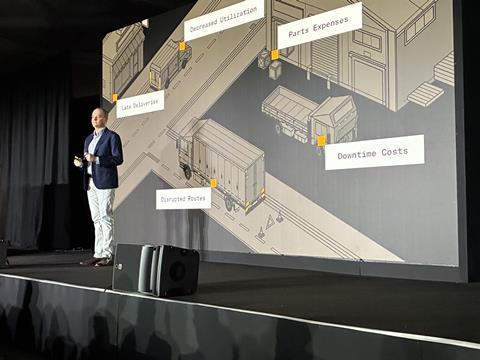
To address the issue, Samsara demonstrated Connected Maintenance, an AI-enabled maintenance platform that consolidates information from preventive maintenance inspections, fault codes, walk-around checks and predictive analytics.
One demonstration focused on battery health monitoring. By analysing voltage drops during engine starts and comparing historical patterns, Samsara can identify batteries showing signs of deterioration before failure occurs. Maintenance teams can then schedule replacements proactively, avoiding roadside breakdowns and vehicle downtime.
A second example examined fault-code analysis on a DAF truck equipped with a PACCAR MX-13 engine. The system interpreted fault-code information, assessed the probability of failure escalation and estimated potential repair costs. Where an issue might initially require a repair costing £100 to £400, delaying action could eventually lead to repairs costing thousands of pounds and significant workshop downtime.
McGee said the goal is to convert emergency repairs into planned maintenance events, allowing operators to manage work around their own schedules rather than reacting to failures.
Extending visibility beyond vehicles
Returning to the stage, Gal outlined developments in asset tracking and logistics visibility.
He said Samsara’s Bluetooth-based Asset Tag range has seen strong adoption since launch, enabling businesses to track tools and equipment across large operational networks. The company recently introduced a smaller Asset Tag Extra Small and expanded its network infrastructure by adding 90m smartphones while also doubling network strength across Europe.
However, Gal acknowledged that shipment tracking presents different challenges.
To address them, Samsara has developed a disposable shipment tracking label costing less than $15 (£11), the actual price depending on volumes. Combining a battery, Bluetooth radio and connection to the Samsara network within a paper-thin sticker, the technology provides location visibility without requiring recovery and reuse of the tracking device.
The labels are aimed at high-value or time-critical shipments such as pharmaceuticals, technology equipment and vital industrial materials. AI-powered anomaly detection identifies delays, thefts, mis-deliveries and other exceptions so that managers can focus attention on the small percentage of shipments that require intervention.
From insights to action
Running throughout the conference was a consistent message: data alone is no longer enough.
Whether discussing safety, compliance, vehicle maintenance or asset management, every announcement focused on reducing manual intervention and helping operators act faster.
The foundation for much of that ambition is Agent Studio, Samsara’s platform for building custom AI-driven workflows. Gal described it as a workshop where customers can combine their operational knowledge with Samsara’s data and AI capabilities to create solutions tailored to their own businesses.
The platform offers templates across safety, maintenance, dispatch, asset management and compliance, but Samsara’s message was that customers should ultimately build agents tailored to their own priorities and processes.
Samsara believes the next frontier for fleet technology is not simply connecting vehicles and assets. It is creating intelligent systems capable of making recommendations, triggering interventions and automating routine work before problems escalate.
For an industry facing relentless cost pressure, driver shortages, increasing compliance demands and growing operational complexity, that promise of turning information into action may prove to be the most significant development of all.