





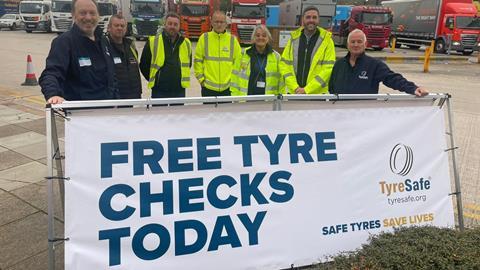

New roadside data collected by TyreSafe and partners at major UK motorway service areas reveals a concerning divide in tyre compliance, with a low adoption rate of proactive technology and significant knowledge gaps among commercial drivers.
The findings, which come in the midst of the nationwide Police’s Commercial Vehicle Operation from 26 January to 8 February, highlight the urgent need for systematic fleet management across all HGV operators and have spurred calls from across the industry for action.
The data was gathered from tyre checks conducted by International Tyres and Trading, with assistance from Truck Tyre Solutions and BTMA members Goodyear, and Michelin, at Exeter and Lymm motorway service areas in October, covering 186 vehicles and trailers and collecting over 1,320 individual tyre readings.
The report from TyreSafe states: “The targeted checks exposed a stark contrast between policy-driven national fleets and smaller, owner-operated businesses, confirming that safety risk increases where formal management systems are absent.”
Only 11% of the 66 drivers surveyed confirmed they use an in-cab TPMS monitoring solution. This high reliance on reactive manual checks, or visual checks, exposes fleets to unnecessary downtime and safety risks, the report warns.
Over a fifth of drivers (21%) admitted to relying solely on visual checks to monitor tyre pressures - a method proven ineffective for identifying critical pressure loss or internal damage.
In contrast the data showed a high level of training among drivers from large fleets, who quoted their Total Operating Cost replacement policy, rather than the 1mm legal minimum.
However, observations of smaller, transient fleets revealed dangerous technical errors, the research revealed, including the fitting of steer tyres on trailers and a reliance on lower-quality casings, compromising the vehicle’s integrity.
While 100% of drivers were aware of their daily legal obligation to check their vehicle, the survey highlighted knowledge deficiencies that contribute to non-compliance, with 38% of drivers unaware of their fleet’s formal tyre fitment policy and 38% of drivers not knowing the legal 1mm minimum tread depth for an HGV tyre in the UK.
Industry leaders called for urgent action this week, emphasising that the findings underline the necessity of moving beyond basic compliance to adopting a Total Operating Cost (TOC) approach that prioritises casing integrity and safety systems.
Commenting on the findings, Rich Allen, International Tyres and Trading commercial director, said: “What we saw on the ground at Lymm provided immediate, visible proof of the risk disparity.
“Where we saw policy in action, we saw quality fitment and trained drivers. But among the smaller fleets and owner-operators, we found a high degree of technical complacency—mixed brands, cheaper rubber, and errors like using steer tyres on trailers.
“For these operators, their lack of policy is likely to lead to mismatching of tread depths or load ratings and an overall reduction in handling capability.
“It is likely that tyres are being purchased directly on price for immediate savings, however there is a growing correlation between that trend and an increase in Total Cost of Ownership with higher rolling resistance (increased fuel consumption) during a reduced lifespan (lower mileage capability).”
Darren Lindsey, British Tyre Manufacturers Association (BTMA) chief executive, added: “The data confirms that the industry is divided. Where strong policies exist—often driven by the need to preserve the valuable tyre casing for retreading—compliance is excellent, running to standards well above the law.
“We urge smaller operators to understand that without a robust retreading policy in place means these fleets are effectively throwing money away, sacrificing future cost savings, and compromising safety by running rubber down to the limit.”
Stuart Lovatt, TyreSafe chairman, said: “The 11% TPMS adoption rate is a significant red flag. For smaller, regional fleets operating in hazardous urban or construction environments, tyre damage is a daily reality, yet these operators are the least equipped to detect it early.
“Relying on a quick visual check is a high-stakes gamble; by the time a tyre looks under-inflated, the internal structure is often already compromised beyond repair.
“This is the definition of a false economy. Ahead of the upcoming Police enforcement operation, we urge operators to move beyond the ‘bare minimum’ mindset.
“Whether through digital tools or enhanced driver training, the goal must be to identify damage—like cuts to cords or incorrect load applications—before they become fatal failures or costly roadside prohibitions.”
Lisa Scott, National Highways regional road safety programme manager (North West), commented: “Safety is our top priority. While it’s encouraging to see high average tread depths on vehicles on our roads, the knowledge gaps and the low adoption of in-cab monitoring are concerning.
“A vehicle that is prohibited at the roadside due to a defective tyre is not only a danger but is causing avoidable disruption to the network.
“Road safety is a shared responsibility, and we fully support TyreSafe’s call for all operators to treat tyre maintenance as a critical, non-negotiable part of their operational safety culture.”
TyreSafe and its partners are urging all operators—particularly owner-drivers and smaller regional fleets—to move beyond a “pass or fail” mind-set. To improve safety and reduce operating costs, they recommend the following focus areas:
- Move Beyond the “Quick Look” - A simple walk-around is the legal baseline, but it often misses critical internal damage. Drivers should be trained to specifically look for cuts to cords and sidewall bulges—defects that lead to catastrophic blowouts regardless of how much tread is left.
- Ensuring Fitness for Purpose - Compliance isn’t just about tread depth; it’s about fitness for purpose. Operators must ensure tyres are correctly matched for the vehicle’s specific load requirements and operating speeds to prevent premature fatigue and heat-related failure. Drivers must be aware that tyres marked ‘FRT’ are designed specifically for trailer or non-steering axles. Fitting an FRT tyre to a front steering or drive axle is a serious safety risk and a common cause of roadside prohibitions. Always match the tyre to the axle as intended by the manufacturer.
- Prioritise Damage Prevention over Replacement - Smaller fleets can significantly reduce costs by identifying minor injuries early. Understanding the difference between a minor repairable puncture and a major internal failure prevents the false economy of running a damaged tyre until it fails.
- Bridge the Knowledge Gap - Every driver should understand that the 1mm legal limit is a minimum, not a safety target. We encourage operators to adopt a safety margin by replacing at a higher threshold than the legal minimum, to maintain handling and braking performance, particularly in wet or urban conditions. Crucially, removing a tyre before it reaches the legal limit preserves the integrity of the casing. A healthy casing can be regrooved or retreaded, allowing the operator to get a second or third life out of the same tyre. This multi-life approach is the most effective way to lower the total cost of ownership without sacrificing safety.
- Evaluate Monitoring Solutions - While manual pressure gauges are a vital first step, we encourage operators to explore how monitoring technology, such as like TPMS, can provide a safety net against slow punctures and overheating-issues that are impossible to detect through visual inspection alone.