



Brigade Electronics has launched Haloniq, its largest-ever technology investment and a strategic shift from hardware supplier to connected fleet services provider, combining video telematics, live tracking, compliance tools and AI-driven safety insights in one integrated platform tested across more than 1,000 vehicles.
Safety technology specialist Brigade Electronics is taking its biggest step yet beyond hardware with the launch of Haloniq, a comprehensive fleet intelligence platform designed to combine video telematics, compliance management and operational efficiency in a single connected ecosystem.
For a company that has spent five decades building its reputation on vehicle safety technology, the introduction of Haloniq marks a significant strategic shift. Rather than simply supplying cameras, sensors and warning systems, Brigade is positioning itself as a provider of connected fleet services, bringing together software, telematics and safety intelligence under one roof.
Developed as a cloud-based platform, Haloniq combines Brigade’s established hardware portfolio with video telematics, live vehicle tracking, driver behaviour monitoring and reporting tools. The aim is to provide fleet operators with a single source of truth for managing risk, compliance and vehicle performance.
According to James Tyrrell, head of telematics at Brigade Electronics, the platform has been built to address some of the most pressing challenges facing commercial fleets.
“With 50 years of safety experience built in, Haloniq is designed to solve the most common risk, compliance and efficiency problems faced by commercial fleet operations,” he said. “We have created this unified system covering live tracking, intelligent video, driver-safety insight and powerful reporting.”
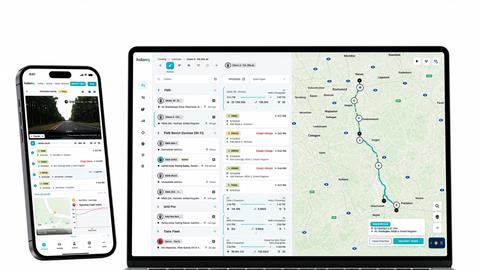
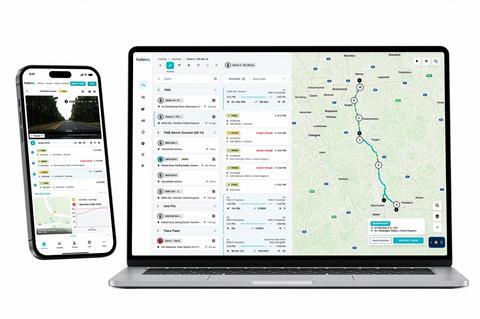
One of Haloniq’s key differentiators is its ability to consolidate functions that traditionally require multiple software systems. Fleet managers can access tracking, compliance data, safety event reporting and video evidence from a single interface, with incidents linked directly to journey reports and supporting footage.
Brigade says this integrated approach reduces complexity and provides faster access to actionable information. The system’s user interface has been designed around simplicity, enabling users to move quickly from an alert to the associated video footage and vehicle data.
Akvile Willmore, Brigade communications and brand manager, described the launch as a major evolution for the business.
“This is a new product that brings Brigade into the fleet services game,” she said. “We were hardware onlyfirst and now we have connected services. We developed our own platform to bring everything together.”
Artificial intelligence (AI) plays an important role within the platform, helping to process information and connect data from multiple sources. However, Brigade is keen to emphasise a measured approach to the technology, particularly as regulatory scrutiny increases.
Willmore said the company has adopted AI “quite cautiously”, ensuring that compliance and cybersecurity remain central to the system’s architecture.
The timing is significant. The European Union’s Artificial Intelligence Act is gradually coming into force, with full compliance requirements due by August 2027. Although UK operators are not directly subject to the legislation, any AI-powered platform sold into EU markets must comply.
“One of Haloniq’s main selling points is cybersecurity and compliance,” said Willmore. “It is built in Europe and we have full control, so Haloniq is compliant with the AI Act.”
Before launch, Haloniq underwent testing across more than 1,000 vehicles, and Brigade says at least one major fleet operator has already committed to deploying the platform. The company believes the system’s scalability makes it suitable for both large national operators and smaller fleets seeking to improve safety and compliance performance.
A major advantage for Brigade is its extensive product portfolio. With more than 2,000 safety products available, the company can integrate cameras, detection systems and telematics hardware directly into the platform, providing a seamless flow of information from data capture through to analysis and reporting.
The software also integrates with vehicle manufacturers’ CANBus systems, enabling fleets operating mixed marques to view performance data through a single dashboard rather than switching between multiple OEM platforms.
Compliance remains a central focus. Camera configurationsSafety systems can be aligned with Direct Vision Standard (DVS), Fleet Operator Recognition Scheme (FORS) and Construction Logistics and Community Safety (CLOCS) requirements, while remote tachograph download functionality, supportings drivers’ hours compliance, will be available before the end of the year.
Brigade has also adopted a device-agnostic approach. The platform can integrate with third-party hardware and software systems, while its REST API enables connectivity with existing telematics platforms and wider fleet management ecosystems.
This flexibility is likely to appeal to operators that have already invested heavily in telematics infrastructure but want to improve visibility across disparate systems.
Despite entering a highly competitive fleet technology market, Brigade insists safety remains at the core of its proposition.
“Safety remains first and foremost Brigade’s selling point,” said Willmore. “We built the platform with safety in mind and it remains at the forefront of everything we do. But safety expands and this allows us to expand with it. In this economic environment, operational efficiency is also very important.”
That broader view of safety increasingly encompasses driver behaviour, vehicle utilisation, compliance management and operational performance. By bringing these elements together, Brigade believes fleets can reduce risk while simultaneously improving efficiency.
The launch version of Haloniq focuses on safety, compliance and vehicle intelligence, but Brigade has ambitious plans for future development.
Among the features already on the roadmap are route planning and scheduling tools, including support for alternative-fuel vehicles.
“Route planning including for electric and hydrogen vehicles is one of the features that is coming,” Willmore confirmed.
This suggests Brigade intends to broaden the platform into a more comprehensive fleet management solution, potentially competing with established software providers across additional operational functions.
For Brigade, the launch represents more than a product release. It is a strategic repositioning of the business.
Simon Collinson, Brigade group marketing director, described Haloniq as the company’s largest-ever technology investment and a transformational moment in its evolution.
“Haloniq is the biggest single investment we have ever made in technology, in a fully integrated intelligence platform, which we’ve built ourselves,” he said. “The platform can capture safety events like harsh braking or harsh cornering and record and analyse video footage. It can give the fleet manager clear insights into driver behaviour, good and bad.”
Collinson believes Brigade’s competitive advantage lies in its combination of safety expertise, installation capability and extensive hardware range.
“This is the biggest leap we’ve made in the history of the company and it will change the business. It’s a move away from being a hardware supplier to a high-value software connected services company.”
With fleet operators under increasing pressure to improve safety, demonstrate compliance and control operating costs, Brigade is betting that an integrated approach can deliver all three. If Haloniq gains traction in the way the company expects, it could mark the beginning of a new chapter not only for Brigade but also for how fleets view the relationship between safety technology and operational performance.