









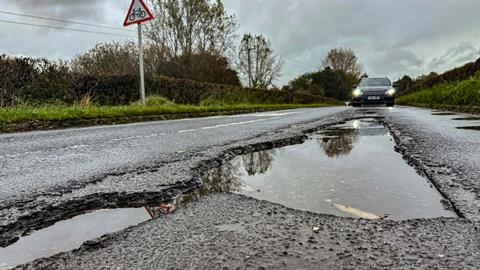

Local authorities in England and Wales now face a record £18.62bn backlog of carriageway repairs that would take 12 years to clear, despite an increase in funding, according to this year’s Annual Local Authority Road Maintenance (ALARM) survey.
Additional investment from both central government and local authorities’ own sources has led to a 17% increase in average highway maintenance budgets in England and Wales, yet only marginal improvements in conditions have been reported.
Around half (51%) of the local road network is reported to be in good structural condition, with 15 years or more life remaining, up 3% from last year. However, almost one in six (16%) local roads – equivalent to over 32,500 miles – is reported to have less than five years’ structural life remaining.
“I think all road users would agree that the condition of our local roads has become a national disgrace,” said David Giles, chair of the Asphalt Industry Alliance (AIA), which commissions the ALARM survey.
“Tracking ALARM data over the last decade shows the amount needed to bring local roads up to scratch has increased dramatically, and the impact of frequent adverse weather events on a consistently underfunded – and increasingly fragile – network are coming home to roost so road users should not expect a quick fix.”
Highway maintenance budgets in England and Wales for 2025-26 are reported to be an average £30.5m per authority, with over half of that (54%) spent on the surface and structure of the road.
However, local authorities reported that the additional amount they would have needed for the last year to maintain the network to their target conditions has continued to rise. It now stands at £1.37bn, up 10% on last year to an average of £8.1m per authority, and likely to be compounded by the impacts of one of the wettest winters on record.
“The AIA has long advocated for substantial, sustained and targeted funding for highways maintenance so that local authority highway teams can plan ahead and deliver lasting improvements,” added Giles.
“It appears the government has listened. It’s funding announcements for local highway maintenance in England, including £1.6bn for this (2025/26) financial year – £500m more than the previous year – plus its subsequent pledge to allocate £7.3bn over the next four years, represent an important step forward.
“And, local authority highway engineers have told us they are cautiously optimistic that the increased funding announced by the government, supplemented by their own coffers, should help them stem further decline. However, it is not the silver bullet that will enable them to clear the backlog of repairs any time soon.”
The ALARM survey reports local road funding and conditions in England and Wales based on information provided directly by those responsible for the maintenance of the network. This year’s survey, the 31st, received responses from 79% of local authorities.
Commenting on the ALARM report, AA president Edmund King, said: “The ALARM 2026 report starkly warns us how much more needs to be done to eradicate this plague of potholes.
“We have been seeing with our own eyes, and feeling with our wheels, how record wet weather linked to substandard roads has led to many local roads becoming patchwork obstacle courses.
“The AA has been called out to 137,000 pothole-related incidents in the UK in January and February this year – 25,000 up on last year. Extra funding needs to be maintained and spent on more permanent repairs to prevent extensive vehicle damage and potentially fatal injuries to those on two wheels.”
Lyle Andrew, Institute of Highway Engineers (IHE) chief executive, said the findings showed that, whilst there are signs of progress, local road networks continue to face considerable pressure.
“The government’s funding announcement for the 2025/26 financial year, together with the commitment of £7.3bn over the next four years, signifies an important and positive step forward in addressing the challenges faced by local authorities, but we agree that this expenditure needs to be front-loaded to slow down the rate of deterioration,” he said.
“We have seen minor improvements in the condition of the network, with RCI data showing an increase of 2% in roads reported as ‘green’, and 51% of local roads now reported to be in good structural condition. However adverse weather conditions continue to expose how fragile many parts of the network are.
“Despite these improvements there remains a significant gap in funding. And, with ALARM 2026 reporting 49% of roads estimated to have 15 years of structural life remaining, sustained funding for local authorities remains vital in order for us to see increased resilience of the road network long-term.”
Giles concluded: “It will be some time before the impact of increased funding levels, if fully delivered, will be noticed by the public. However, the dial could be moved quicker if the Government’s commitment to additional funding was frontloaded, rather than ramping up in the years to 2030.
“This would support a shift away from the seemingly endless cycle of pothole patch and repair and allow local authority highway teams to deliver necessary resurfacing and proactive programmes that prevent potholes forming in the first place to improve the experience of all road users.”
Findings of ALARM 2026, which relate to the 2025/26 financial year, show that in England and Wales:
· Local authorities would have needed, on average, an extra £8.1m each last year to maintain their network to their own target conditions and prevent further decline.
· £18.62bn is now reported to be required, as a one-off, for local authorities to bring the network up to their ‘ideal’ conditions.
· If this backlog of repairs was cleared, the amount local authorities would need to maintain their roads in a steady state would be £1bn less every year going forward: funds that could be usefully redeployed elsewhere.
· Just over 100,000 miles (49%) of the network is now reported to have less than 15 years’ structural life remaining.
· RCI data also shows that 20,400 miles (10%) of the network are likely to need some form of maintenance in the next 12 months. This is down 2% on last year’s figure, meaning there are around 4,000 fewer miles of road classed as RED.
· Roads are only resurfaced, on average, once every 97 years.
· 1.9 million potholes have been filled at a cost of £149.3m.
The full ALARM survey report can be downloaded at www.asphaltuk.org