


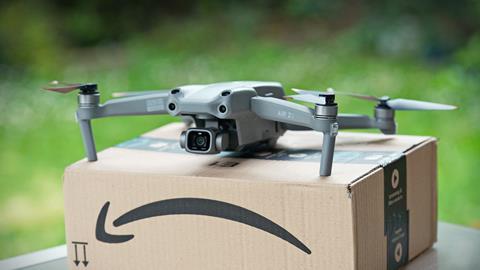

Amazon’s launch of drone deliveries in Darlington has received a cool response from the industry and provided an “answer to a question no-one is asking”.
The online giant said it could carry out a maximum of 10 flights an hour as part of its limited launch in the County Durham town, with packages weighing less than 5lb being delivered within a 7.5k radius of its fulfilment centre in under two hours.
David Carbon, VP of Prime Air said: “In Darlington they’ll have the fastest delivery option available to any customers in Europe.”
But Seb Robert, founder and CEO of last-mile delivery service Gophr, said the move needed to be met with cautious excitement.
“Drones have often been branded the silver bullet of the delivery game, but the buzz around them often clouds clear thinking,” he said.
“There are some amazing examples of drone delivery working well and providing a vital service – medical deliveries in the Australian Bush, for example.
“Hard-to-reach areas are where drones come into their own. But what about the city landscape?
“Navigating through tower blocks, high streets and busy city centres is going to take very smart programming or a skilled pilot to avoid unexpected obstacles.
“Amazon needs to know it can’t be a one-size-fits-all approach.”
David Jinks, head of consumer research at Parcelhero, said the technology still had a long way to go before they became part of everyday deliveries:
“Until we all have a drop-off point in our gardens or on our rooftops, the logistics just don’t add up for nine-tenths of the UK,” he said.
“It’s interesting Amazon chose Darlington as the first place outside the US to launch regular drone services,” Jinks added.
“Darlington was where the first public railway to use steam locomotives opened. At the time ‘experts’ claimed the human body wasn’t designed for speeds of 15mph and prophesied disaster.
“I don’t want to be one of those expert’s 21st century equivalents, but to make drones viable you need a nearby distribution centre, houses with gardens, no groupings of high rise buildings and a host of other restrictions.”
Jinks acknowledged that drones had a role in dropping medical supplies to remote locations such as the Orkneys and he said that in time the infrastructure could be developed sufficiently for them to become economically viable for fast, same-day deliveries.
However, he added: “Parcelhero is always enthusiastic about useful new technology in the logistics industry, such as AI.
“For now, though, drones represent tech for tech’s sake and the answer to a question no-one is asking.”